Electric Potential Energy From Potential: Track Charge Sign and Delta V
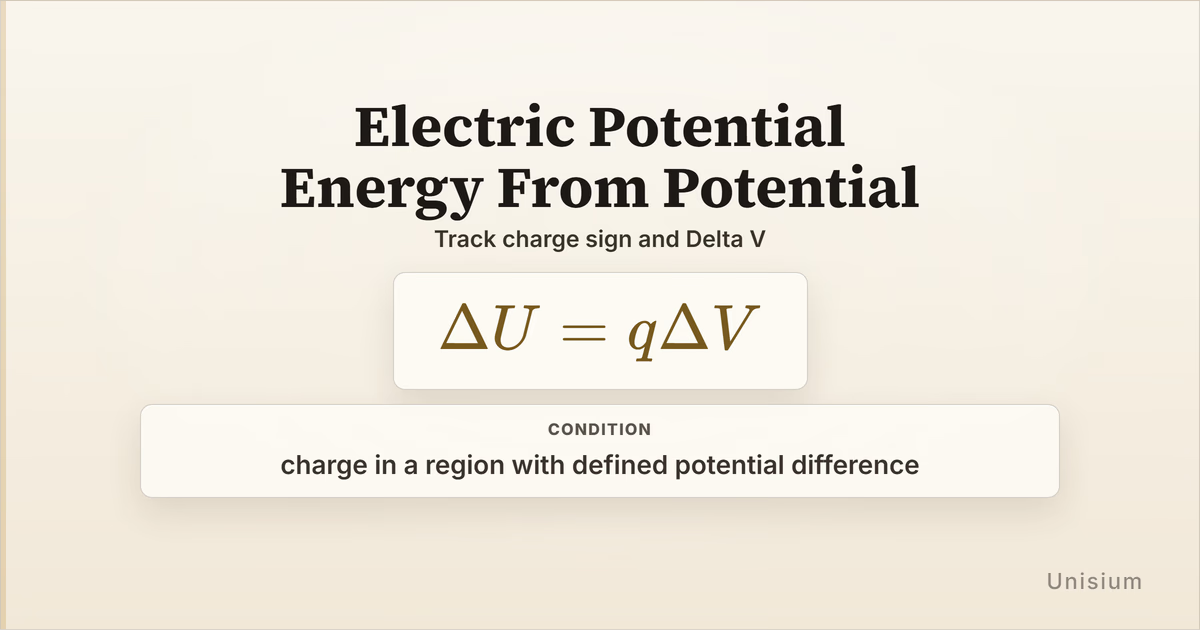
Electric potential energy from potential says a charge changes electric potential energy by charge times potential difference. The model is , and it applies when a charge is in a region with a defined potential difference. Use it to convert voltage information into energy change, while keeping charge sign and the direction of explicit.
This principle is the bridge from scalar potential language to energy-change language. It comes after Electric Potential Of A Point Charge and Electric Potential Energy Of Two Point Charges: instead of computing a potential or a pair energy directly from source geometry, you use a known potential difference to find the energy change of one charge.
The surrounding decisions are charge sign and potential-difference interpretation. They are not new principles; they are the setup work that decides whether is positive, negative, or zero.
On this page: The Principle | Conditions | Misconceptions | Elaborative Encoding | Retrieval Practice | Worked Example | Solve a Problem | Related Principles | FAQ | Related Guides | How This Fits
The Principle
Statement
Electric Potential Energy From Potential gives the change in electric potential energy of a charge between two states with a defined potential difference. Since potential difference is energy change per unit charge, multiplying by the signed charge gives the signed energy change. The sign depends on both the charge sign and the chosen direction for .
Mathematical Form
Where:
- is the change in electric potential energy in J
- is the charge in C
- is the potential difference in V, often
The diagram shows the guide-level relationship: a charge is linked to two potential levels, and the energy change belongs to that charge in that potential difference. The visual does not decide the sign for you; the sign comes from the charge and from how initial and final potential are assigned.
Common form with endpoints
If the problem gives an initial potential and final potential , the same relation is usually used as:
That is not a separate principle. It is the same model after writing the potential difference as final potential minus initial potential.
What this relation does and does not say
- It converts a known potential difference into electric potential energy change for a charge.
- A positive charge gains potential energy when it moves to higher potential; a negative charge loses potential energy for the same .
- It does not by itself compute the potential difference from source charges or a field.
- It does not require a point-charge source model; the potential difference may come from many possible electrostatic setups.
Conditions of Applicability
Condition: charge in a region with defined potential difference
Practical modeling notes
- Charge means the object or particle has a definite charge value during the comparison.
- Defined potential difference means the two states, points, plates, or terminals have a meaningful under the chosen convention.
- If the problem gives and , decide whether means before multiplying by .
- If the charge is negative, do not replace with its magnitude unless the question explicitly asks for magnitude only.
When it does not apply directly
- No defined potential difference: if the problem only gives a field, geometry, or source charge, first use an appropriate potential relation, such as Uniform-Field Potential Difference when that guide exists and the condition fits.
- Changing charge: if is not constant during the comparison, this simple product is not the full model.
- Force or field targets: if the target is electric field or force, use the relevant field or force relation instead.
- Energy of two source charges: if the problem asks for pair energy from two point charges and their separation, use Electric Potential Energy Of Two Point Charges.
Want the complete framework behind this guide? Read Masterful Learning.
Common Misconceptions
Misconception 1: A higher potential always means higher potential energy
The truth: Higher potential means higher potential energy only for a positive charge. For a negative charge, the same positive potential difference gives a negative energy change.
Why this matters: Many sign errors come from treating voltage as if it were potential energy instead of energy per unit charge.
Misconception 2: Delta V is always positive
The truth: is signed. If it is defined as , moving from to gives .
Why this matters: The energy change cannot be interpreted until the direction of the potential difference is clear.
Misconception 3: This formula tells you where the potential difference came from
The truth: uses a defined potential difference. A different principle may be needed to compute from a point charge, a uniform field, or another setup.
Elaborative Encoding
Use these questions to build understanding before memorizing the formula. See Elaborative Encoding for the broader method.
Within the Principle
- Why does multiplying potential difference by charge produce units of energy?
- What changes in when the charge is negative but the same is used?
For the Principle
- What clue tells you that a problem is giving potential difference directly instead of asking you to compute potential from source geometry?
- Why must the direction of be fixed before the sign of means anything?
Between Principles
- How is this relation different from Electric Potential Of A Point Charge, which gives potential before a test charge is included?
Generate an Example
- Describe a situation where a negative charge has a positive change in electric potential energy.
Retrieval Practice
Answer from memory, then reveal the result and check it. See Retrieval Practice for the full study method.
State the principle in words: _____A charge changes electric potential energy by an amount equal to the charge times the potential difference it experiences.
Write the canonical equation: _____
State the canonical condition: _____charge in a region with defined potential difference
Worked Example
Use this worked example to practice Self-Explanation.
Problem
A particle with charge moves from point A, where , to point B, where . Find the change in electric potential energy of the particle, using .
Step 1: Verbal Decoding
Target:
Given:
Constraints: charge remains fixed; initial and final potentials are defined;
Step 2: Visual Decoding
Draw two labeled potential levels, and , then draw an arrow from A to B and mark the charge as negative.
(The key visual fact is that the particle moves to lower potential, while the charge sign is negative.)
Step 3: Physics Modeling
Step 4: Mathematical Procedures
Step 5: Reflection
- Dimensional analysis: equals , so the unit matches electric potential energy.
- Interpretation: A negative charge moving to lower potential gains potential energy because the two signs multiply to a positive result.
- Magnitude: Microcoulomb charges across volt-scale differences produce microjoule-scale energy changes, so the size is plausible.
Before moving on: self-explain the model
Try explaining why the endpoint order matters, why the negative charge changes the sign of the energy result, and why no source-charge geometry was needed.
Physics model with explanation
Principle: We use Electric Potential Energy From Potential because the problem gives a charge and two defined potentials.
Conditions: The charge value is fixed, and the potential difference between A and B is defined by the given endpoint potentials.
Relevance: This relation is the direct bridge from voltage information to energy change.
Description: The particle moves from to , so the potential difference is negative under the stated convention. Because the charge is also negative, the energy change is positive.
Goal: We want the change in electric potential energy, so the most direct model is .
Solve a Problem
Apply what you have learned with Problem Solving.
Problem
A particle with charge moves from point A, where , to point B, where . Find the change in electric potential energy of the particle, using .
Hint: Compute the signed potential difference before multiplying by the signed charge.
Show Solution
Step 1: Verbal Decoding
Target:
Given:
Constraints: charge remains fixed; initial and final potentials are defined;
Step 2: Visual Decoding
Draw two labeled potential levels, and , then draw an arrow from A to B and mark the charge as positive.
(The key visual fact is that the particle moves to higher potential, and the charge sign is positive.)
Step 3: Physics Modeling
Step 4: Mathematical Procedures
Step 5: Reflection
- Interpretation: A positive charge moving to higher potential has a positive change in potential energy.
- Dimensional analysis: Charge times potential difference gives joules because a volt is a joule per coulomb.
- Connection to concept: The calculation used voltage information directly; it did not need the field or source charges that produced the potentials.
Related Principles
See Electromagnetism: The Principle Map for placement in the subdomain and the wider guides library for adjacent study paths.
| Principle | Relationship to Electric Potential Energy From Potential |
|---|---|
| Electric Potential Of A Point Charge | Gives scalar potential from a point source; this guide uses a potential difference to get energy change for a charge. |
| Electric Potential Energy Of Two Point Charges | Gives pair energy from charge signs and separation; this guide starts from potential difference instead. |
| Uniform-Field Potential Difference | adjacent principle: computes a potential difference from a uniform electric field, which can then feed this energy-change relation. |
See Principle Structures for a broader view of how nearby relations connect.
FAQ
What is electric potential energy from potential?
It is the relation that gives the change in electric potential energy of a charge from a known potential difference. In canonical form, it is .
When does change in electric potential energy equal charge times potential difference?
It applies when a charge is in a region with a defined potential difference. The charge and the potential difference must both be interpreted with their signs.
Why does charge sign matter?
Potential difference is energy change per unit positive charge. A negative charge reverses the sign of the energy change compared with a positive charge experiencing the same .
Is potential difference the same as potential energy change?
No. Potential difference is energy change per unit charge, measured in volts. Potential energy change is the total energy change for a particular charge, measured in joules.
Do I need to know what created the potential difference?
Not for this relation. If the potential difference is already defined, converts it into energy change; another principle is needed only when you must compute first.
Related Guides
- Electric Potential Of A Point Charge - Compare scalar potential with energy change for a charge.
- Electric Potential Energy Of Two Point Charges - Separate pair energy from energy change across a potential difference.
- Electromagnetism: The Principle Map - Place this relation in the electromagnetism progression.
- Problem Solving - Practice keeping given quantities, signs, and targets separate.
How This Fits in Unisium
In Unisium, this principle sits where voltage becomes energy accounting. The useful learning move is to retrieve , explain which direction defines , and then check whether the charge sign reverses the energy interpretation. Check access and join the Unisium waitlist or see the wider framework in Masterful Learning.

Masterful Learning
The book behind these guides: a study system for physics, math, & programming built on retrieval, connection, explanation, and problem solving.
Ready to apply this strategy?
Unisium turns these evidence-based techniques into guided study sessions for math and physics. Places are limited during early access. Check current availability to start a trial; joining the mailing list is optional.
See plans and availability Read More GuidesAlready have access? Sign in