Pretesting: Try Before You Know (and Learn Faster)
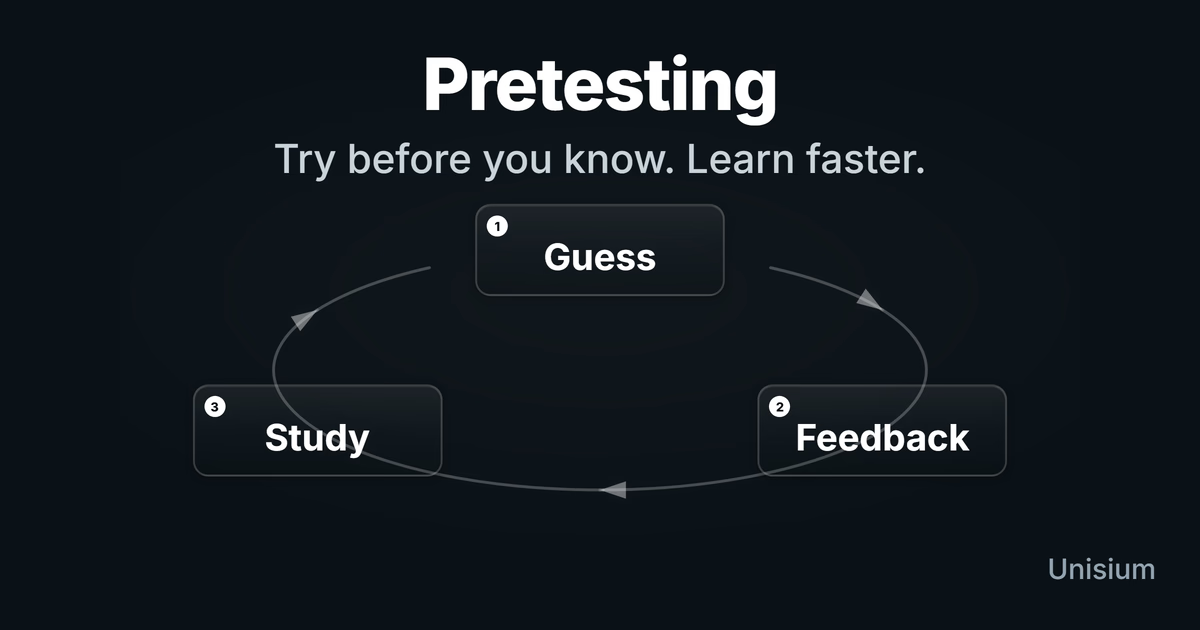
Pretesting (prequestioning) = trying before you know. Answer a question, attempt a problem, predict a result, or try the next step before you study the explanation or check the solution. You’ll be wrong a lot. Good. The attempt is already a learning event: prediction errors sharpen attention, activate prior knowledge, and make later elaborative encoding, self-explanation, and problem solving hit harder.
Use it at several scales: before a new topic, before a worked example, before revealing the next solution step, or before checking an answer. The point is not to prove that you already know it. The point is to make your mind do useful work before the answer arrives.
Bottom line: A brief pretest creates a “search image” for what matters. It makes the subsequent retrieval practice and spacing more efficient.
Key Takeaways
- Prediction errors are high-gain signals. Wrong answers + fast feedback sharpen attention and prepare memory for later study.
- Effect size matters: 0.5 SD on tested material. Alignment is critical—pretest with questions you’ll care about.
- Pretest to aim, then posttest to build, then space. The loop: attempt → study → consolidate → revisit.
Why Pretesting Works
Pretesting works through several interconnected mechanisms:
Error-Driven Encoding
Making a concrete guess creates a prediction. Seeing the answer creates a mismatch. That mismatch is a high-gain signal—your brain tags the correction as important.
Attention Steering
Guesses generate specific questions (“When does momentum conservation apply?”). Study that follows is no longer passive; it’s targeted.
Schema Hooks
Even a bad first model gives you slots to hang details on. Later information attaches more easily.
Principle: Attempt → Feedback → Study → Posttest beats Study → Test when the attempt is brief, aligned, and followed by fast feedback.
Research Snapshot: Pretesting
Pretesting is not just a way to diagnose what you do not know. It can be a learning event in itself. A recent meta-analysis found a moderate benefit for material that students tried to answer before learning it, about g = 0.54 on the pretested material, but little benefit for unrelated material, about g = 0.04 (St. Hilaire et al., 2024; see Learning Literature for full citations). That is large enough to treat pretesting as a serious learning strategy, not just a diagnostic step. The catch is alignment: the benefit is strongest for the material connected to the pretest question, not for unrelated content.
Works even with minimal knowledge. Pretesting helps even when students feel they “know nothing” (Pan & Carpenter, 2023).
Sometimes beats posttesting. When the bottleneck is encoding (not consolidation), pretesting can outperform posttesting on new information (Pan & Sana, 2021).
Students underrate it. Learners typically prefer passive methods and misjudge pretesting’s value—but beliefs shift with brief demos (Pan & Rivers, 2023).
Critical design tip: Make answers easy to find in the target material. Pretest questions must align with headings, examples, or worked steps. Misalignment kills the encoding boost. Test yourself on what matters (James & Storm, 2019).
Why Pretest Even If You “Know Nothing”
Unsuccessful attempts help anyway. Brief, specific guesses prime your attention and activate prior knowledge, so the correction lands harder—often called test potentiation. Keep the set tiny, give fast feedback, and then study with those misses in mind.
Pretesting vs Posttesting
| Aspect | Pretesting | Posttesting |
|---|---|---|
| When | Before study | After study |
| Job | Primes encoding | Drives consolidation |
| Feeling | Disorienting | Clarifying |
| Best for | Brand-new, confusing content | Locking in & spacing |
| When to use both | Pretest to aim, posttest to build |
Bottom line: Use pretesting to aim; use The Testing Effect to build—then space it (1–2d → 3–5d → 7–14d).
When Pretesting (Briefly) Backfires
Goal = immediate quiz score? Pretesting can lower same-day performance on a quick quiz. Use a micro-pretest (2 items), then heavier posttesting before the exam.
No feedback? Guessing without fast correction risks entrenching errors. Always map answers to the material or mark them right/wrong immediately.
Misaligned prompts? If pretest questions don’t match headings, examples, or worked steps in the study material, you won’t get the encoding boost. Align stems carefully.
Student resistance. Many feel uncomfortable guessing when they “don’t know.” That’s normal—and it’s a feature, not a bug. What matters is your default interpretation: treat struggle as feedback. The discomfort signals encoding. Brief support (“30 seconds, cold; no penalty for wrong”) usually dissolves it. If that discomfort turns into avoidance, use an entry script to beat the initial struggle.
See also: When Testing Can Hurt and Common Failure Modes (complement sections in the Testing Effect guide).
How to Pretest
Step 1: Pick 3–5 Items (2–3 min)
Align with today’s topic: old exam stems, quick prompts, or worked example headers.
Step 2: Answer Cold, No Notes (4–6 min)
Keep it short. Concept pretests: ~60–120s per item. Problem pretests: ~3–4 min.
Concept Pretest format:
- Name the principle
- State one key condition for use
- Name one neighbor it’s confused with
- Give one canonical example
Problem Pretest format:
- Decode givens and goal
- Pick a first-pass model (it can be wrong)
- Commit to one step or operation
- Stop
Step 3: Immediate Feedback, Clearly Mapped
Show where the answer lives in the material. Tag misses: Recall / Condition / Procedure (use the same tags everywhere). This preserves the pretest benefit and accelerates your fix.
Step 4: Study with Intent (20–30 min)
Drive your elaborative encoding and examples at the misses. Don’t re-read passively.
Step 5: Posttest Quickly (1–3 items, 3–5 min)
Confirm the fix, then schedule spaced follow-ups (1–2d → 3–5d → 7–14d).
Only 60 Seconds?
Ask one exam-style stem. Write a 1-line answer from memory. Check it. Circle the gap word (term, condition, unit). Now study for ~20 minutes with that gap in mind. Re-answer in 60 seconds.
What to Pretest (Map to the Four Strategies)
Testing plugs into each of the four core learning strategies. Pretest aligns to all of them:
- Elaborative Encoding (EE): “Two neighbors + one contrast.”
- Retrieval Practice (RP): “Name → form → one condition.”
- Self-Explanation (SE): “Justify the next worked-example step (principle + condition).”
- Problem Solving (PS): “Decode → select principles → do the first operation.”
- Prompt variability: Ask the same idea three ways (definition → condition → contrast) to create multiple retrieval routes.
Then study → tiny posttest → space (1–2d → 3–5d → 7–14d).
For the full framework, see How Testing Connects to the Four Primary Strategies in the Testing Effect guide.
Pretesting in Unisium (Built-In)
- Try first. Every study card asks for a cold, closed-book attempt.
- Fast mapping. Checking shows the answer and where it lives.
- Flows into posttests. Misses (or “Hard”) resurface as quick posttests; RP cards auto-schedule at increasing intervals.
Pretesting in Practice
Past-Exam Loop
- Solve 2–3 old items at the start (pretest).
- Attend class or read.
- Revisit those same items (posttest).
- Tag misses; schedule resurfacing.
The Micro-Pretest
Spend 3 minutes. Attempt 1–2 key definitions or one tiny problem. Then study for 25 minutes with those answers in mind. Posttest one variant 60 seconds later.
Interleaved Pretest
Mix 3 topic areas (e.g., kinematics, energy, momentum). Attempt cold, get feedback, study the weak spots, then a mixed posttest set (see interleaving).
For Teachers (90–180s opener)
- 3 cold prompts at the start (30–45s each), closed book.
- Teach the content.
- Re-ask 1 quick variant at the end (30–60s), closed book.
- Post the answer key in the LMS and note where each answer appears (slide/page).
Tag frequent misses as Recall / Condition / Procedure.
If students still stall on a step after a pretest, keep them active with Hint and Try: reveal the smallest next hint, explain why it matters, then try again before returning for feedback.
Common Mistakes
Skipping the guess. You think you’ll “save time,” then waste it on directionless study. Make the guess.
Essay pretests. Keep attempts short and checkable (name → condition → example, not paragraphs).
No feedback loop. Pretesting without fast correction is just guessing. You need to see what was right.
Treating pretest scores as grades. They’re signals, not judgments. A low score is data, not failure.
FAQ
Should I pretest if I know nothing?
Yes. Even “wild” guesses create anchors and curiosity cues. Keep it short (3–5 min), get feedback fast, then study.
Won’t wrong answers stick?
Not with immediate feedback and a posttest. The correction sticks. The brain tags errors as high-priority updates.
How often?
At the start of any new subtopic or study block. Keep it to ~10% of total study time.
Is pretesting the same as the testing effect?
No. Pretesting primes encoding. The testing effect (posttesting) drives consolidation. Use both: pretest to aim, posttest to build.
When is pretesting better than posttesting?
When you’re meeting brand-new content and the main problem is encoding (getting it to make sense). Use a short pretest → study → tiny posttest to confirm, then schedule spaced follow-ups.
Start Now (5 minutes)
- Pick one principle you’ll study today.
- Write one question you’d expect on an exam.
- Answer it from memory (no notes).
- Check the answer. Tag the miss type (Recall / Condition / Procedure).
- Study for 20–30 minutes, targeting that miss.
- Re-answer in 60 seconds (posttest).
- Schedule the next touch (1–2 days out).
Related Guides
- The Testing Effect — Posttesting + spacing locks knowledge in. Complement to pretesting.
- Retrieval Practice — The core mechanism behind both pretesting and posttesting.
- Elaborative Encoding — Build meaningful links; pretesting focuses where to elaborate.
- Spacing — Space your posttests after pretesting to compound gains.
- Self-Explanation — Explain the gap between pretest guess and correct answer.
How This Fits in Unisium
Unisium makes “try before you know” the default: you attempt first, then get fast feedback and follow up with spaced recalls. That’s the Unisium Study System applied to pretesting—small prediction errors that steer your next elaborative encoding and self-explanation so the work compounds over time. Ready to try it? Check access and join the Unisium waitlist or explore the full framework in Masterful Learning.
← Prev: Highlighting and Underlining | Next → The Testing Effect
Evidence at a Glance
Pretesting boosts encoding efficiency, with effect sizes ≈ 0.5 SD on tested material (St. Hilaire et al., 2024). It can occasionally outperform posttesting on new content (Pan & Sana, 2021). Students systematically underestimate its value—but brief exposure shifts beliefs (Pan & Rivers, 2023).
For effect sizes, moderators, and full study links, see the Learning Literature guide.
Ready to apply this strategy?
Unisium turns these evidence-based techniques into guided study sessions for math and physics. Places are limited during early access. Check current availability to start a trial; joining the mailing list is optional.
See plans and availability Read More GuidesAlready have access? Sign in