From Resistance to Flow: Deep Focus for Math and Physics
Flow is deep focus that shows up when the task is hard enough, the next step is clear, and feedback is close. You do not “find” flow first; you earn it by pushing through the first minutes of resistance, then keeping difficulty and feedback calibrated. In math and physics, flow is less about inspiration and more about running a system that prevents boredom, confusion, and panic.
Most students wait to feel motivated before they start. That is backwards. Motivation and flow are outputs: they follow action and fast feedback, not wishful thinking. If this is your loop, read How to Stay Motivated Studying Math and Physics.
This applies to any demanding subject, but I’ll use math/physics because they’re the cleanest case. Browse the full Unisium guides library for related strategies.
In the Unisium Study System (based on the principles in Masterful Learning), study sessions are structured to make flow likely: active start, clear micro-goals, tight feedback loops, and difficulty that stays slightly above your current level.
On this page: The Initial Struggle · Emotion Follows Motion · Flow Is Not the Goal · The 5 Triggers · The 10-45-5 Protocol · Examples · FAQ · How This Fits
The Initial Struggle
Every study session begins with a battle. We call this the Initial Struggle.
It is the period of stress, restlessness, and resistance you feel when you first sit down to work. This struggle is common and predictable. Your brain is transitioning from a low-energy state or a high-distraction state into deep focus.
Never negotiate with the first 3 minutes. Your brain will offer alternatives (“check one thing”, “plan first”, “later”). The win condition is simply: pen on paper or hands on keyboard doing the task.
If you need an external shove, use a timer as an on-ramp—see Pomodoro technique.
If this keeps failing, treat it like a cue problem: make the start a habit with a stable trigger and a tiny first action (see Study Habits for Math and Physics).
If you lose this struggle, your day dissolves into low-value distractions. If you win, you break through to clarity. The struggle usually lasts only a few minutes, but you must fight it every time you return from a break.
Emotion Follows Motion
The biggest myth about flow is that you need to “feel like” studying to begin.
The truth is that emotion follows motion. You cannot wait for motivation to bubble up while scrolling on your phone. You must act first.
Low-effort rewards (like social media) train your brain to expect constant novelty. That makes sustained attention feel unusually uncomfortable at first. To win the initial struggle, do something—anything—relevant to your goals. Engage the mechanism.
Kickstart with Retrieval Practice
The most reliable way to overcome resistance is to start with retrieval practice.
Retrieval is a high-friction, high-engagement activity. It forces your brain into gear immediately. Unlike re-reading notes (which is passive and allows your mind to wander), retrieval demands your full attention.
Start your day by retrieving one or two principles from memory. This simple action provides the “motion” that pulls your emotions into line.
Flow is Not the Goal
Flow can happen while doing easy tasks you’re already good at. But learning requires calibrated difficulty and error-correction.
Use flow as a signal you’ve set the system right, not as the objective. This protects you from the “flow-chasing” trap where you avoid hard problems just to stay comfortable.
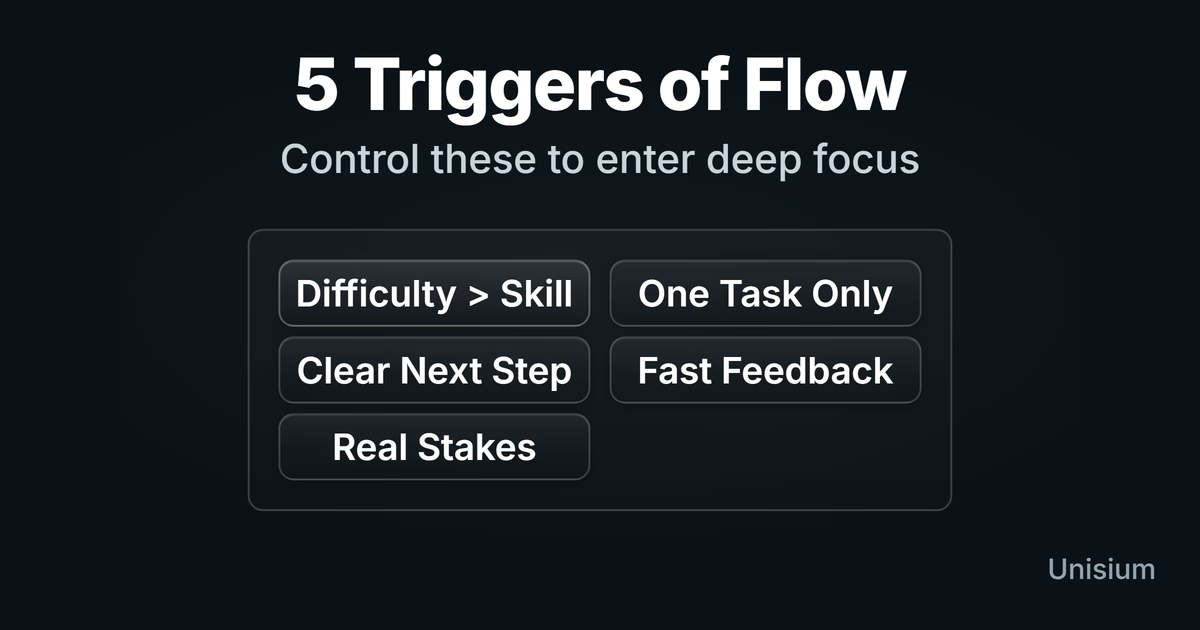
The 5 Triggers of Flow
Flow is fragile. In math and physics, you keep it by controlling five variables. If one breaks, you feel it immediately: boredom, anxiety, or mental fog.
1. Calibrated Difficulty (challenge slightly above skill)
Flow lives in the narrow band where you must concentrate to succeed.
- Too easy: boredom, drifting, tab-switching.
- Too hard: panic, avoidance, random guessing.
- Hard enough: full attention, steady progress.
How to set it up: Pick problems where you can make progress, but not on autopilot. Use scaffolding on purpose: worked example first, then near-transfer, then harder.
Quick fixes: If you are bored, increase difficulty, interleave, add time pressure, or switch from reading to solving. If you are overwhelmed, reduce scope (one sub-problem), lower difficulty (simpler case), or add support (one hint).
2. Single-Task Focus (no parallel input)
Flow cannot coexist with a feed.
How to set it up: Phone out of reach (ideally another room). One tab. One notebook. One task.
If “one task” keeps collapsing, fix the soundscape too—study music is only sometimes worth it.
Quick fixes: If you keep drifting, make the next action smaller and concrete (see Trigger 3). If you keep checking “just one thing”, block the site or log out. Willpower is not a plan.
3. Clear Next Action (micro-goals, not intentions)
“Study physics” is not a goal. It is a vague wish.
How to set it up: Write one sentence before you start: “Retrieve the 2 key conditions for Newton 2 and write one example” or “Decode this problem and choose the principle.”
If you keep rewriting the goal instead of starting, you don’t have a stable cue/script—use the rule format in Study Habits.
Quick fixes: If you feel lost, your goal is too large. Shrink it until you can start in under 30 seconds. If you keep planning instead of working, your goal is still vague. Rewrite it.
4. Tight Feedback (answers and hints close at hand)
Flow breaks when you do not know whether you are on track.
When you’re stuck, don’t guess—run Hint and Try to get one step of information and re-attempt.
How to set it up: Keep solutions close, but enforce “attempt first, then check.” If stuck, take one hint and retry before reading more.
Quick fixes: If you are spinning your wheels, get feedback immediately (peer, TA, or AI). If you are mindlessly copying, delay the solution and force an attempt.
5. Stakes (commitment, urgency, consequence)
You focus harder when the cost of drifting is real.
How to set it up: Timebox: 45 minutes of real work, then a break. Commit publicly (study buddy, group, or a “deliverable” you must show).
Quick fixes: If you only get flow near deadlines, you are outsourcing stakes to panic. Add stakes earlier with timeboxes and commitments. If you feel numb, set a tiny deliverable you can complete today.
The 10-45-5 Flow Protocol
Students need a script, not just triggers. Use this mechanical loop to enter flow reliably.
The 10–45–5 Flow Protocol
10 min (Entry): Retrieval warm-up (1–2 principles), phone away. Rule: If you check your phone, you restart the 10 minutes.
45 min (Deep Work): One narrow objective (e.g., “solve 2 Newton 2 problems and self-explain each step”). Keep the feedback loop tight (attempt → check → fix).
5 min (Reset): Stand up, water, no phone. Repeat.
Examples in Action
Physics: The Clear Path
Flow survives because the next step is always clear.
- Decode: Read the problem and draw the diagram.
- Choose: Select the principle (e.g., Conservation of Energy).
- Model: Write the equation .
- Solve: Algebra and calculation.
If you get stuck at step 2, you don’t drift. You use the Hint and Try method to get unstuck and keep moving.
Math: The Scaffolding Ladder
- Start: Copy one worked example by hand.
- Explain: Self-explain each line (“Why did they divide by here?”).
- Transfer: Do a near-transfer problem immediately (same structure, different numbers).
- Advance: Try a harder problem with less support.
Start Now (5 minutes)
- Put your phone in another room.
- Retrieve 1 principle from memory (30–90 seconds).
- Write the next action as one sentence: “I will ____ for 10 minutes.”
- Start immediately. No planning.
FAQ
Why can’t I get into flow when reading my textbook?
Reading is often too passive. It doesn’t demand enough cognitive load to fill your attention, so your mind wanders. To trigger flow while reading, use self-explanation. Stop after every paragraph and explain it to yourself. This increases the challenge level to match your skills.
Is flow the same as hyperfocus?
They are similar, but flow is usually described as a positive, controlled state where you are aware of the activity but lose track of time. Hyperfocus can sometimes be uncontrollable or applied to non-productive tasks (like gaming). We aim for directed flow on high-value tasks.
What if I’m too tired to fight the initial struggle?
If you are truly exhausted, rest. But often, “tiredness” is just resistance. Try the “5-minute rule”: commit to working for just five minutes. If you are still exhausted after five minutes, stop. Most of the time, you will find that the energy comes once you start.
If this is a recurring pattern, solve it at the system level: motivation follows feedback loops and starts become automatic with cues + tiny actions.
Why do I only get flow right before deadlines?
You are relying on panic to create stakes. This works, but it’s stressful and brittle. Replicate that urgency earlier by using timeboxes (e.g., “I must finish this problem in 20 minutes”) and commitment devices (e.g., “I will send my draft to my study partner at 5 PM”).
How This Fits in Unisium
The Unisium Study System is built to automate these flow triggers.
We don’t just give you a list of problems; we manage the challenge-to-skill ratio for you. If a principle is new, we scaffold it. If you know it well, we space it out and combine it with others to keep the difficulty high.
By forcing you to engage actively through retrieval and self-explanation, Unisium ensures you never drift into passive boredom. We provide the structure, the immediate feedback, and the clear goals. You need to bring the effort to win the initial struggle.
If you want the full framework behind this loop, see Masterful Learning or check access and join the Unisium waitlist.
Next Steps
- Can’t start? See Study Habits or Pomodoro Technique.
- Start but drift? Check Study Music.
- Working but not improving? See Effective Study Mindsets.
Want the complete framework behind this guide? Read Masterful Learning.
Ready to apply this strategy?
Unisium turns these evidence-based techniques into guided study sessions for math and physics. Places are limited during early access. Check current availability to start a trial; joining the mailing list is optional.
See plans and availability Read More GuidesAlready have access? Sign in