Electric Potential Line Integral: Field Along Path Sets Voltage
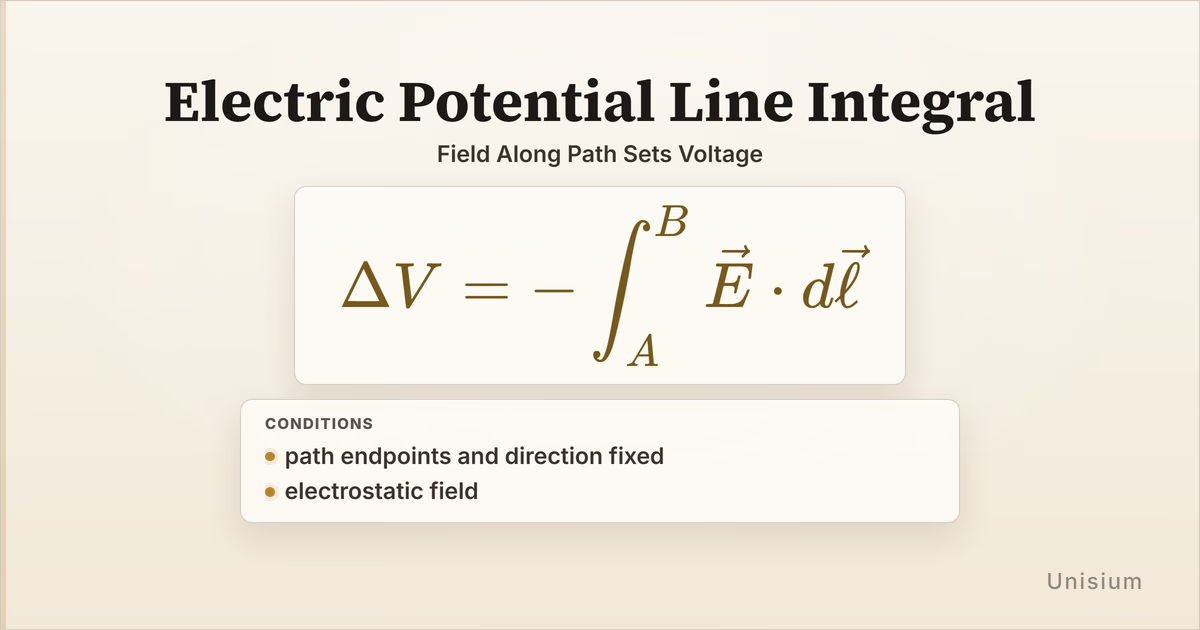
Electric Potential Line Integral says the potential difference from A to B is the negative line integral of electric field along the directed path. The model is , and it applies when the path endpoints and direction are fixed in an electrostatic field. Use it to convert field-along-path information into voltage change.
This guide extends Uniform-Field Potential Difference from one straight displacement in a uniform field to many local dot products along a path. The surrounding choices are endpoint labels, path direction, and the field expression on that path.
On this page: The Principle | Conditions | Misconceptions | Elaborative Encoding | Retrieval Practice | Worked Example | Solve a Problem | Related Principles | FAQ | Related Guides | How This Fits
The Principle
Statement
Electric Potential Line Integral connects voltage change to the electric field accumulated along a directed path. For motion from point to point , the electric field component along each small displacement contributes to the integral, and the minus sign converts field work per unit charge into potential change.
Mathematical Form
Where:
- is the potential difference , in volts
- is the electric field along the path, in or
- is a small displacement along the directed path from to
- The dot product keeps only the field component tangent to the path
The directed path is part of the setup. If the path direction is reversed, the bounds and direction reverse, so the sign of reverses. In an electrostatic field, different paths between the same endpoints give the same potential difference, but the path and direction still have to be named before the integral is written.
Connection to the uniform-field form
If is constant and the path is a straight displacement from to , the integral reduces to the familiar dot product:
That is the same principle in a simpler setting. The line-integral form is needed when the field changes with position, the path is curved, or the problem gives the field as a function along a coordinate.
Conditions of Applicability
Condition: path endpoints and direction fixed; electrostatic field
Practical modeling notes
- Path endpoints fixed means you know which point is and which point is .
- Direction fixed means the integral is oriented from to , so means .
- Electrostatic field means the field is conservative, so electric potential can be treated as a well-defined scalar potential.
- The path can be curved or straight, but the field must be expressible along the path you integrate over.
- If a problem gives an electric field as a function of position, substitute the path coordinate before integrating.
When it does not apply directly
- Time-varying magnetic fields drive nonconservative electric fields: a single-valued electrostatic potential difference may not describe the full loop behavior.
- Endpoints are unlabeled: decide which point is the start and which is the end before assigning the sign.
- Only charge energy is requested: first find , then use Electric Potential Energy From Potential if charge energy is the target.
Want the complete framework behind this guide? Read Masterful Learning.
Common Misconceptions
Misconception 1: The electric field itself is the voltage
The truth: Electric field is voltage change per distance in a direction. Voltage difference comes from accumulating the field component along a path.
Why this matters: A strong field over a tiny distance can produce the same voltage change as a weaker field over a longer distance.
Misconception 2: The dot product always uses the whole field magnitude
The truth: Only the component of along contributes. A field perpendicular to the path segment contributes zero locally.
Why this matters: Curved paths and component fields are sign traps unless you track the tangent direction.
Misconception 3: The minus sign is optional
The truth: The minus sign encodes that electric potential decreases in the direction of the electric field.
Why this matters: Dropping the minus sign reverses the interpretation of whether potential rises or falls along the chosen path.
Elaborative Encoding
Use these questions to build understanding before memorizing the formula. See Elaborative Encoding for the broader method.
Within the Principle
- Why does have a direction, not just a length?
- What does the minus sign say about moving with the electric field versus against it?
For the Principle
- What wording in a problem tells you the endpoints and path direction are fixed?
- Why does the electrostatic condition matter for interpreting the result as a potential difference?
Between Principles
- How does this line integral extend Uniform-Field Potential Difference?
Generate an Example
- Describe a path where part of the electric field is tangent to the path and part is perpendicular to it.
Retrieval Practice
Answer from memory, then reveal the result and check it. See Retrieval Practice for the full study method.
State the principle in words: _____The potential difference from A to B equals the negative line integral of electric field along the directed path.
Write the canonical equation: _____
State the canonical condition: _____path endpoints and direction fixed; electrostatic field
Worked Example
Use this worked example to practice Self-Explanation.
Problem
Along the -axis, an electrostatic field is . Find the potential difference from at to at .
Step 1: Verbal Decoding
Target:
Given:
Constraints: path is the -axis; direction is from to ; field is electrostatic
Step 2: Visual Decoding
Draw an -axis with at and at , then mark the path arrow in the direction. (The key visual fact is that and point along the same axis for .)
Step 3: Physics Modeling
Step 4: Mathematical Procedures
Step 5: Reflection
- Dimensional analysis: times gives volts.
- Interpretation: The potential drops because the path follows the electric field direction.
- Limiting case: If the endpoint moved back to , the integration interval would vanish and would be zero.
Before moving on: self-explain the model
Try explaining why Step 3 uses the field component along the -axis, why the path direction sets the bounds, and why the answer is negative.
Physics model with explanation
Principle: We use Electric Potential Line Integral because the problem asks for potential difference from a specified start point to a specified end point in an electrostatic field.
Conditions: The endpoints are fixed at and , the direction is from to , and the field is electrostatic.
Relevance: The field varies with position, so the uniform-field dot product is not enough; a line integral accumulates the local field-along-path contribution.
Description: On the -axis, the directed path element is , so .
Goal: Integrate the field contribution from to and apply the negative sign to get .
Solve a Problem
Apply what you have learned with Problem Solving.
Problem
On a straight path along the -axis, an electrostatic field is . Find from at to at .
Hint: Use for the directed path from to .
Show Solution
Step 1: Verbal Decoding
Target:
Given:
Constraints: path is the -axis; direction is from to ; field is electrostatic
Step 2: Visual Decoding
Draw a -axis with at and at , then mark the path arrow upward and the electric field arrow downward. (The key visual fact is that is negative.)
Step 3: Physics Modeling
Step 4: Mathematical Procedures
Step 5: Reflection
- Dimensional analysis: Electric field times path length gives volts.
- Interpretation: Moving opposite the electric field increases electric potential.
- Verification: The negative dot product and the leading minus sign combine to give a positive potential change.
Related Principles
See Electromagnetism: The Principle Map for where this path-integral relation sits in the field-calculus layer.
| Principle | Relationship to Electric Potential Line Integral |
|---|---|
| Uniform-Field Potential Difference | The constant-field, straight-displacement case that the line integral generalizes. |
| Electric Potential Energy From Potential | Converts the potential difference into potential-energy change for a charge. |
| Electric Field From Potential Gradient | Reverses the relationship locally by recovering electric field from spatial change in potential. |
See Principle Structures for a broader view of how field and potential relations connect.
FAQ
What is the electric potential line integral?
The electric potential line integral is . It says the voltage change from to equals the negative accumulated electric-field component along the directed path.
When does the electric potential line integral apply?
It applies when the path endpoints and direction are fixed and the field is electrostatic. Those conditions let the result be interpreted as a potential difference from the start point to the end point.
Why is there a minus sign in the formula?
The minus sign means potential decreases in the direction of the electric field. A positive charge naturally moves from higher electric potential energy toward lower electric potential energy when the field does positive work on it.
Is the path important in an electrostatic field?
The result between two endpoints is path independent in an electrostatic field, but the path direction still matters for sign. The integral must be written from a chosen start point to a chosen end point.
How is this different from electric flux?
Electric potential line integral adds field components along a path. Electric Flux Integral adds field components through a surface, so it uses instead of .
Related Guides
- Electromagnetism: The Principle Map - Place potential line integrals in the field-calculus layer.
- Uniform-Field Potential Difference - Review the straight, constant-field case first.
- Electric Potential Of A Point Charge - Compare a source-specific potential formula with a path-integral definition.
- Problem Solving - Practice turning endpoints, direction, and conditions into a usable model.
How This Fits in Unisium
Unisium treats Electric Potential Line Integral as a principle because the equation is compact but the setup is easy to blur: endpoint order, path direction, field component, and electrostatic condition must stay separate. The useful learning path is to encode the sign convention, retrieve the integral with its condition, self-explain path examples, and solve new problems where field direction and path direction do not automatically match.
Ready to master Electric Potential Line Integral? Check access and join the Unisium waitlist or explore the full framework in Masterful Learning.

Masterful Learning
The book behind these guides: a study system for physics, math, & programming built on retrieval, connection, explanation, and problem solving.
Ready to apply this strategy?
Unisium turns these evidence-based techniques into guided study sessions for math and physics. Places are limited during early access. Check current availability to start a trial; joining the mailing list is optional.
See plans and availability Read More GuidesAlready have access? Sign in