RL Time Constant: Time Scale for Inductor Circuits
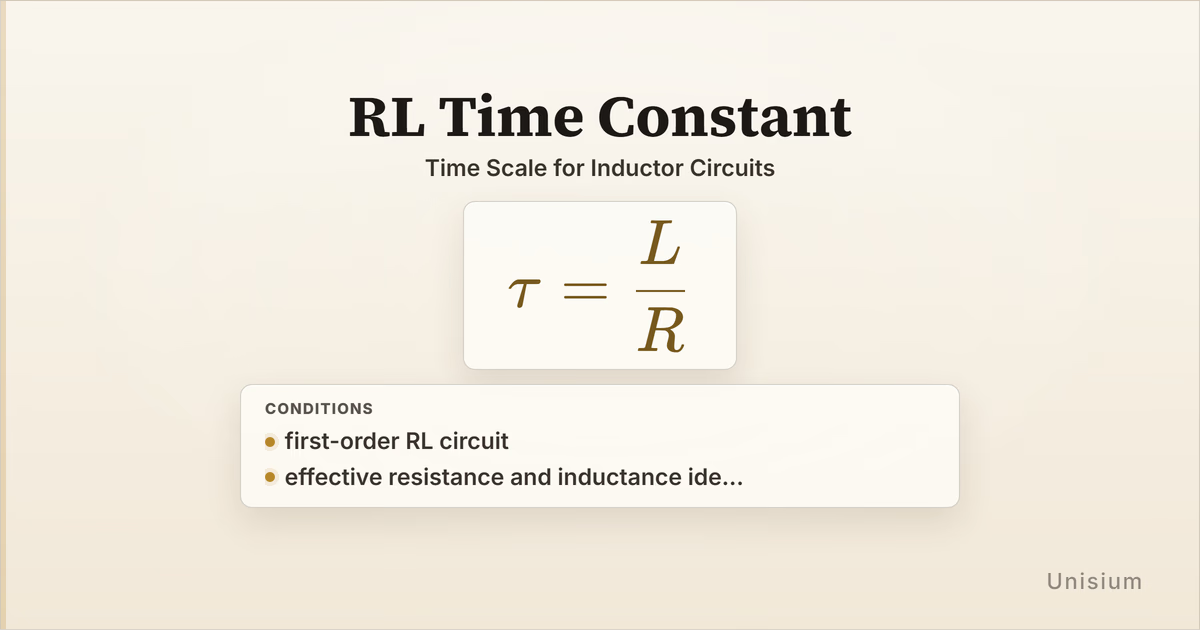
RL Time Constant says a first-order RL circuit changes on the time scale . It applies after the effective resistance and inductance for the transient have been identified. Use it to compare how quickly inductor current changes; the full current-rise or current-decay curve is a nearby relation, not the time constant itself.
This guide sits in the magnetic devices-and-networks lane of the Electromagnetism Principle Map, after relations such as Inductance-Flux Relation and Inductor Voltage Relation. The surrounding decisions are recognizing a first-order RL transient, reducing the circuit to the effective resistance seen by the inductor, and choosing the current-rise or current-decay model. Those are setup choices around the principle, not new principle keys.
On this page: The Principle | Conditions | Misconceptions | Elaborative Encoding | Retrieval Practice | Worked Example | Solve a Problem | Related Principles | FAQ | Related Guides | How This Fits
The Principle
Statement
RL Time Constant gives the characteristic time scale for a first-order resistor-inductor transient. Inductance resists changes in current, while resistance provides the damping path that sets the response rate. Their ratio determines how quickly the inductor current approaches a new steady value or decays from an old one.
Mathematical Form
Where:
- is the time constant, in seconds
- is the inductance involved in the transient, in henries
- is the effective resistance relevant to the transient, in ohms
The unit check is part of the meaning:
What the time constant tells you
The time constant is not the whole current formula. It is the scale that appears inside the exponential rise or decay. After one time constant, a simple RL current-rise process has moved about 63 percent of the way from its initial current toward its final current. A current-decay process has fallen to about 37 percent of its starting difference from the final value.
Those percentages come from exponential behavior. The principle here is narrower: once the circuit has been reduced to the relevant effective and , tells you the time scale.
Conditions of Applicability
Condition: first-order RL circuit; effective resistance and inductance identified
Practical modeling notes
- First-order RL circuit means the transient has one independent inductor current state and no extra energy-storage element creating a higher-order response.
- Effective resistance means the rest of the circuit has been reduced to the resistance that controls how current through the inductor changes.
- The inductance must be the inductance participating in the transient, not an unrelated coil elsewhere in the circuit.
- Circuit topology recognition and switch-state interpretation happen before this principle is applied.
When it does not apply directly
- Capacitor present: if capacitance matters, the circuit may be RC, LC, or RLC rather than first-order RL.
- Multiple independent inductors: an inductor network may need reduction or a more advanced circuit model before one time constant is meaningful.
- Nonlinear inductance or resistance: if or changes strongly during the transient, one constant may be only a local approximation.
Want the complete framework behind this guide? Read Masterful Learning.
Common Misconceptions
Misconception 1: Larger resistance always makes the transient slower
The truth: For an RL time constant, larger effective resistance makes smaller, so the current reaches its new value faster.
Why this matters: Students often carry the RC pattern into RL circuits and predict the wrong dependence.
Misconception 2: The time constant is the total settling time
The truth: is a scale, not a finish time. A first-order RL current approaches its final value gradually.
Why this matters: Treating one time constant as “done” hides the exponential approach and can make timing estimates too short.
Misconception 3: Use any resistor in the circuit
The truth: must be the effective resistance that controls the inductor’s transient.
Why this matters: In a larger circuit, the named resistor in the problem may not be the resistance paired with the inductor for the transient.
Elaborative Encoding
Use these questions to build understanding before memorizing the formula. See Elaborative Encoding for the broader method.
Within the Principle
- Why does increasing inductance make the current change more slowly?
- Why does increasing effective resistance make an RL time constant smaller, unlike the RC case?
For the Principle
- What wording in a problem tells you that the circuit has already been reduced to a first-order RL model?
- Before using , how would you check that is the effective resistance controlling the inductor current?
Between Principles
- How does Inductor Voltage Relation explain why an inductor resists current change, while Ohm’s Law explains why resistance affects the response rate?
Generate an Example
- Describe a circuit change that would halve without changing the inductor.
Retrieval Practice
Answer from memory, then reveal the result and check it. See Retrieval Practice for the full study method.
State the principle in words: _____The time scale for a first-order RL circuit is the inductance divided by the effective resistance.
Write the canonical equation: _____
State the canonical condition: _____first-order RL circuit; effective resistance and inductance identified
Worked Example
Use this worked example to practice Self-Explanation.
Problem
A first-order RL circuit has an effective resistance of controlling an inductor with inductance . Find the RL time constant .
Step 1: Verbal Decoding
Target:
Given:
Constraints: first-order RL circuit; effective resistance identified; inductance identified
Step 2: Visual Decoding
Draw one inductor in the current path with the effective resistance that controls the transient, and label the values on those two elements. (The key visual fact is that the same and define one RL transient.)
Step 3: Physics Modeling
Step 4: Mathematical Procedures
Step 5: Reflection
- Dimensional analysis: Henries divided by ohms reduce to seconds, so the result is a time.
- Magnitude: A fraction of a henry with a few ohms naturally gives a tens-of-milliseconds response.
- Interpretation: The inductor current changes on a time scale of about , not instantly.
Before moving on: self-explain the model
Try explaining why Step 3 uses only the effective resistance and inductance, and why the full exponential current curve is not needed to find the time constant.
Physics model with explanation
Principle: We use RL Time Constant because the problem asks for the characteristic time scale of a first-order RL circuit.
Conditions: The problem states that the circuit is first-order and gives the effective resistance and inductance, so the canonical condition is satisfied.
Relevance: The target is directly related to the given and by .
Description: The inductance resists current change, and the effective resistance controls how quickly the transient energy is dissipated. Their ratio becomes the time scale.
Goal: Divide the inductance by the effective resistance and keep unit prefixes consistent.
Solve a Problem
Apply what you have learned with Problem Solving.
Problem
A first-order RL current transient has a time constant of . The effective resistance is . Find the inductance .
Hint: Solve for before substituting values.
Show Solution
Step 1: Verbal Decoding
Target:
Given:
Constraints: first-order RL circuit; effective resistance controls the transient; inductance is the unknown
Step 2: Visual Decoding
Draw one inductor paired with the effective resistance in the transient current path, then label as the time scale of that path. (The key visual fact is that is the inductance paired with this resistance for the RL transient.)
Step 3: Physics Modeling
Step 4: Mathematical Procedures
Step 5: Reflection
- Dimensional analysis: Seconds times ohms gives henries because .
- Verification: Substituting and gives .
- Interpretation: A millisecond-scale transient with a dozen ohms points to an inductance in the tens of millihenries.
Related Principles
See Electromagnetism: The Principle Map for where RL time scale sits in the magnetic devices-and-networks lane.
| Principle | Relationship to RL Time Constant |
|---|---|
| Inductor Voltage Relation | Explains why current-change rate matters for an inductor. |
| Inductance-Flux Relation | Connects inductance to flux linkage before transient behavior is modeled. |
| Ohm’s Law | Connects resistance, voltage, and current in the resistive part of the circuit model. |
See Principle Structures for a broader way to organize time scales, device relations, and transient models.
FAQ
What is the RL time constant?
The RL time constant is . It gives the characteristic time scale for current change in a first-order resistor-inductor circuit.
When does tau equals L over R apply?
It applies under the canonical condition: first-order RL circuit; effective resistance and inductance identified. You need the resistance that controls the inductor transient and the inductance involved in that transient.
Does a larger resistor make an RL circuit slower?
No. In , larger effective resistance makes the time constant smaller, so the current approaches its new value faster. This is the opposite dependence from the RC time constant.
How is RL Time Constant different from Capacitor Time Constant?
Capacitor Time Constant is , so resistance increases the time scale. RL Time Constant is , so resistance appears in the denominator.
Which resistance should I use for an RL time constant?
Use the effective resistance seen by the inductor for the transient being modeled. In simple textbook circuits that may be the only resistor, but in networks it may require a circuit reduction first.
Related Guides
- Electromagnetism Principle Map - Place RL time scale in the magnetic devices-and-networks lane.
- Inductor Voltage Relation - Review why inductor voltage depends on current-change rate.
- Ohm’s Law - Review the resistance-current-voltage relation behind the resistive part of the transient.
- Problem Solving - Practice turning circuit wording into the right model.
How This Fits in Unisium
Unisium treats RL Time Constant as a principle because the formula is short but the model boundary matters: the circuit must be first-order, and must be the effective resistance paired with the inductor. The useful learning path is to encode what and mean, retrieve with its condition, self-explain why the ratio has units of time, and solve new problems before adding the full current-rise or current-decay curve.
Ready to study physics principles this way? Check access and join the Unisium waitlist or explore the full framework in Masterful Learning.

Masterful Learning
The book behind these guides: a study system for physics, math, & programming built on retrieval, connection, explanation, and problem solving.
Ready to apply this strategy?
Unisium turns these evidence-based techniques into guided study sessions for math and physics. Places are limited during early access. Check current availability to start a trial; joining the mailing list is optional.
See plans and availability Read More GuidesAlready have access? Sign in