Ohm's Law: Voltage, Current, and Resistance
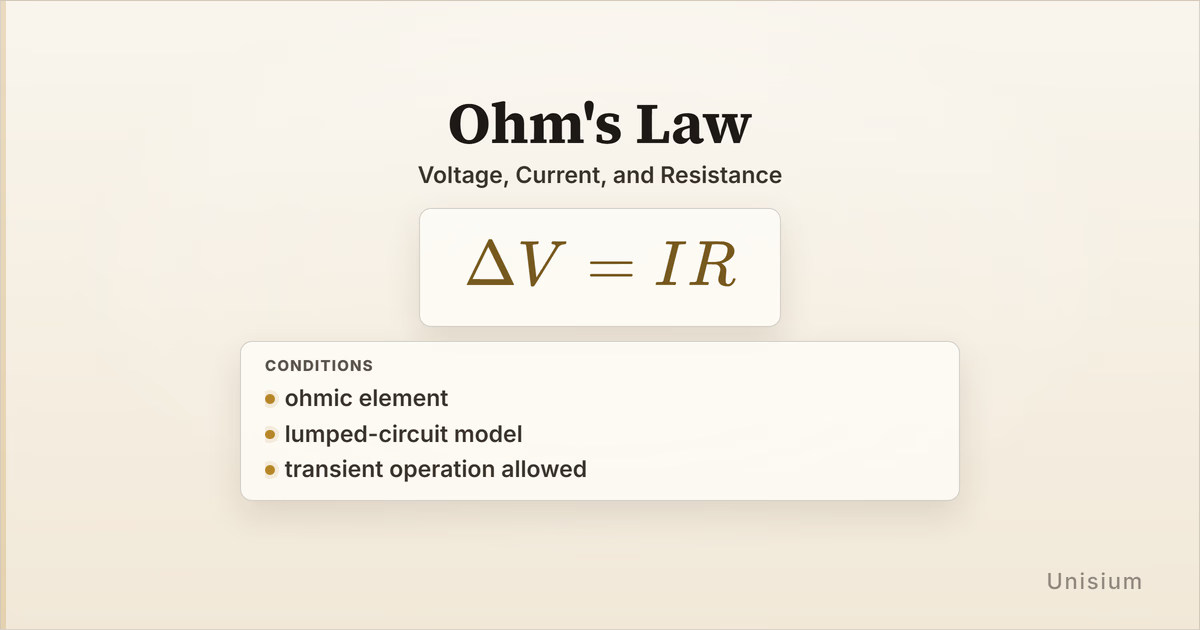
Ohm’s Law says the potential difference across an ohmic element equals the current through it times its resistance. The model is , and it applies to an ohmic element in a lumped-circuit model, including during transient operation. Use it for one selected element when voltage, current, and resistance are connected linearly; do not use it as a universal rule for every electrical device.
This guide follows Electric Current Definition and Resistance From Geometry in the circuit branch of the Electromagnetism Principle Map. The surrounding decisions are choosing the element, choosing a voltage polarity and current direction, and deciding whether the element is being modeled as ohmic; those setup choices are not separate principles.
On this page: The Principle | Conditions | Misconceptions | Elaborative Encoding | Retrieval Practice | Worked Example | Solve a Problem | Related Principles | FAQ | Related Guides | How This Fits
The Principle
Statement
Ohm’s Law models an ohmic circuit element by making potential difference proportional to current. For the same element, the resistance is the constant of proportionality between the current through the element and the potential difference across it. The principle is local to the selected element; a circuit may contain many elements, but this equation describes one ohmic element at a time.
Mathematical Form
Where:
- is the potential difference across the element in volts
- is the current through the element in amperes
- is the resistance of the element in ohms, with
The diagram shows the bookkeeping choice: is measured across the same element that carries current and has resistance . The plus and minus markers define the voltage polarity; for the signed form , that polarity is paired with the chosen current direction using the passive sign convention. These are setup choices around the relation, not extra laws.
Equivalent ways to read the relation
The same model can be rearranged for different targets:
- Current:
- Resistance:
These are algebraic forms of Ohm’s Law, not separate circuit principles.
Conditions of Applicability
Condition: ohmic element; lumped-circuit model; transient operation allowed
Practical modeling notes
- Ohmic element means the element is being modeled with a constant resistance over the range of current and voltage in the problem.
- Lumped-circuit model means the resistor is represented as one element with negligible distributed effects. For an ohmic resistor, holds instant by instant during a transient while remains constant over the operating range.
- The voltage difference must be across the same element that carries the current .
- Choose a current direction and a voltage polarity before assigning signs. For signed circuit equations, pair them consistently: with the passive sign convention, the current enters the terminal marked positive and the element voltage is . If you choose the opposite polarity, the signed relation changes sign. Many introductory problems ask only for magnitudes, but sign conventions still matter in circuit equations.
When it does not apply directly
- Non-ohmic device: a diode, lamp filament over a wide temperature range, or other nonlinear device may not have one constant connecting and .
- Incomplete circuit model: a changing transient does not invalidate Ohm’s Law for an ohmic resistor, but the resistor relation alone does not describe capacitor or inductor voltages elsewhere in the circuit.
- Wrong object boundary: using the voltage across one part of a circuit with the current through a different part mixes quantities from different elements.
Want the complete framework behind this guide? Read Masterful Learning.
Common Misconceptions
Misconception 1: Ohm’s Law applies to every electrical device
The truth: Ohm’s Law applies when the selected element can be modeled as ohmic with constant resistance under the stated conditions.
Why this matters: Treating every device as ohmic hides the model check. A nonlinear device may need its own current-voltage curve instead of one resistance value.
Misconception 2: Resistance is always caused by geometry alone
The truth: Resistance From Geometry can explain one source of resistance for a uniform conductor, while Ohm’s Law uses resistance as the proportionality between voltage and current for an ohmic element.
Why this matters: One principle tells where a resistance value can come from; the other tells how that value relates current and voltage.
Misconception 3: Current is used up by a resistor
The truth: A resistor has a potential difference across it and current through it. The current is not consumed; energy is transferred out of the electrical system as charges move through the element.
Elaborative Encoding
Use these questions to build understanding before memorizing the formula. See Elaborative Encoding for the broader method.
Within the Principle
- If stays fixed, why does doubling double ?
- Why do the units of resistance reduce to volts per ampere?
For the Principle
- What evidence in a problem tells you the element can be treated as ohmic?
- Before using , how do you check that the voltage and current refer to the same element?
Between Principles
- How does Electric Current Definition prepare the meaning of before Ohm’s Law connects it to voltage and resistance?
Generate an Example
- Describe a simple circuit element where Ohm’s Law is a reasonable model and a device where it would be risky to assume one constant resistance.
Retrieval Practice
Answer from memory, then reveal the result and check it. See Retrieval Practice for the full study method.
State the principle in words: _____For an ohmic element, the potential difference across the element equals the current through it times its resistance.
Write the canonical equation: _____
State the canonical condition: _____ohmic element; lumped-circuit model; transient operation allowed
Worked Example
Use this worked example to practice Self-Explanation.
Problem
A steady current of flows through an ohmic resistor with resistance . Find the potential difference across the resistor.
Step 1: Verbal Decoding
Target:
Given:
Constraints: ohmic resistor; steady-state circuit model; voltage is across the same resistor
Step 2: Visual Decoding
Draw one resistor with current through it and mark the two terminals where the potential difference is measured. (The key visual fact is that , , and all belong to the same element.)
Step 3: Physics Modeling
Step 4: Mathematical Procedures
Step 5: Reflection
- Dimensional analysis: Amperes times ohms gives volts because .
- Magnitude: A fraction of an ampere through a tens-of-ohms resistor giving several volts is plausible.
- Interpretation: The resistor needs a potential difference to maintain that steady current in this model.
Before moving on: self-explain the model
Try explaining why Step 3 uses one element’s voltage, current, and resistance together, and why the word “ohmic” matters before the equation is used.
Physics model with explanation
Principle: We use Ohm’s Law because the problem gives current and resistance for one ohmic resistor and asks for the potential difference across that resistor.
Conditions: The resistor is stated to be ohmic and the current is steady, so the canonical condition is satisfied.
Relevance: The target is directly related to the given and by .
Description: The same element carries the current and has the measured voltage across its terminals.
Goal: Multiply current by resistance to find the potential difference across the resistor.
Solve a Problem
Apply what you have learned with Problem Solving.
Problem
An ohmic resistor has a potential difference of across it and carries a steady current of . Find the resistor’s resistance .
Hint: Rearrange Ohm’s Law for resistance before substituting numbers.
Show Solution
Step 1: Verbal Decoding
Target:
Given:
Constraints: ohmic resistor; steady-state circuit model; voltage and current refer to the same resistor
Step 2: Visual Decoding
Draw one resistor, label the terminal voltage , and draw the current through that same resistor. (The key visual fact is that the voltage and current are paired to one element.)
Step 3: Physics Modeling
Step 4: Mathematical Procedures
Step 5: Reflection
- Dimensional analysis: Volts divided by amperes gives ohms.
- Verification: Substituting and gives .
- Interpretation: The resistor allows for every across it, so its resistance is moderate.
Related Principles
See Electromagnetism: The Principle Map for where Ohm’s Law starts the simple circuit-model branch.
| Principle | Relationship to Ohm’s Law |
|---|---|
| Electric Current Definition | Defines current before current is related to voltage and resistance. |
| Resistance From Geometry | Explains how a uniform conductor’s material and shape can determine resistance. |
| Electric Power | Uses voltage and current, sometimes with Ohm’s Law substitutions, to model power in circuit elements. |
See Principle Structures for a broader view of how definitions, material models, and circuit relations connect.
FAQ
What is Ohm’s Law?
Ohm’s Law is the relation . It says the potential difference across an ohmic element equals the current through it times its resistance.
When does Ohm’s Law apply?
It applies for an ohmic element in a lumped-circuit model, including during transient operation. In practice, check that one constant resistance is reasonable and that the voltage and current refer to the same element.
Is Ohm’s Law the definition of resistance?
In an ohmic model, gives the constant resistance of the element. But not every device has one constant resistance over all voltages and currents.
What is the difference between voltage and current?
Voltage is potential difference across two points, while current is charge flow through an element or surface per time. Ohm’s Law connects them only through the resistance of an ohmic element.
What is the most common mistake with Ohm’s Law?
The most common mistake is mixing quantities from different parts of a circuit, such as using the total circuit voltage with the current or resistance of only one element.
Related Guides
- Electric Current Definition - Review what current means before using it in a circuit relation.
- Resistance From Geometry - Connect resistance to material and shape for uniform conductors.
- Electromagnetism Principle Map - Place Ohm’s Law in the broader circuit sequence.
- Problem Solving - Practice translating a physical setup into the right model.
How This Fits in Unisium
Unisium treats Ohm’s Law as a principle because the formula is short but the modeling boundary matters: identify one ohmic element, pair its current with its voltage difference, and keep the lumped-element condition in view. The useful learning path is to encode the model boundary, retrieve with its condition, self-explain examples where the target changes, and solve new circuit problems before adding networks or power.
Want to study physics principles this way? Check access and join the Unisium waitlist or read the full framework in Masterful Learning.

Masterful Learning
The book behind these guides: a study system for physics, math, & programming built on retrieval, connection, explanation, and problem solving.
Ready to apply this strategy?
Unisium turns these evidence-based techniques into guided study sessions for math and physics. Places are limited during early access. Check current availability to start a trial; joining the mailing list is optional.
See plans and availability Read More GuidesAlready have access? Sign in