Poynting Vector Definition: Direction of Energy Flow
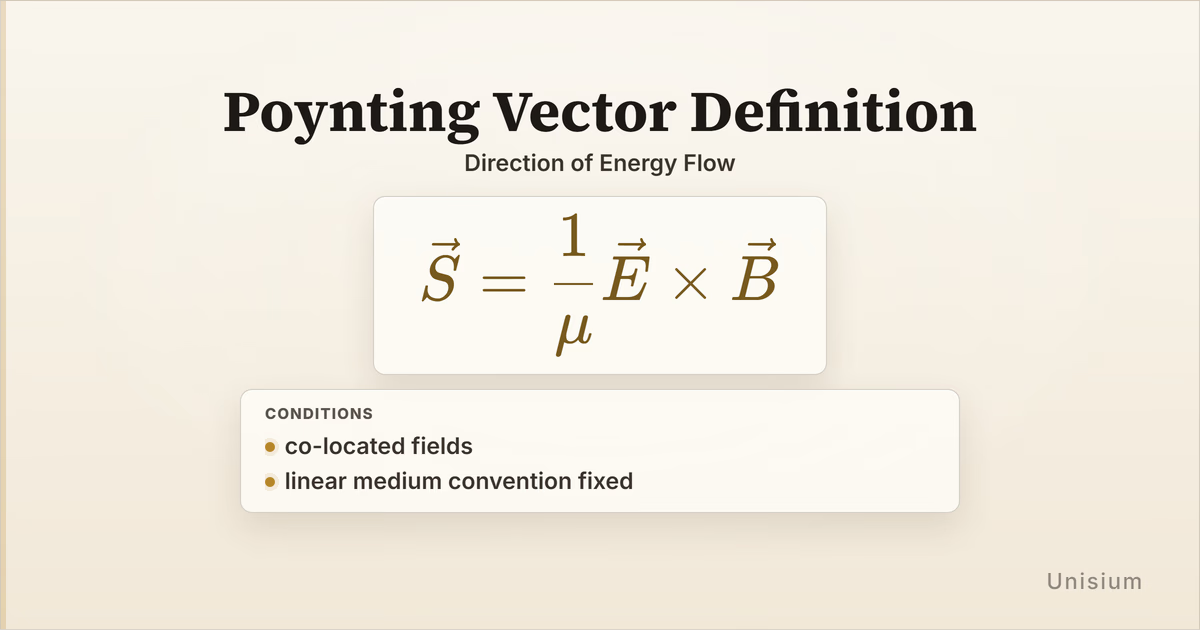
Poynting Vector Definition says electromagnetic energy flux is . It applies when the electric and magnetic fields are co-located and the linear-medium permeability convention is fixed. Use it to find the direction and rate-per-area of electromagnetic energy flow, not to cross fields sampled at different points.
In the Electromagnetism Principle Map, this guide sits after the plane-wave field relation and before later magnetic-dipole orientation work. The surrounding decisions are choosing a local orientation frame, applying the right-hand cross product, and choosing the medium convention for . Those decisions set up the relation, but the principle is the energy-flux vector itself.
On this page: The Principle | Conditions | Misconceptions | Elaborative Encoding | Retrieval Practice | Worked Example | Solve a Problem | Related Principles | FAQ | Related Guides | How This Fits
The Principle
Statement
Poynting Vector Definition gives the local electromagnetic energy flux vector. Its magnitude tells you power per unit area, while its direction comes from the cross product of the electric field with the magnetic field.
Mathematical Form
Where:
- is the Poynting vector, in watts per square meter
- is the electric field vector at the point, in volts per meter
- is the magnetic field vector at the same point, in tesla
- is the permeability used by the chosen linear-medium convention
The diagram is a guide-level orientation scaffold. It shows one local field sample, with upward, out of the page, and to the right. The right-hand direction is surrounding setup; the definition itself says that the local energy flux is the scaled cross product of those co-located fields.
Alternative Forms
For perpendicular fields, the magnitude reduces to:
If the fields meet at an angle , the magnitude is:
These are magnitude forms of the same vector definition, not separate principles.
Conditions of Applicability
Condition: co-located fields; linear medium convention fixed
Practical modeling notes
- Co-located fields means and are evaluated at the same point and time. Do not combine field values sampled from different places.
- Linear medium convention fixed means the permeability in the denominator has been chosen. In vacuum, use ; in a simple linear medium, use the appropriate for that model.
- The vector direction follows , so reversing either field reverses the energy-flux direction.
When it does not apply directly
- Unrelated fields: An electric field from one device and a magnetic field from another location cannot be crossed as if they were one local field state.
- Missing medium convention: If the problem has a material medium but does not specify the permeability convention, the scale of is not fixed.
- Asking for total power through a surface: The Poynting vector gives flux per area. Total power requires surface area and orientation, usually through an integral or dot product with an area vector.
Want the complete framework behind this guide? Read Masterful Learning.
Common Misconceptions
Misconception 1: The Poynting vector always points with E or B
The truth: always points along , which is perpendicular to both and regardless of the angle between them.
Why this matters: Following either field arrow instead of the cross product gives the wrong energy-flow direction.
Misconception 2: Any electric and magnetic fields can be crossed
The truth: The fields must be co-located. The definition is local, so both vectors must describe the same point and time in the same model.
Why this matters: Mixing unrelated measurements can create an energy-flux answer that has no physical meaning.
Misconception 3: The formula gives total power immediately
The truth: is power per unit area. To find total power through a surface, you still need the surface orientation and area relation.
Elaborative Encoding
Use these questions to build understanding before memorizing the formula. See Elaborative Encoding for the broader method.
Within the Principle
- Why does need a cross product instead of an ordinary product of field magnitudes?
- What do the units of become, and why do they match power per area?
For the Principle
- What wording in a problem tells you that the electric and magnetic fields are co-located?
- How would reversing the magnetic-field direction change the Poynting vector?
Between Principles
- How does this definition extend Electromagnetic Wave Field Relation, which only compares paired field magnitudes?
Generate an Example
- Describe a local wave or field setup where , , and form a right-handed triad.
Retrieval Practice
Answer from memory, then reveal the result and check it. See Retrieval Practice for the full study method.
State the principle in words: _____The Poynting vector is the local electromagnetic energy-flux vector, given by permeability-scaled E cross B for co-located fields.
Write the canonical equation: _____
State the canonical condition: _____co-located fields; linear medium convention fixed
Worked Example
Use this worked example to practice Self-Explanation.
Problem
At one point in a vacuum electromagnetic field, has magnitude upward and has magnitude out of the page. Find the Poynting-vector magnitude and direction. Use .
Step 1: Verbal Decoding
Target:
Given:
Constraints: co-located fields; perpendicular fields; vacuum medium convention fixed
Step 2: Visual Decoding
Draw an upward arrow for and an out-of-page dot marker for at the same point. Use the right-hand direction from to to mark to the right. (The key visual fact is the right-handed orientation triad.)
Step 3: Physics Modeling
Step 4: Mathematical Procedures
Step 5: Reflection
- Dimensional analysis: The Poynting-vector unit is watts per square meter, matching energy flow per area.
- Direction check: Upward crossed with out-of-page points rightward.
- Condition check: The problem states one point and a vacuum permeability, so the co-location and medium-convention requirements are satisfied.
Before moving on: self-explain the model
Try explaining why Step 3 uses the perpendicular magnitude form, why the direction belongs to the cross product, and why both fields must be sampled at the same point.
Physics model with explanation
Principle: We use Poynting Vector Definition because the target is electromagnetic energy flux from local electric and magnetic fields.
Conditions: The fields are co-located, perpendicular, and in vacuum, so is the fixed permeability convention.
Relevance: The target is exactly the scaled cross product of the given fields.
Description: The electric field points upward and the magnetic field points out of the page. Their cross product points to the right, while the magnitude comes from multiplying the field magnitudes and dividing by .
Goal: Use the right-hand orientation for direction and the magnitude form for the numerical flux.
Solve a Problem
Apply what you have learned with Problem Solving.
Problem
At one point in a vacuum field, has magnitude upward and has magnitude into the page. Find the Poynting-vector magnitude and direction. Use .
Hint: Into the page reverses the magnetic-field direction compared with the worked example.
Show Solution
Step 1: Verbal Decoding
Target:
Given:
Constraints: co-located fields; perpendicular fields; vacuum medium convention fixed
Step 2: Visual Decoding
Draw an upward arrow for and an into-page cross marker for at the same point. Use the right-hand direction from to into-page to mark to the left. (The key visual fact is that reversing reverses the energy-flux direction.)
Step 3: Physics Modeling
Step 4: Mathematical Procedures
Step 5: Reflection
- Dimensional analysis: The result has units of watts per square meter, so it is a flux, not total power.
- Direction check: Upward crossed with into-page points leftward.
- Verification: Reversing the magnetic-field direction from the worked example reverses while keeping the same magnitude rule.
Related Principles
See Electromagnetism: The Principle Map for where the Poynting vector sits in the induction-and-waves branch.
| Principle | Relationship to Poynting Vector Definition |
|---|---|
| Electromagnetic Wave Field Relation | Gives a plane-wave field-magnitude relation before energy flux is computed. |
| Electric Field Energy Density | Gives local electric-field energy per volume, while the Poynting vector gives energy flow per area. |
| Magnetic Field Energy Density | Gives the magnetic-field partner density that often appears near energy-flow reasoning. |
See Principle Structures for a broader way to organize field magnitudes, energy density, and flux relations.
FAQ
What is the Poynting vector?
The Poynting vector is the local electromagnetic energy-flux vector. It is defined by for co-located fields with a fixed linear-medium permeability convention.
What direction does the Poynting vector point?
It points in the direction of . For perpendicular fields, use the right-hand rule from the electric-field direction toward the magnetic-field direction.
Is the Poynting vector total power?
No. The Poynting vector is power per unit area. Total power through a surface requires combining with the surface orientation and area.
Does the formula only apply to plane waves?
No. Plane waves are a common simple example, but the definition is local. The required condition is co-located fields with a fixed linear-medium convention.
Why is permeability in the denominator?
The permeability factor sets the scale for the energy-flux definition under the chosen medium convention. In vacuum, that factor is .
Related Guides
- Electromagnetism: The Principle Map - Place this relation in the induction-and-waves lane.
- Electromagnetic Wave Field Relation - Review the paired field-magnitude relation that often comes before energy-flux calculations.
- Electric Field Energy Density - Compare energy per volume with energy flow per area.
- Problem Solving - Practice turning conditions, directions, and targets into the right model.
How This Fits in Unisium
Unisium treats Poynting Vector Definition as a principle because the equation is compact but the local setup is easy to misuse: the fields must be co-located, the medium convention must be fixed, and the direction comes from vector order. The useful learning path is to encode the condition, retrieve the cross-product definition, self-explain the orientation, and solve problems where magnitude and direction both matter.
Ready to study principles this way? Check access and join the Unisium waitlist or explore the full framework in Masterful Learning.

Masterful Learning
The book behind these guides: a study system for physics, math, & programming built on retrieval, connection, explanation, and problem solving.
Ready to apply this strategy?
Unisium turns these evidence-based techniques into guided study sessions for math and physics. Places are limited during early access. Check current availability to start a trial; joining the mailing list is optional.
See plans and availability Read More GuidesAlready have access? Sign in