Electric Field Energy Density: Field Energy Per Volume
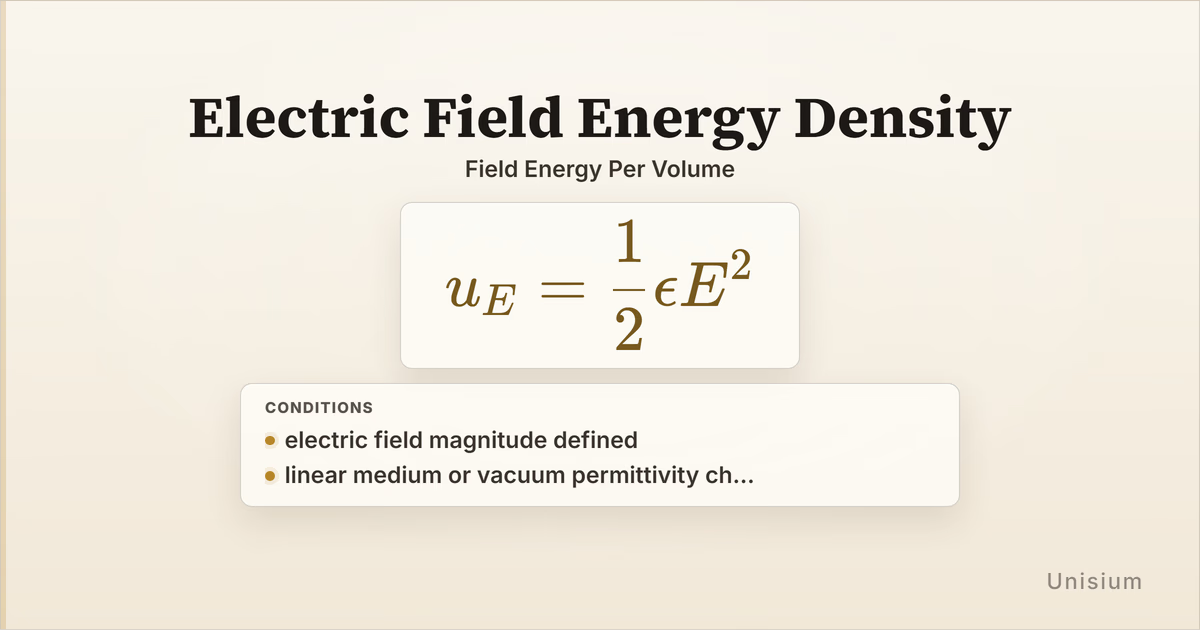
Electric Field Energy Density says a region with electric field magnitude stores local energy density . It applies when the field magnitude is defined and the medium’s permittivity is chosen. Use it to find energy per volume before multiplying by a volume or integrating over space.
In the Electromagnetism Principle Map, this guide sits near capacitor energy and field relations. The surrounding decisions are choosing the relevant permittivity, deciding whether the field can be treated as uniform over the region, and distinguishing local density from total stored energy. Those are setup choices around the principle, not new principles to memorize.
On this page: The Principle | Conditions | Misconceptions | Elaborative Encoding | Retrieval Practice | Worked Example | Solve a Problem | Related Principles | FAQ | Related Guides | How This Fits
The Principle
Statement
Electric Field Energy Density gives the amount of energy stored per unit volume in an electric field. The square on means stronger fields store much more energy locally, while tells you which medium or vacuum model the field is being measured in.
Mathematical Form
Where:
- is electric field energy density, in joules per cubic meter
- is the permittivity of the medium, in farads per meter
- is electric field magnitude, in volts per meter or newtons per coulomb
The diagram is a guide-level local-field scaffold. It shows that belongs to a local field region, not automatically to an entire capacitor, object, or circuit. To get a total energy from this density, you still need the volume where the field exists or an integral over a nonuniform field.
Useful Total-Energy Link
For a uniform field over a volume , the local density can be converted into total field energy:
For a nonuniform field, the density must be integrated:
These are application steps, not separate definitions of the density itself.
Conditions of Applicability
Condition: electric field magnitude defined; linear medium or vacuum permittivity chosen
Practical modeling notes
- Electric field magnitude defined means you know the scalar magnitude at the point or in the region being modeled.
- Permittivity chosen means the medium is vacuum with or a linear medium with a specified .
- If the field varies over space, apply the relation locally before integrating.
When it does not apply directly
- Undefined field magnitude: If only voltage or charge is given, first use a field or device relation to determine where the density is being evaluated.
- No chosen medium model: If the material response is nonlinear, anisotropic, or unspecified, the compact form may not be enough.
- Asking for total energy: The formula gives energy per volume. Total energy needs volume information or an integral.
Want the complete framework behind this guide? Read Masterful Learning.
Common Misconceptions
Misconception 1: Energy density is the same as total energy
The truth: is energy per unit volume. Total energy requires multiplying by a volume for a uniform field or integrating over space for a nonuniform field.
Why this matters: Confusing density with total energy can make units and magnitudes wrong even when the formula is remembered.
Misconception 2: The formula uses electric potential instead of field magnitude
The truth: The variable is , the electric field magnitude. Potential difference may help you find in a simple geometry, but it does not replace in the density relation.
Why this matters: A voltage by itself does not determine field energy density unless the geometry or field relation is known.
Misconception 3: Permittivity is optional
The truth: The density depends on the chosen vacuum or linear-medium permittivity. Changing the medium changes the energy-density model for the same field magnitude.
Elaborative Encoding
Use these questions to build understanding before memorizing the formula. See Elaborative Encoding for the broader method.
Within the Principle
- What do the units of become, and why does that match energy per volume?
- If doubles while stays fixed, what happens to ?
For the Principle
- What wording in a problem tells you that the field magnitude is defined locally?
- How would you decide whether to use or a material permittivity?
Between Principles
- How does this density relation connect to Capacitor Energy, which gives total energy stored by a capacitor?
Generate an Example
- Describe a region between capacitor plates where field energy density applies, and name what extra information you would need to find total energy.
Retrieval Practice
Answer from memory, then reveal the result and check it. See Retrieval Practice for the full study method.
State the principle in words: _____Electric field energy density is the energy stored per unit volume in an electric field, proportional to permittivity and to the square of the field magnitude.
Write the canonical equation: _____
State the canonical condition: _____electric field magnitude defined; linear medium or vacuum permittivity chosen
Worked Example
Use this worked example to practice Self-Explanation.
Problem
A vacuum region has a uniform electric field of magnitude . Find the electric field energy density in that region. Use .
Step 1: Verbal Decoding
Target:
Given:
Constraints: vacuum region; uniform electric field; field magnitude defined; vacuum permittivity chosen
Step 2: Visual Decoding
Draw a small box inside a region of parallel electric-field arrows, label the arrows , and mark the box as the local volume whose density is being evaluated. (The key visual fact is that the answer is per volume, not total energy.)
Step 3: Physics Modeling
Step 4: Mathematical Procedures
Step 5: Reflection
- Dimensional analysis: times reduces to .
- Interpretation: The result is a density, so a larger field-filled volume would store more total energy at the same .
- Parameter dependence: If the field magnitude were doubled, the energy density would become four times larger.
Before moving on: self-explain the model
Try explaining why Step 3 uses the field magnitude and permittivity directly, and why no volume appears until a total-energy question is asked.
Physics model with explanation
Principle: We use Electric Field Energy Density because the target is local energy per volume in a known electric field.
Conditions: The field magnitude is given, and the problem specifies vacuum, so is the chosen permittivity.
Relevance: The formula directly connects to the two given inputs.
Description: The field region stores energy locally. The density is fixed by the square of the field magnitude and the permittivity model.
Goal: Substitute the field magnitude and permittivity into the density relation and report energy per cubic meter.
Solve a Problem
Apply what you have learned with Problem Solving.
Problem
A linear dielectric region has permittivity and a uniform electric field magnitude . Find the electric field energy density. Use .
Hint: First write the permittivity in terms of , then keep the answer as energy per volume.
Show Solution
Step 1: Verbal Decoding
Target:
Given:
Constraints: linear dielectric; uniform electric field; field magnitude defined; material permittivity chosen
Step 2: Visual Decoding
Draw a small local box in the dielectric field region, label the parallel field arrows , and write beside the medium. (The key visual fact is that the medium choice changes the density model.)
Step 3: Physics Modeling
Step 4: Mathematical Procedures
Step 5: Reflection
- Dimensional analysis: The units still reduce to joules per cubic meter.
- Magnitude: The density is larger than the same field in vacuum because the chosen permittivity is three times larger.
- Verification: Substituting into the canonical equation reproduces the numerical result.
Related Principles
See Electromagnetism: The Principle Map for where this field-energy relation sits in the potential, energy, and flux lane.
| Principle | Relationship to Electric Field Energy Density |
|---|---|
| Capacitor Energy | Gives total energy stored by a capacitor, while this guide gives local field energy per volume. |
| Parallel-Plate Capacitance | Can supply a simple geometry where the field between plates is approximately uniform. |
| Magnetic Field Energy Density | The magnetic-field partner relation uses magnetic field magnitude and permeability instead of electric field magnitude and permittivity. |
See Principle Structures for a broader way to organize local densities, total quantities, and bridge relations.
FAQ
What is electric field energy density?
Electric field energy density is the energy stored per unit volume in an electric field. In a vacuum or linear medium, it is .
When does the electric field energy density formula apply?
It applies under the canonical condition: electric field magnitude defined; linear medium or vacuum permittivity chosen. The field magnitude and the permittivity model must both be known.
Is electric field energy density the same as capacitor energy?
No. Capacitor energy is a total stored energy for a capacitor. Electric field energy density is local energy per volume; it can be integrated over the field region to get total energy.
Why does the formula use field magnitude instead of voltage?
Energy density is local to the electric field. Voltage can help determine in simple geometries, but the density relation itself depends on field magnitude and permittivity.
What happens if the electric field is not uniform?
Apply locally where is known, then integrate the density over the region to find total energy.
Related Guides
- Electromagnetism: The Principle Map - Place this guide in the field-energy part of the EM sequence.
- Capacitor Energy - Compare local field-energy density with total capacitor energy.
- Parallel-Plate Capacitance - Review the simple plate geometry that often gives a nearly uniform electric field.
- Problem Solving - Practice distinguishing local quantities from total quantities in physics problems.
How This Fits in Unisium
Unisium treats Electric Field Energy Density as a principle because the formula is compact but the modeling boundary matters: is local, depends on the chosen permittivity, and becomes total energy only after a volume or integral is supplied. The useful learning path is to encode the condition, retrieve , self-explain the local-versus-total distinction, and solve problems where the target variable changes.
Ready to study principles this way? Check access and join the Unisium waitlist or explore the full framework in Masterful Learning.

Masterful Learning
The book behind these guides: a study system for physics, math, & programming built on retrieval, connection, explanation, and problem solving.
Ready to apply this strategy?
Unisium turns these evidence-based techniques into guided study sessions for math and physics. Places are limited during early access. Check current availability to start a trial; joining the mailing list is optional.
See plans and availability Read More GuidesAlready have access? Sign in