Electromagnetic Wave Field Relation: Linked by the Wave Speed
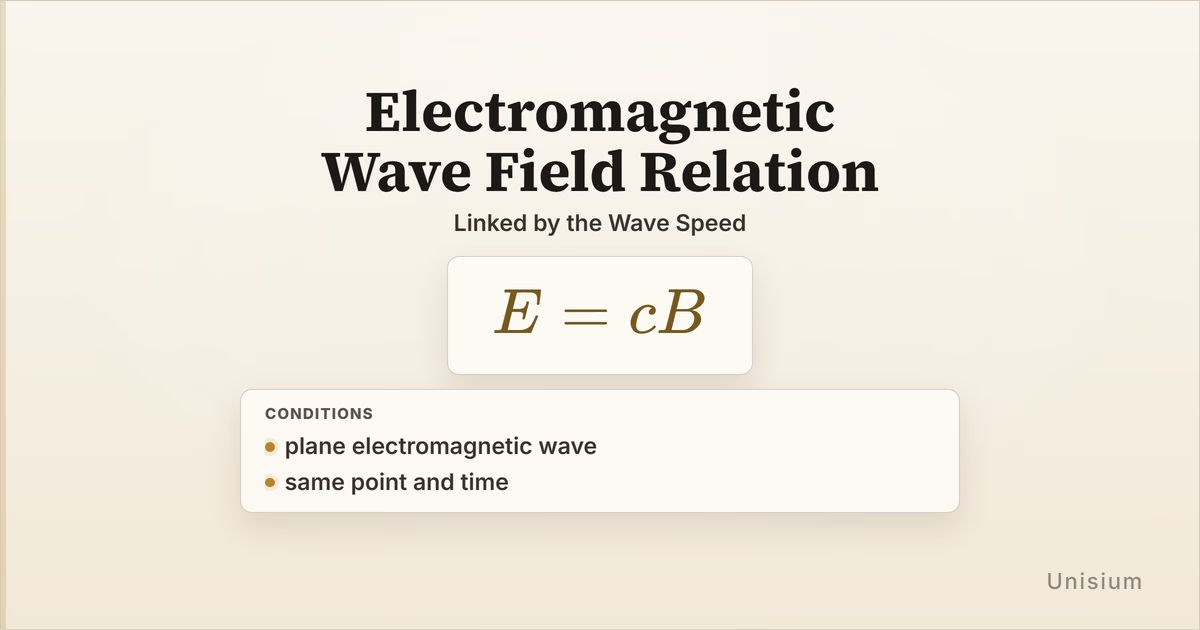
Electromagnetic Wave Field Relation says that in a plane electromagnetic wave, the electric-field magnitude and magnetic-field magnitude obey . It applies at the same point and time in the wave. Use it to convert between co-located field magnitudes, not between unrelated electric and magnetic fields.
In the Electromagnetism Principle Map, this guide sits after Electromagnetic Wave Speed and before the Poynting-vector relation. The surrounding decisions are propagation direction, polarization direction, medium choice, and energy-flow interpretation. Those decisions help set up the wave, but the principle here is the local magnitude relation itself.
On this page: The Principle | Conditions | Misconceptions | Elaborative Encoding | Retrieval Practice | Worked Example | Solve a Problem | Related Principles | FAQ | Related Guides | How This Fits
The Principle
Statement
Electromagnetic Wave Field Relation states that the electric-field magnitude and magnetic-field magnitude in a plane electromagnetic wave are linked by the wave speed . At any one point and instant in the wave, the SI electric-field magnitude equals the magnetic-field magnitude multiplied by the unit-carrying speed .
Mathematical Form
Where:
- is the electric-field magnitude, in newtons per coulomb or volts per meter
- is the magnetic-field magnitude, in tesla
- is the electromagnetic wave speed in vacuum, in meters per second for the usual vacuum form
The diagram is a guide-level orientation scaffold. It shows the co-located electric and magnetic fields for one sample event in a plane wave. The propagation direction, polarization choice, and out-of-page convention are surrounding setup decisions; the relation compares the two local magnitudes after that setup is fixed.
Alternative Forms
The same relation can be rearranged depending on the target variable:
- Solve for magnetic-field magnitude:
- Solve for wave speed from paired magnitudes:
Conditions of Applicability
Condition: plane electromagnetic wave; same point and time
Practical modeling notes
- Plane electromagnetic wave means the wave is treated locally as a clean plane wave, not a near-field source, static field, or arbitrary radiation pattern.
- Same point and time means and are sampled at the same event in the wave. Do not pair an electric-field value from one location with a magnetic-field value from another.
- In the usual intro-physics vacuum form, use . In a material wave model, your course may replace the wave speed with the appropriate medium speed.
When it does not apply directly
- Static or unrelated fields: A capacitor’s electric field and a bar magnet’s magnetic field do not satisfy this wave relation.
- Near-field source regions: Close to antennas or accelerating charges, electric and magnetic fields can have richer structure than a plane-wave magnitude pair.
- Different samples of the wave: A peak electric field cannot be paired with a magnetic field measured at a different phase point unless the problem says they correspond.
Want the complete framework behind this guide? Read Masterful Learning.
Common Misconceptions
Misconception 1: Any electric field and magnetic field satisfy E equals cB
The truth: The condition is a plane electromagnetic wave at the same point and time. Static fields and unrelated source fields do not have to obey this ratio.
Why this matters: Treating as a universal conversion can create false magnetic fields from electrostatic situations.
Misconception 2: E and B point in the same direction
The truth: In a plane electromagnetic wave, the fields are perpendicular to each other and to the propagation direction. The equation compares magnitudes, not vector directions.
Why this matters: Direction belongs to wave geometry and later cross-product reasoning, not to the scalar magnitude relation alone.
Misconception 3: The formula compares peak values only
The truth: It can compare corresponding instantaneous magnitudes or corresponding amplitudes, as long as the two field values are from the same point and time in the same plane wave.
Elaborative Encoding
Use these questions to build understanding before memorizing the formula. See Elaborative Encoding for the broader method.
Within the Principle
- Why does compare magnitudes rather than full vector directions?
- If doubles at a fixed sample point in the same plane wave, what happens to ?
For the Principle
- What words in a problem tell you the electric and magnetic field values come from the same point and time?
- Why should a static electric-field problem make you pause before using this wave relation?
Between Principles
- How does this relation differ from Electromagnetic Wave Speed, which explains where the vacuum speed comes from?
Generate an Example
- Describe a plane-wave situation where applies, and a static-field situation where it does not.
Retrieval Practice
Answer from memory, then reveal the result and check it. See Retrieval Practice for the full study method.
State the principle in words: _____In a plane electromagnetic wave, electric-field magnitude equals the wave speed times magnetic-field magnitude at the same point and time.
Write the canonical equation: _____
State the canonical condition: _____plane electromagnetic wave; same point and time
Worked Example
Use this worked example to practice Self-Explanation.
Problem
A plane electromagnetic wave in vacuum has magnetic-field magnitude at one point and time. Find the electric-field magnitude at that same point and time. Use .
Step 1: Verbal Decoding
Target:
Given:
Constraints: plane electromagnetic wave; same point and time; vacuum speed supplied
Step 2: Visual Decoding
Draw one sample point on a right-moving plane wave. At that same point, sketch and mark as the unknown co-located field magnitude. (The key visual fact is that both field values are sampled at the same event.)
Step 3: Physics Modeling
Step 4: Mathematical Procedures
Step 5: Reflection
- Dimensional analysis: In SI units, meters per second times tesla gives volts per meter.
- Magnitude: The result is modest because the magnetic-field value is tiny even after conversion through the large speed .
- Condition check: The problem explicitly uses a plane wave and the same point and time, so the relation is legal.
Before moving on: self-explain the model
Try explaining why Step 3 uses only the local field-magnitude relation, why direction is not being solved here, and why the same-point condition matters.
Physics model with explanation
Principle: We use Electromagnetic Wave Field Relation because the problem asks for one field magnitude from the other in a plane electromagnetic wave.
Conditions: The wave is plane, the sample point and time are shared, and the vacuum speed is supplied.
Relevance: The target appears directly in , with and given.
Description: The electric and magnetic fields are part of the same local wave state. Multiplying the magnetic-field magnitude by the wave speed gives the corresponding electric-field magnitude.
Goal: Substitute the magnetic-field magnitude and wave speed into the relation, then report the electric field in volts per meter.
Solve a Problem
Apply what you have learned with Problem Solving.
Problem
At one point and time in a plane electromagnetic wave, the electric-field magnitude is . Find the corresponding magnetic-field magnitude . Use .
Hint: Rearrange for before substituting numbers.
Show Solution
Step 1: Verbal Decoding
Target:
Given:
Constraints: plane electromagnetic wave; same point and time; wave speed supplied
Step 2: Visual Decoding
Draw one sample point in the plane wave, label the electric-field magnitude , and mark the magnetic-field magnitude as the unknown at the same point. (The key visual fact is that the two magnitudes are paired locally.)
Step 3: Physics Modeling
Step 4: Mathematical Procedures
Step 5: Reflection
- Dimensional analysis: Volts per meter divided by meters per second reduces to tesla in SI.
- Magnitude: The magnetic-field magnitude is small because the electric-field magnitude is divided by a large wave speed.
- Verification: Substituting into gives .
Related Principles
See Electromagnetism: The Principle Map for where this wave-field relation sits in the induction-and-waves branch.
| Principle | Relationship to Electromagnetic Wave Field Relation |
|---|---|
| Electromagnetic Wave Speed | Supplies the vacuum-speed relation that gives the value of used in the field-magnitude ratio. |
| Electric Field Energy Density | Uses electric-field magnitude to compute local energy density, rather than comparing the paired magnetic field. |
| Poynting Vector Definition | Uses both fields and their orientation to represent energy flux, a later step beyond the scalar magnitude relation. |
See Principle Structures for a broader way to organize wave relations, field magnitudes, and energy-flow ideas.
FAQ
What is Electromagnetic Wave Field Relation?
Electromagnetic Wave Field Relation is the principle that electric and magnetic field magnitudes in a plane electromagnetic wave satisfy . It compares co-located field magnitudes at the same point and time.
When does E equals cB apply?
It applies under the canonical condition: plane electromagnetic wave; same point and time. The electric-field and magnetic-field values must come from the same wave sample.
Does E equals cB work for static electric and magnetic fields?
No. Static fields and unrelated source fields are not automatically paired as a plane electromagnetic wave, so the ratio is not a universal conversion rule.
Are E and B in the same direction in an electromagnetic wave?
No. In a plane electromagnetic wave, the electric and magnetic fields are perpendicular to each other and to the propagation direction. The equation compares their magnitudes.
Is this relation about amplitudes or instantaneous values?
It can be used for corresponding amplitudes or for corresponding instantaneous magnitudes. The key is that both values refer to the same point and time in the same plane wave.
Related Guides
- Electromagnetism: The Principle Map - Place the wave-field relation after the wave-speed bridge.
- Electromagnetic Wave Speed - Review the vacuum-speed relation that supplies .
- Electric Field Energy Density - Compare a local electric-field magnitude relation with an energy-density relation.
- Problem Solving - Practice turning conditions and targets into the right equation.
How This Fits in Unisium
Unisium treats Electromagnetic Wave Field Relation as a principle because the equation is short but the sampling condition is doing real work: the fields must belong to the same plane wave at the same point and time. The useful learning path is to encode the condition, retrieve , self-explain the local wave geometry, and solve problems where one field magnitude is missing.
Ready to study principles this way? Check access and join the Unisium waitlist or explore the full framework in Masterful Learning.

Masterful Learning
The book behind these guides: a study system for physics, math, & programming built on retrieval, connection, explanation, and problem solving.
Ready to apply this strategy?
Unisium turns these evidence-based techniques into guided study sessions for math and physics. Places are limited during early access. Check current availability to start a trial; joining the mailing list is optional.
See plans and availability Read More GuidesAlready have access? Sign in