Parallel-Plate Capacitance: Area, Gap, and Medium
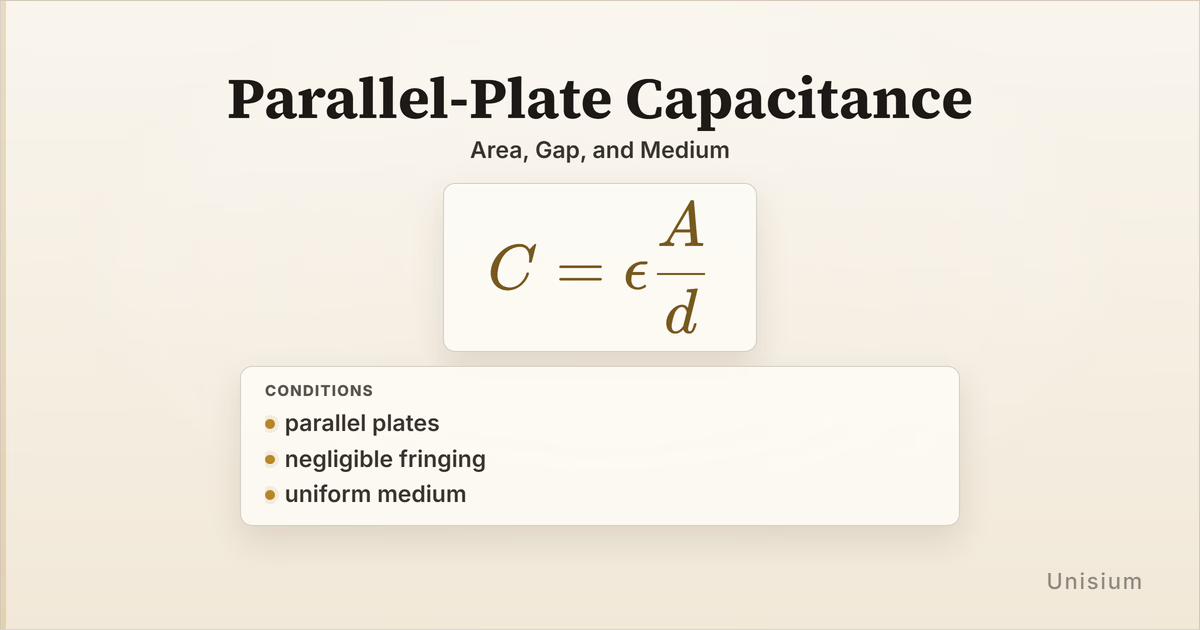
Parallel-Plate Capacitance says an ideal parallel-plate capacitor has capacitance . It applies for parallel plates with negligible fringing in a uniform medium. Use it when geometry sets the capacitance: larger plate area and larger permittivity increase , while larger separation decreases it.
This guide follows Capacitance Definition in the device-and-network part of the electromagnetism map. The surrounding decisions are recognizing the parallel-plate geometry, deciding whether edge fringing can be ignored, and identifying the medium between the plates. Those are setup decisions around the principle, not new principles.
On this page: The Principle | Conditions | Misconceptions | Elaborative Encoding | Retrieval Practice | Worked Example | Solve a Problem | Related Principles | FAQ | Related Guides | How This Fits
The Principle
Statement
Parallel-Plate Capacitance predicts the capacitance of a capacitor from its physical geometry and the material between the plates. For the idealized setup, the field between the plates is treated as nearly uniform and edge effects are ignored. The result tells you how easily that geometry stores charge per volt.
Mathematical Form
Where:
- is capacitance in farads, with
- is the permittivity of the medium in
- is the overlapping plate area in
- is the separation between the plates in meters
The diagram shows the three quantities that the formula compares. Plate area increases how much charge can be stored for the same voltage, plate separation reduces that ability, and the medium’s permittivity captures how much charge the plates can store for a given electric field and voltage difference.
Common equivalent form
If the medium is described by a relative permittivity , then , so the same principle can be written:
This is not a separate principle. It is the same geometry model with the medium parameter split into vacuum permittivity and relative permittivity.
Conditions of Applicability
Condition: parallel plates; negligible fringing; uniform medium
Practical modeling notes
- Parallel plates means the overlapping surfaces face each other with a well-defined separation.
- Negligible fringing means edge fields are small enough that the between-plate field dominates the capacitance.
- Uniform medium means one permittivity value represents the material between the plates.
- Use the overlapping area, not the total area of metal that does not face the other plate.
- The principle predicts from geometry; the capacitance definition relates that to charge and voltage.
When it does not apply directly
- Strong edge effects: if the plate separation is not small compared with the plate dimensions, fringing can materially change the capacitance.
- Nonparallel or irregular conductors: the field geometry is different, so this compact area-over-gap model is not enough.
- Layered or nonuniform material: if the medium changes across the gap, one uniform no longer captures the setup.
Want the complete framework behind this guide? Read Masterful Learning.
Common Misconceptions
Misconception 1: More separation means more room for charge
The truth: In this ideal model, increasing lowers capacitance because the same plate charge produces a larger potential difference across a wider gap.
Why this matters: Treating the gap as storage space reverses the parameter dependence and leads to the wrong design intuition.
Misconception 2: The formula uses total plate area
The truth: The relevant is the overlapping area that faces the other plate.
Why this matters: Extra metal outside the facing region does not contribute to the ideal parallel-plate field in the same way.
Misconception 3: Any capacitor can use this geometry formula
The truth: This formula is for the parallel-plate idealization with negligible fringing and a uniform medium.
Elaborative Encoding
Use these questions to build understanding before memorizing the formula. See Elaborative Encoding for the broader method.
Within the Principle
- Why does the ratio make capacitance larger for wider plates but smaller for a larger gap?
- What does the unit for need to do so that has units of farads?
For the Principle
- What wording or diagram evidence tells you the plates can be treated as parallel with negligible fringing?
- How would you decide whether the medium should be modeled as vacuum, air, or a dielectric with ?
Between Principles
- How does this geometry model connect to Uniform-Field Potential Difference, where field strength and separation determine voltage difference?
Generate an Example
- Describe a classroom or lab capacitor setup where doubling the plate separation would halve the capacitance if the area and medium stayed fixed.
Retrieval Practice
Answer from memory, then reveal the result and check it. See Retrieval Practice for the full study method.
State the principle in words: _____For an ideal parallel-plate capacitor, capacitance equals medium permittivity times overlapping plate area divided by plate separation.
Write the canonical equation: _____
State the canonical condition: _____parallel plates; negligible fringing; uniform medium
Worked Example
Use this worked example to practice Self-Explanation.
Problem
Two large parallel plates have overlapping area and separation . The space between the plates is air, so use . Neglect fringing. Find the capacitance.
Step 1: Verbal Decoding
Target:
Given:
Constraints: parallel plates; negligible fringing; uniform air medium
Step 2: Visual Decoding
Draw two broad facing plates, label the overlapping area , mark the small gap between them, and write inside the gap. (The key visual fact is that the same medium fills the whole separation.)
Step 3: Physics Modeling
Step 4: Mathematical Procedures
Step 5: Reflection
- Dimensional analysis: times divided by gives farads.
- Magnitude: Picofarads are plausible for small air-gap parallel plates.
- Parameter dependence: Halving the gap would double the capacitance if area and medium stayed fixed.
Before moving on: self-explain the model
Try explaining why Step 3 uses geometry instead of charge and voltage, why air is represented by , and why fringing is mentioned as a condition rather than a correction inside the formula.
Physics model with explanation
Principle: We use Parallel-Plate Capacitance because the problem gives plate geometry and asks for capacitance.
Conditions: The plates are parallel, fringing is neglected, and the medium is uniform air, so the canonical condition is satisfied.
Relevance: The target is , and the given quantities are exactly the variables in .
Description: The plates face each other across a small gap. The overlapping area and the medium help store charge per volt, while the gap opposes it.
Goal: Substitute the geometry and permittivity into the capacitance formula to find the device property.
Solve a Problem
Apply what you have learned with Problem Solving.
Problem
A parallel-plate capacitor in air has overlapping area and capacitance . Use and neglect fringing. Find the plate separation.
Hint: Rearrange the formula symbolically before substituting numbers.
Show Solution
Step 1: Verbal Decoding
Target:
Given:
Constraints: parallel plates; negligible fringing; uniform air medium
Step 2: Visual Decoding
Draw two facing plates, mark the unknown separation between them, label the overlapping area , and put in the gap. (The key visual fact is that the unknown is the distance in the denominator.)
Step 3: Physics Modeling
Step 4: Mathematical Procedures
Step 5: Reflection
- Dimensional analysis: times divided by leaves meters.
- Interpretation: A millimeter-scale gap is consistent with a few hundred picofarads for this plate area.
- Verification: Substituting back into the formula gives about .
Related Principles
See Electromagnetism: The Principle Map for where this geometry relation sits in the device-and-network branch.
| Principle | Relationship to Parallel-Plate Capacitance |
|---|---|
| Capacitance Definition | Defines capacitance as charge per voltage; this guide predicts that capacitance from geometry. |
| Capacitor Energy | Uses capacitance and voltage to compute energy stored in the capacitor. |
| Equivalent Capacitance In Parallel | Later network relation that combines multiple capacitances after each device’s is known. |
See Principle Structures for a broader view of how definitions, geometry models, and network relations connect.
FAQ
What is parallel-plate capacitance?
Parallel-plate capacitance is the geometry model . It says capacitance depends on the medium permittivity, overlapping plate area, and plate separation.
When does the parallel-plate capacitance formula apply?
It applies for parallel plates when fringing is negligible and the medium between the plates is uniform. Those conditions are what let the compact area-over-gap relation represent the field geometry.
Does increasing plate area increase capacitance?
Yes. In the ideal parallel-plate model, increasing overlapping area increases capacitance because more facing surface can store charge for the same potential difference.
Why does increasing plate separation reduce capacitance?
A larger separation makes the same charge produce a larger potential difference, so the charge stored per volt is smaller. That is why appears in the denominator.
What does epsilon mean in the capacitance formula?
is the permittivity of the medium between the plates. For a dielectric, it is often written , where is the relative permittivity.
Related Guides
- Capacitance Definition - Review what capacitance means before using the geometry model.
- Uniform-Field Potential Difference - Connect plate separation with voltage in a uniform electric field.
- Electromagnetism Principle Map - Place this relation in the broader EM sequence.
- Problem Solving - Practice turning a geometry condition into a usable model.
How This Fits in Unisium
Unisium treats parallel-plate capacitance as a principle because the formula is short but the modeling decision is easy to blur: the geometry relation only works after the parallel-plate, negligible-fringing, and uniform-medium conditions are accepted. The useful learning path is to encode the parameter dependence, retrieve with its condition, self-explain the geometry, and solve new problems where the target variable changes.
Ready to master Parallel-Plate Capacitance? Check access and join the Unisium waitlist or explore the full framework in Masterful Learning.

Masterful Learning
The book behind these guides: a study system for physics, math, & programming built on retrieval, connection, explanation, and problem solving.
Ready to apply this strategy?
Unisium turns these evidence-based techniques into guided study sessions for math and physics. Places are limited during early access. Check current availability to start a trial; joining the mailing list is optional.
See plans and availability Read More GuidesAlready have access? Sign in