Capacitance Definition: Charge Stored per Volt
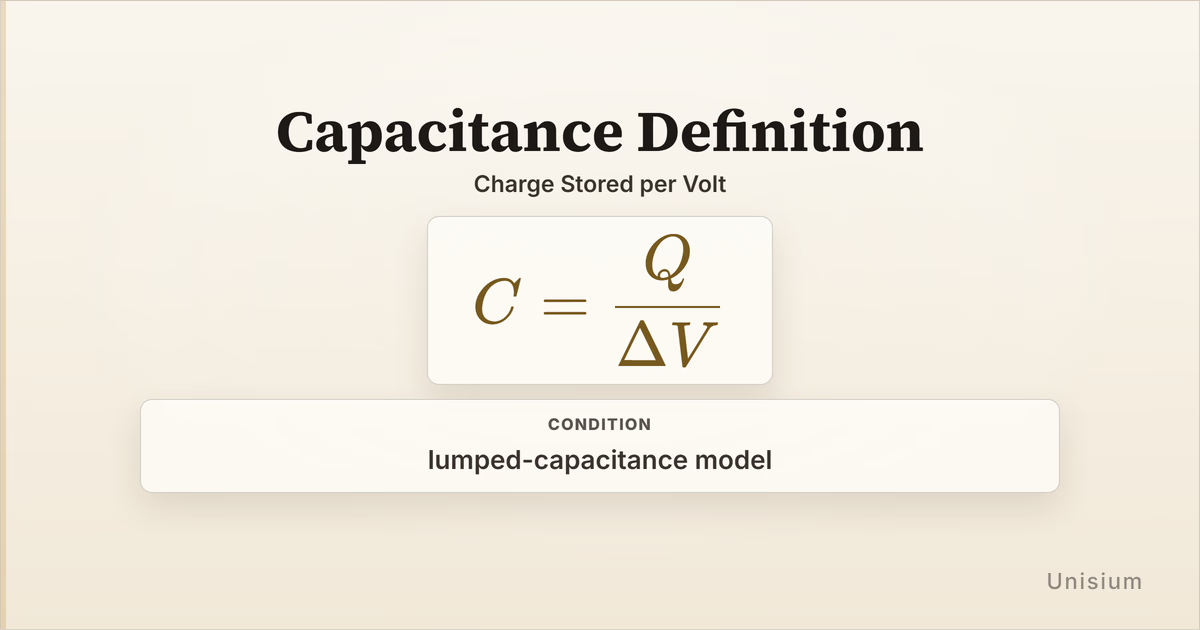
Capacitance Definition says capacitance is charge magnitude on one conductor divided by the potential difference across a capacitor. The model is , and it applies in the lumped-capacitance model. Use it when a device can be treated as one capacitor: is not the net charge of both plates added together.
This guide begins the device-and-network part of the electromagnetism map. The surrounding setup decisions are identifying the two terminals, choosing the sign convention for charge, and distinguishing potential difference from absolute potential. Those are setup decisions around the principle, not new principles.
On this page: The Principle | Conditions | Misconceptions | Elaborative Encoding | Retrieval Practice | Worked Example | Solve a Problem | Related Principles | FAQ | Related Guides | How This Fits
The Principle
Statement
Capacitance Definition assigns a device property to a capacitor by comparing how much charge magnitude is stored on one conductor with the potential difference across the two terminals. A larger capacitance means the capacitor stores more charge for the same potential difference. The definition is not a geometry formula; it is the relationship that makes later geometry and circuit formulas meaningful.
Mathematical Form
Where:
- is capacitance in farads, with
- is the magnitude of charge stored on one conductor in coulombs
- is the potential difference across the capacitor in volts
The diagram shows the bookkeeping choice that often gets hidden. A capacitor can have on one plate and on the other, while the capacitance relation uses the magnitude on one conductor and the voltage difference across the terminals.
Equivalent ways to read the definition
The same relation can be rearranged for different targets:
- Stored charge:
- Potential difference:
These are not separate principles. They are algebraic forms of the same charge-per-voltage definition.
Conditions of Applicability
Condition: lumped-capacitance model
Practical modeling notes
- Lumped capacitance means the device is treated as one capacitor with two terminals and one potential difference across it.
- Use as the magnitude on either conductor. Do not add and together and call the result zero stored charge.
- The definition does not tell you the capacitance from plate area, spacing, or material. That is handled by the later geometry model shown in the Electromagnetism Principle Map.
- The definition can be used for measured capacitor behavior even when the internal field geometry is not being modeled.
When it does not apply directly
- Distributed systems: if charge and voltage vary along an object, a single lumped may not represent the system.
- Unidentified terminals: if the two conductors or terminal voltage are not defined, is ambiguous.
- Nonlinear capacitors: if the charge-voltage relationship is not proportional over the range of interest, gives a ratio over that range; a small-signal or local model may need differential capacitance instead.
Want the complete framework behind this guide? Read Masterful Learning.
Common Misconceptions
Misconception 1: Q is the net charge of the whole capacitor
The truth: In the usual capacitor model, is the magnitude on one conductor. The whole capacitor may be neutral because the plates carry and .
Why this matters: Adding both plates would erase the stored charge that the capacitance relation is meant to describe.
Misconception 2: Capacitance is the same as stored charge
The truth: Capacitance is charge per potential difference. A capacitor with larger stores more charge at the same , but is not the charge itself.
Why this matters: Changing voltage changes for a fixed capacitor, while changing the capacitor changes .
Misconception 3: Any voltage value can be used
The truth: The voltage in the definition is the potential difference across the capacitor’s terminals, not an absolute potential at one point.
Why this matters: Using an absolute potential instead of the terminal difference can give a capacitance value that depends on the arbitrary zero of potential.
Elaborative Encoding
Use these questions to build understanding before memorizing the formula. See Elaborative Encoding for the broader method.
Within the Principle
- Why does a farad have units of coulombs per volt?
- If stays fixed, what does a larger say about the stored charge magnitude?
For the Principle
- What wording in a problem tells you the capacitor can be treated as one lumped device?
- Before using , how do you decide which two points define ?
Between Principles
- How is this definition different from Electric Potential Energy From Potential, where voltage changes energy for a charge instead of defining a device property?
Generate an Example
- Describe a simple two-terminal capacitor situation where doubling would double if stays constant.
Retrieval Practice
Answer from memory, then reveal the result and check it. See Retrieval Practice for the full study method.
State the principle in words: _____Capacitance is stored charge magnitude on one conductor divided by the potential difference across the capacitor.
Write the canonical equation: _____
State the canonical condition: _____lumped-capacitance model
Worked Example
Use this worked example to practice Self-Explanation.
Problem
A capacitor is charged so the magnitude of charge on one plate is . The potential difference across its terminals is . Treat the capacitor as a lumped device. Find its capacitance.
Step 1: Verbal Decoding
Target:
Given:
Constraints: lumped capacitor; charge is the magnitude on one plate; terminal potential difference is defined
Step 2: Visual Decoding
Draw two parallel conductors with on one side and on the other, then mark across the terminals. (The key visual fact is that belongs to one plate’s charge magnitude.)
Step 3: Physics Modeling
Step 4: Mathematical Procedures
Step 5: Reflection
- Dimensional analysis: Coulombs divided by volts gives farads.
- Magnitude: A few microfarads is plausible for a capacitor storing tens of microcoulombs at classroom-scale voltage.
- Interpretation: The capacitor stores about of charge per volt of potential difference.
Before moving on: self-explain the model
Try explaining why Step 3 uses the charge magnitude on one plate, why the voltage must be a difference across the terminals, and why no plate-area formula is needed.
Physics model with explanation
Principle: We use Capacitance Definition because the problem asks for the device’s capacitance from measured charge and voltage.
Conditions: The problem states a lumped capacitor and a defined terminal potential difference, so the canonical condition is satisfied.
Relevance: The target is , and the given quantities are exactly the variables in .
Description: The charge value is the magnitude stored on one plate; the opposite plate carries the opposite charge.
Goal: Divide stored charge magnitude by terminal voltage to find charge stored per volt.
Solve a Problem
Apply what you have learned with Problem Solving.
Problem
A lumped capacitor has capacitance . A potential difference of is applied across its terminals. Find the magnitude of charge stored on one conductor.
Hint: Rearrange the definition before substituting numbers.
Show Solution
Step 1: Verbal Decoding
Target:
Given:
Constraints: lumped capacitor; terminal potential difference is defined; target charge is the magnitude on one conductor
Step 2: Visual Decoding
Draw two conductors as capacitor plates, label the terminal voltage , and mark the unknown charge magnitudes as and . (The key visual fact is that the requested is one conductor’s magnitude.)
Step 3: Physics Modeling
Step 4: Mathematical Procedures
Step 5: Reflection
- Dimensional analysis: Farads times volts gives coulombs because .
- Interpretation: One conductor has charge magnitude and the other has the opposite charge.
- Parameter dependence: Increasing the voltage would increase the stored charge for the same capacitance.
Related Principles
See Electromagnetism: The Principle Map for where capacitance starts the device-and-network branch.
| Principle | Relationship to Capacitance Definition |
|---|---|
| Parallel-Plate Capacitance | geometry model that predicts from plate area, separation, and medium. |
| Capacitor Energy | Uses capacitance and voltage to compute energy stored in the electric field. |
| Electric Potential Energy From Potential | Uses with a charge to find energy change, while this guide defines a capacitor property. |
See Principle Structures for a broader view of how definitions, models, and derived relations connect.
FAQ
What is Capacitance Definition?
Capacitance Definition is the relation . It says capacitance is the stored charge magnitude on one conductor divided by the potential difference across the capacitor.
When does C equals Q over Delta V apply?
It applies in the lumped-capacitance model. That means the capacitor is treated as one two-terminal device with a single potential difference across it.
What does Q mean in the capacitance formula?
is the magnitude of charge on one conductor. For an ordinary two-plate capacitor, one plate has and the other has .
Is capacitance determined by charge and voltage?
The definition measures capacitance as a charge-to-voltage ratio. For a fixed ideal capacitor, is a device property, while changes when changes.
How is capacitance different from parallel-plate capacitance?
Capacitance Definition tells what means. Parallel-plate capacitance is a later geometry model that predicts from plate area, plate separation, and material conditions.
Related Guides
- Electromagnetism Principle Map - Place capacitance inside the full EM sequence.
- Electric Potential Energy From Potential - Review how voltage affects energy for a charge.
- Uniform-Field Potential Difference - Compare potential difference across a field region with voltage across a device.
- Problem Solving - Use the five-step routine on new physics problems.
How This Fits in Unisium
Unisium treats capacitance as a principle because the formula is short but the bookkeeping is easy to lose: is one conductor’s charge magnitude, and is across the terminals. The useful learning path is to encode that distinction, retrieve with its condition, self-explain example setups, and solve new problems where the target variable changes.
Ready to master Capacitance Definition? Check access and join the Unisium waitlist or explore the full framework in Masterful Learning.

Masterful Learning
The book behind these guides: a study system for physics, math, & programming built on retrieval, connection, explanation, and problem solving.
Ready to apply this strategy?
Unisium turns these evidence-based techniques into guided study sessions for math and physics. Places are limited during early access. Check current availability to start a trial; joining the mailing list is optional.
See plans and availability Read More GuidesAlready have access? Sign in