Magnetic Field in a Long Solenoid: Interior Field Formula
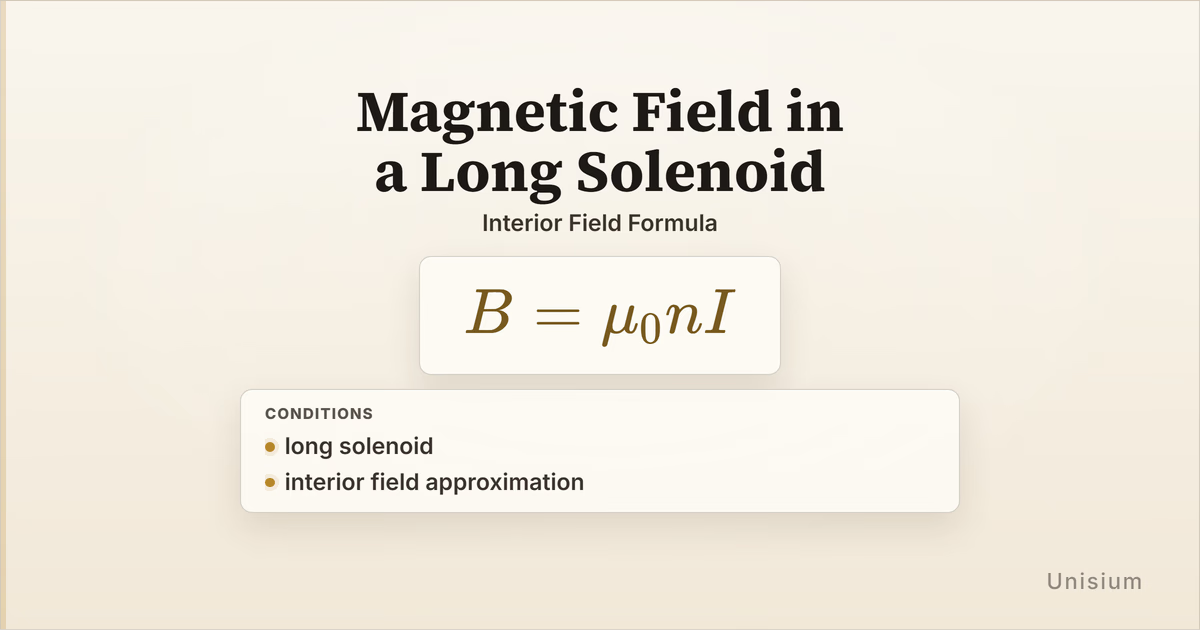
Magnetic Field In A Long Solenoid gives the approximate interior magnetic-field magnitude for a long coil. It applies for a long solenoid when the interior field approximation is justified. Use it when a many-turn coil is long enough that the field well inside the coil is treated as nearly uniform, and remember that means turns per length, not total turns.
This guide follows Magnetic Field Near A Long Straight Wire in the Electromagnetism Principle Map. The surrounding decisions are recognizing a long-coil model, deciding whether the field point is interior and away from the ends, converting total turns into turn density, and using right-hand-rule direction as setup. Those choices support the principle; they are not separate principle keys.
On this page: The Principle | Conditions | Misconceptions | Elaborative Encoding | Retrieval Practice | Worked Example | Solve a Problem | Related Principles | FAQ | Related Guides | How This Fits
The Principle
Statement
Magnetic Field In A Long Solenoid gives the approximate magnetic-field magnitude inside a long current-carrying coil. The field inside the central region is treated as nearly uniform and proportional to both the current and the turn density .
Mathematical Form
Where:
- is the interior magnetic-field magnitude, in tesla
- is the permeability of free space, in
- is the number of turns per unit length, in
- is the current through the solenoid, in amperes
The diagram is a guide-level orientation scaffold. It shows a long coil, an interior field along the coil axis, and the turn-density idea . The full principle equation stays in the mathematical form above; the diagram’s job is to keep the geometry and the meaning of visible.
Turn-density form
If a problem gives total turns over solenoid length , first convert to turn density:
Then the same principle becomes:
This is not a different principle. It is the same solenoid field relation after replacing with the information a problem happened to give.
Conditions of Applicability
Condition: long solenoid; interior field approximation
Practical modeling notes
- Long solenoid means the coil length is large compared with its radius, so end effects are small in the region being modeled.
- Interior field approximation means the field point is well inside the solenoid, not near an end or outside the coil.
- The form is the standard free-space or air-core approximation. A magnetic material core changes the effective permeability, so that situation needs a modified model.
- The formula gives field magnitude. Direction still comes from the winding direction and the right-hand rule.
- If the problem gives and , compute before using the principle.
When it does not apply directly
- Near the ends: the field is no longer close to the ideal interior value.
- Outside the solenoid: the simple interior approximation is not the right field model.
- Magnetic material core: the field can be stronger than the model predicts because the medium changes the effective permeability.
- Short or sparse coil: the long-solenoid approximation may be too crude, so a more detailed source-geometry model is needed.
Want the complete framework behind this guide? Read Masterful Learning.
Common Misconceptions
Misconception 1: More total turns always means a stronger field
The truth: The formula uses , turns per length. A coil with more total turns spread over proportionally more length can have the same .
Why this matters: Using instead of gives the wrong units and usually the wrong field size.
Misconception 2: The formula gives the field everywhere around the solenoid
The truth: This guide’s principle is the interior field approximation for a long solenoid.
Why this matters: End regions and exterior regions require different modeling.
Misconception 3: The current direction is irrelevant
The truth: Current direction does not change the magnitude formula, but it does set the direction of the interior field.
Elaborative Encoding
Use these questions to build understanding before memorizing the formula. See Elaborative Encoding for the broader method.
Within the Principle
- Why does increasing current increase the interior field magnitude?
- What does count, and why are its units ?
For the Principle
- What wording in a problem tells you that the long-solenoid approximation is being used?
- How would you decide whether a field point is safely in the interior region?
Between Principles
- How is this solenoid field relation similar to Magnetic Field Near A Long Straight Wire, and how is its geometry different?
Generate an Example
- Describe two solenoids with the same current but different turn densities, and predict which one has the larger interior field.
Retrieval Practice
Answer from memory, then reveal the result and check it. See Retrieval Practice for the full study method.
State the principle in words: _____Inside a long solenoid, the approximate magnetic-field magnitude is proportional to the coil's turn density and current.
Write the canonical equation: _____
State the canonical condition: _____long solenoid; interior field approximation
Worked Example
Use this worked example to practice Self-Explanation.
Problem
A long solenoid has turn density and carries current . Find the approximate magnetic-field magnitude well inside the solenoid.
Step 1: Verbal Decoding
Target:
Given: ,
Constraints: long solenoid; field point is well inside the coil; interior field approximation
Step 2: Visual Decoding
Draw a long coil with a central axis, mark several evenly spaced turns, and draw parallel magnetic-field arrows inside the coil. Label the turn density and the current . (The key visual fact is that the modeled field is the nearly uniform interior field.)
Step 3: Physics Modeling
Step 4: Mathematical Procedures
Step 5: Reflection
- Dimensional analysis: times times amperes gives tesla.
- Interpretation: The value describes the central interior field, not the field outside the solenoid.
- Parameter dependence: Doubling the turn density or current would double the approximate interior field.
Before moving on: self-explain the model
Try explaining why Step 3 uses the solenoid relation, why is already a density, and why the long-interior condition is doing physical work in the model.
Physics model with explanation
Principle: We use Magnetic Field In A Long Solenoid because the problem asks for the magnetic field inside a long current-carrying coil.
Conditions: The solenoid is described as long, and the field point is well inside the coil, so the interior field approximation is the intended model.
Relevance: The target is the interior field magnitude, and the problem directly gives the two quantities in the canonical equation.
Description: A long solenoid can be treated as producing a nearly uniform magnetic field through its interior central region.
Goal: Substitute the turn density and current into the solenoid field relation to find .
Solve a Problem
Apply what you have learned with Problem Solving.
Problem
A long solenoid has turns over a length . It carries current . Find the approximate magnetic-field magnitude well inside the solenoid.
Hint: Convert total turns and length into turn density before using the solenoid field relation.
Show Solution
Step 1: Verbal Decoding
Target:
Given: , ,
Constraints: long solenoid; field point is well inside the coil; interior field approximation; turn density must be computed from total turns and length
Step 2: Visual Decoding
Draw a long coil of length , mark that turns are spread across that length, and draw parallel magnetic-field arrows inside the coil. (The key visual fact is that turn density is turns divided by coil length.)
Step 3: Physics Modeling
Step 4: Mathematical Procedures
Step 5: Reflection
- Dimensional analysis: has units of inverse meters, so the final units reduce to tesla.
- Interpretation: The answer is an interior approximation, so it should not be used for points outside the coil.
- Verification: The computed turn density is , which is larger than the worked example’s turn density, so a similar millitesla result is plausible with the smaller current.
Related Principles
See Electromagnetism: The Principle Map for where this coil-source relation sits in the magnetic branch.
| Principle | Relationship to Magnetic Field In A Long Solenoid |
|---|---|
| Magnetic Field Near A Long Straight Wire | Another steady-current source relation, but for a point outside a straight wire instead of the interior of a coil. |
| Magnetic Force On A Wire | Uses magnetic field as an input to find force on a current-carrying wire segment. |
| Lorentz Force | Uses magnetic field as part of the total force on a moving charge. |
See Principle Structures for a broader view of how source relations and force relations connect across a subdomain.
FAQ
What is the magnetic field inside a long solenoid?
The approximate interior magnetic-field magnitude is . It is proportional to the turn density and the current.
When does the long-solenoid field formula apply?
It applies under the canonical condition: long solenoid; interior field approximation. The field point should be well inside the solenoid and away from the ends.
What does n mean in the solenoid formula?
is the number of turns per unit length. If a problem gives total turns and length , use .
Does the formula give the direction of the magnetic field?
The formula gives magnitude. Direction comes from the winding direction and the right-hand rule, usually along the solenoid axis in the ideal interior model.
Does the formula change if the solenoid has an iron core?
Yes. The form is the free-space or air-core approximation. A magnetic core changes the effective permeability, so an introductory problem must either specify the modified model or give enough information to account for the material.
Why is the field inside a long solenoid treated as uniform?
In the ideal long-solenoid model, the central interior contributions from many turns combine into a nearly constant axial field, while end effects are ignored.
Related Guides
- Electromagnetism: The Principle Map - Place this solenoid model in the broader EM structure.
- Magnetic Field Near A Long Straight Wire - Compare two current-source magnetic-field relations.
- Magnetic Force On A Wire - Use a magnetic field to find a force on a current-carrying segment.
- Problem Solving - Practice translating givens, assumptions, and diagrams into equations.
How This Fits in Unisium
Unisium treats Magnetic Field In A Long Solenoid as a principle because the formula is compact but the modeling boundary matters. The useful learning path is to encode what means, retrieve the equation with the exact condition, self-explain why the field is an interior approximation, and solve new problems where the turn information is given in different forms.
Ready to master Magnetic Field In A Long Solenoid? Check access and join the Unisium waitlist or explore the full framework in Masterful Learning.

Masterful Learning
The book behind these guides: a study system for physics, math, & programming built on retrieval, connection, explanation, and problem solving.
Ready to apply this strategy?
Unisium turns these evidence-based techniques into guided study sessions for math and physics. Places are limited during early access. Check current availability to start a trial; joining the mailing list is optional.
See plans and availability Read More GuidesAlready have access? Sign in