Lorentz Force: Add Electric and Magnetic Force
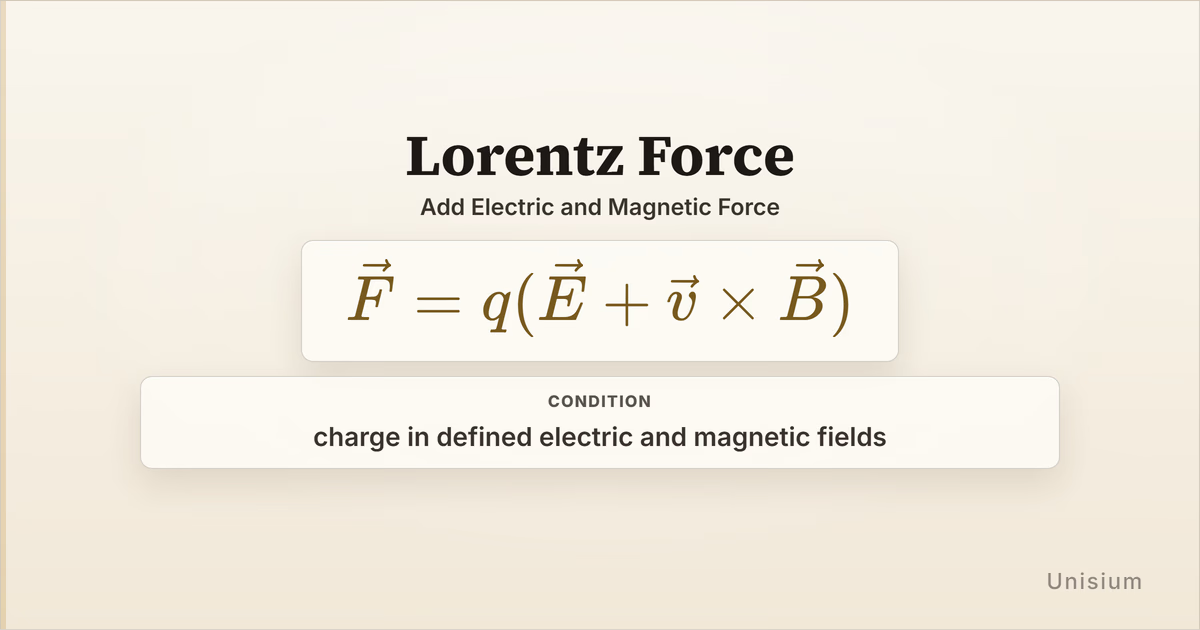
Lorentz Force gives the total electromagnetic force on a charge by adding the electric field term and the velocity cross magnetic field term. It applies to a charge in defined electric and magnetic fields. Use it when electric and magnetic effects act together; the electric part follows the field, while the magnetic part depends on velocity, field direction, and charge sign.
This guide follows Magnetic Force On A Moving Charge in the Electromagnetism Principle Map. The surrounding decisions are field-direction convention, right-hand-rule orientation, charge-sign interpretation, and vector-component setup. Those choices are setup around the principle, not new principle keys.
On this page: The Principle | Conditions | Misconceptions | Elaborative Encoding | Retrieval Practice | Worked Example | Solve a Problem | Related Principles | FAQ | Related Guides | How This Fits
The Principle
Statement
Lorentz Force gives the total electromagnetic force on a charge when both electric and magnetic fields are defined at the charge’s location. The electric contribution is , and the magnetic contribution is , so the total force is their vector sum.
Mathematical Form
Where:
- is the total electromagnetic force on the charge, in newtons
- is the signed charge, in coulombs
- is the electric field at the charge’s location, in newtons per coulomb
- is the charge velocity, in meters per second
- is the magnetic field at the charge’s location, in tesla
The diagram is a guide-level orientation scaffold. It shows one standard case where points upward, points right, and points into the page. In the force construction, and both point upward for a positive charge, so points upward.
Useful split form
For reasoning, it often helps to split the relation into two contributions:
Then add . This is not a different principle; it is the same Lorentz force relation written to keep the two sources of force visible.
Conditions of Applicability
Condition: charge in defined electric and magnetic fields
Practical modeling notes
- Defined fields means and are known or modeled at the charge’s location.
- The charge can be positive or negative; the sign of affects the direction of the total force.
- If , Lorentz force reduces to the Electric Field-Force Relation. If , it reduces to the magnetic force relation.
- The magnetic contribution depends on the velocity relative to the field description used in the problem.
When it does not apply directly
- Fields not specified at the charge: first model or calculate the fields before using the force relation.
- Extended bodies or continuous charge distributions: use the relation on charge elements or choose a more suitable field-force model.
- Relativistic or radiation-heavy settings: introductory Lorentz-force problem solving may need extra modeling beyond this guide’s scope.
Want the complete framework behind this guide? Read Masterful Learning.
Common Misconceptions
Misconception 1: Electric and magnetic force are separate answers
The truth: Lorentz force asks for the vector sum of both contributions when both fields act on the charge.
Why this matters: Reporting only or only misses part of the total force.
Misconception 2: The magnetic term is present only because a magnetic field exists
The truth: The magnetic term also depends on velocity. If the charge is at rest in the chosen field description, .
Why this matters: A stationary charge in electric and magnetic fields can still feel the electric part, but not the magnetic part.
Misconception 3: Positive and negative charges use different formulas
The truth: The formula is the same. The signed charge handles direction reversal.
Elaborative Encoding
Use these questions to build understanding before memorizing the formula. See Elaborative Encoding for the broader method.
Within the Principle
- Why does the magnetic part use a cross product while the electric part does not?
- What does the signed charge do after the electric and magnetic field contributions have been combined?
For the Principle
- What information must be known before the phrase “defined electric and magnetic fields” is satisfied?
- What orientation convention must be clear before deciding the direction of ?
Between Principles
- How does Lorentz Force combine Electric Field-Force Relation with Magnetic Force On A Moving Charge?
Generate an Example
- Describe a situation where the electric and magnetic contributions point in the same direction, then change one vector so they partly cancel.
Retrieval Practice
Answer from memory, then reveal the result and check it. See Retrieval Practice for the full study method.
State the principle in words: _____Lorentz Force gives the total electromagnetic force on a charge by adding the electric force contribution and the magnetic velocity-cross-field contribution.
Write the canonical equation: _____
State the canonical condition: _____charge in defined electric and magnetic fields
Worked Example
Use this worked example to practice Self-Explanation.
Problem
A small bead has charge . At the bead’s location, . The bead moves with through a magnetic field , where . Find the total electromagnetic force on the bead.
Step 1: Verbal Decoding
Target:
Given: , , ,
Constraints: charge is in defined electric and magnetic fields; velocity is perpendicular to magnetic field; charge is positive
Step 2: Visual Decoding
Draw to the right, upward, and out of the page. Draw upward, to the right, and into the page. (The key visual fact is that both and point .)
Step 3: Physics Modeling
Step 4: Mathematical Procedures
Step 5: Reflection
- Dimensional analysis: Electric field and speed times magnetic field both have force-per-charge units.
- Interpretation: The electric and magnetic contributions reinforce each other in this setup.
- Limiting case: If the bead were stationary, the magnetic contribution would disappear.
Before moving on: self-explain the model
Try explaining why Step 3 uses the combined relation, why points upward here, and why the positive charge preserves that direction.
Physics model with explanation
Principle: We use Lorentz Force because the problem asks for the total electromagnetic force on one charge in defined electric and magnetic fields.
Conditions: The charge, electric field, magnetic field, and velocity are all specified at the bead’s location.
Relevance: Neither the electric-force relation nor the magnetic-force relation alone gives the full answer because both fields contribute.
Description: The electric field points upward. The cross product of velocity to the right with magnetic field into the page also points upward, so the vector sum is upward.
Goal: Combine the two force-per-charge contributions first, then multiply by the signed charge.
Solve a Problem
Apply what you have learned with Problem Solving.
Problem
A charged bead has . At the bead’s location, . The bead moves with through a magnetic field , where . Find the total electromagnetic force on the bead.
Hint: Check whether the electric and magnetic contributions point in the same direction or opposite directions.
Show Solution
Step 1: Verbal Decoding
Target:
Given: , , ,
Constraints: charge is in defined electric and magnetic fields; velocity is perpendicular to magnetic field; charge is positive
Step 2: Visual Decoding
Draw to the right, upward, and out of the page. Draw upward, to the right, and out of the page. (The electric contribution points and the magnetic contribution points .)
Step 3: Physics Modeling
Step 4: Mathematical Procedures
Step 5: Reflection
- Dimensional analysis: The quantity inside parentheses has newtons per coulomb, so multiplying by charge gives newtons.
- Interpretation: The magnetic contribution partially cancels the electric contribution in this setup.
- Verification: The positive result means the electric contribution is larger, so the total force points .
Related Principles
See Electromagnetism: The Principle Map for where this combined force relation sits in the subdomain.
| Principle | Relationship to Lorentz Force |
|---|---|
| Electric Field-Force Relation | Gives the electric contribution that appears inside Lorentz force. |
| Magnetic Force On A Moving Charge | Gives the magnetic contribution that appears inside Lorentz force. |
| Magnetic Force On A Wire | current-carrying-wire analog that comes after charge-based force relations. |
See Principle Structures for a broader view of how combined relations organize problem solving.
FAQ
What is Lorentz force?
Lorentz force is the total electromagnetic force on a charge in defined electric and magnetic fields. In this guide’s canonical form, .
When does Lorentz force apply?
It applies under the canonical condition: charge in defined electric and magnetic fields. The fields must be known or modeled at the charge’s location.
What is the difference between Lorentz force and electric force?
Electric force uses only . Lorentz force includes both the electric contribution and the magnetic contribution from .
Does a stationary charge feel Lorentz force?
A stationary charge can still feel the electric part . The magnetic part is zero when .
How does charge sign affect Lorentz force?
The vector inside the parentheses gives the force-per-charge direction. A negative charge reverses that direction because the whole vector is multiplied by signed .
Related Guides
- Magnetic Force On A Moving Charge - Review the magnetic cross-product term before combining fields.
- Electric Field-Force Relation - Review the electric force term in the combined relation.
- Electric Field Superposition - Practice vector addition before adding force contributions.
- Problem Solving - Practice translating field and direction information into equations.
How This Fits in Unisium
Unisium treats Lorentz Force as a principle because the equation is short but the setup decisions are easy to blur: field values, velocity direction, cross-product orientation, and charge sign all have to line up. The useful learning path is to encode the two contribution types, retrieve the canonical condition and equation, self-explain the vector model, and solve new problems where electric and magnetic parts reinforce or cancel.
Ready to master Lorentz Force? Check access and join the Unisium waitlist or explore the full framework in Masterful Learning.

Masterful Learning
The book behind these guides: a study system for physics, math, & programming built on retrieval, connection, explanation, and problem solving.
Ready to apply this strategy?
Unisium turns these evidence-based techniques into guided study sessions for math and physics. Places are limited during early access. Check current availability to start a trial; joining the mailing list is optional.
See plans and availability Read More GuidesAlready have access? Sign in