Magnetic Field Near A Long Straight Wire: Formula and Direction
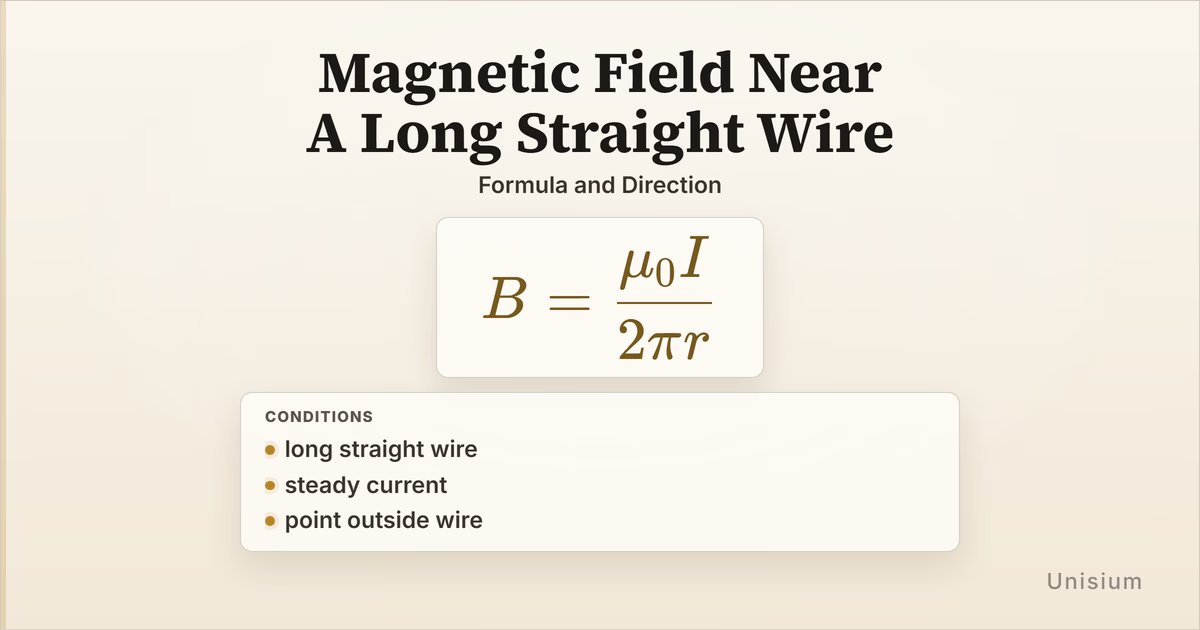
Magnetic Field Near A Long Straight Wire gives the magnetic-field magnitude around a long straight wire carrying steady current. It applies at a point outside the wire. Use it when the wire can be treated as effectively long and straight; the field circles the wire, so is radial distance while is tangent to that circle.
This guide sits in the magnetic-field branch of the Electromagnetism Principle Map. It connects naturally to Magnetic Force On A Wire, where a magnetic field is used to find the force on a current-carrying wire segment. The surrounding decisions are right-hand-rule orientation, choosing the radial distance from the wire axis, deciding whether the wire is long enough for the approximation, and keeping tangent field direction separate from radial distance. Those choices are setup around the principle, not separate principle keys.
On this page: The Principle | Conditions | Misconceptions | Elaborative Encoding | Retrieval Practice | Worked Example | Solve a Problem | Related Principles | FAQ | Related Guides | How This Fits
The Principle
Statement
Magnetic Field Near A Long Straight Wire gives the magnetic-field magnitude at distance from a long straight wire carrying steady current . The field strength falls as , and the direction is circular around the wire by the right-hand rule.
Mathematical Form
Where:
- is the magnetic-field magnitude at the field point, in tesla
- is the permeability of free space, in
- is the steady current in the wire, in amperes
- is the perpendicular distance from the wire axis to the field point, in meters
The diagram is a guide-level orientation scaffold. It shows a wire carrying current out of the page, circular magnetic-field lines around the wire, and a field point at distance . At that point, is tangent to the circle, not along the radial distance line.
Direction rule
The formula gives only the magnitude. To decide direction, point your right thumb with the conventional current; your curled fingers show the direction of the circular magnetic field around the wire. Reversing the current reverses the field direction.
Conditions of Applicability
Condition: long straight wire; steady current; point outside wire
Practical modeling notes
- Long straight wire means the field point is far from wire ends compared with its distance from the wire.
- Steady current means the current is not changing in time for the situation being modeled.
- Point outside wire means is measured from the wire axis to a location in the surrounding space, not inside the wire material.
- The relation gives field magnitude. Direction still comes from the right-hand rule.
When it does not apply directly
- Near wire ends: the long-wire approximation breaks down, so the field is not given by this simple expression.
- Inside a thick wire: the field may depend on how current is distributed through the wire cross-section.
- Curved or finite current path: use a more general source-geometry relation, such as a Biot-Savart setup, when the long-straight approximation is not honest.
Want the complete framework behind this guide? Read Masterful Learning.
Common Misconceptions
Misconception 1: The magnetic field points away from the wire
The truth: The distance is radial, but the magnetic field direction is tangent to a circle centered on the wire.
Why this matters: Treating as radial makes later magnetic-force directions wrong.
Misconception 2: Twice the distance means twice the field
The truth: The field is inversely proportional to distance: doubling halves .
Why this matters: The equation is easy to memorize but easy to read backward under pressure.
Misconception 3: The formula works for any wire shape
The truth: This compact form depends on the long straight wire model.
Why this matters: Loops, bends, and finite wires need source-geometry reasoning instead of this one-line relation.
Elaborative Encoding
Use these questions to build understanding before memorizing the formula. See Elaborative Encoding for the broader method.
Within the Principle
- Why does increasing current increase , while increasing distance decreases ?
- What does represent in the relationship between current and magnetic field?
For the Principle
- What wording in a problem tells you that the wire can be treated as long and straight?
- How do you know whether a distance label is the perpendicular distance from the wire axis?
Between Principles
- How can this field relation feed into Magnetic Force On A Wire or Lorentz Force?
Generate an Example
- Describe a setup where two points are at different distances from the same long current-carrying wire and compare their field magnitudes.
Retrieval Practice
Answer from memory, then reveal the result and check it. See Retrieval Practice for the full study method.
State the principle in words: _____A long straight wire carrying steady current creates a circular magnetic field whose magnitude is proportional to current and inversely proportional to distance from the wire.
Write the canonical equation: _____
State the canonical condition: _____long straight wire; steady current; point outside wire
Worked Example
Use this worked example to practice Self-Explanation.
Problem
A long straight wire carries a steady current out of the page. Point is from the wire axis. Find the magnetic-field magnitude at , and state the field direction at a point to the right of the wire.
Step 1: Verbal Decoding
Target: , direction
Given: ,
Constraints: long straight wire; steady current; point outside wire; field point is to the right of a current out of the page
Step 2: Visual Decoding
Draw the wire as a dot-in-circle for current out of the page, mark point to the right, and draw the perpendicular distance from the wire axis to . Sketch counterclockwise field circles around the wire. (The key visual fact is that the field at the right-side point is upward.)
Step 3: Physics Modeling
Step 4: Mathematical Procedures
- Direction at : is upward.
Step 5: Reflection
- Dimensional analysis: times amperes divided by meters gives tesla.
- Interpretation: The field is tangent to the circular field line, so the right-side direction is upward for current out of the page.
- Parameter dependence: Doubling the current would double , while doubling the distance would halve .
Before moving on: self-explain the model
Try explaining why Step 3 uses the long-wire field relation, why is distance from the wire rather than the field direction, and why the right-hand rule is still needed after the magnitude is calculated.
Physics model with explanation
Principle: We use Magnetic Field Near A Long Straight Wire because the problem asks for the field from one long straight current-carrying wire at a point outside the wire.
Conditions: The wire is treated as long and straight, the current is steady, and the point is outside the wire at a known distance.
Relevance: The target includes field magnitude, so the canonical magnitude relation is the direct model.
Description: Current out of the page makes counterclockwise magnetic-field circles. At a point to the right of the wire, the tangent direction is upward.
Goal: Compute the magnitude from current and distance, then attach the right-hand-rule direction.
Solve a Problem
Apply what you have learned with Problem Solving.
Problem
A long straight wire carries a steady current into the page. Point is from the wire axis and lies to the right of the wire. Find the magnetic-field magnitude at , and state the field direction there.
Hint: Current into the page reverses the field circulation compared with the worked example.
Show Solution
Step 1: Verbal Decoding
Target: , direction
Given: ,
Constraints: long straight wire; steady current; point outside wire; field point is to the right of a current into the page
Step 2: Visual Decoding
Draw the wire as an x-in-circle for current into the page, mark point to the right, and draw the perpendicular distance from the wire axis to . Sketch clockwise field circles around the wire. (The key visual fact is that the field at the right-side point is downward.)
Step 3: Physics Modeling
Step 4: Mathematical Procedures
- Direction at : is downward.
Step 5: Reflection
- Dimensional analysis: The units reduce to tesla.
- Interpretation: Reversing current direction reverses the circular field direction.
- Verification: The magnitude matches the worked example because the ratio is the same.
Related Principles
See Electromagnetism: The Principle Map for where this current-source relation sits in the magnetic branch.
| Principle | Relationship to Magnetic Field Near A Long Straight Wire |
|---|---|
| Magnetic Force On A Wire | Uses magnetic field to find force on a current-carrying wire segment. |
| Lorentz Force | Uses magnetic field as part of the total force on a moving charge. |
| Magnetic Field In A Long Solenoid | Another steady-current field model, but for the interior of a long coil instead of outside a straight wire. |
See Principle Structures for a broader view of how source relations and force relations connect across a subdomain.
FAQ
What is the magnetic field near a long straight wire?
The magnetic-field magnitude near a long straight wire carrying steady current is . The field direction circles the wire.
When does the long straight wire magnetic field formula apply?
It applies under the canonical condition: long straight wire; steady current; point outside wire. If the point is near an end, inside a thick wire, or near a curved section, the compact relation may not apply directly.
Which direction is the magnetic field around a wire?
Use the right-hand rule: point your right thumb with conventional current, and your curled fingers show the magnetic-field direction around the wire.
What does r mean in the long wire magnetic field formula?
is the perpendicular distance from the wire axis to the field point. It is not the direction of the magnetic field.
Why does the field get weaker farther from the wire?
The formula has in the denominator, so the field magnitude follows an inverse-distance pattern. At twice the distance, the field magnitude is half as large for the same current.
Related Guides
- Electromagnetism: The Principle Map - Place this field-source relation in the wider EM structure.
- Magnetic Force On A Wire - Connect current-generated fields with current-carrying-wire forces.
- Lorentz Force - See how magnetic fields contribute to total force on charges.
- Problem Solving - Practice translating diagrams, distance labels, and right-hand-rule directions into equations.
How This Fits in Unisium
Unisium treats Magnetic Field Near A Long Straight Wire as a principle because the formula is short but the representation is easy to blur. The useful learning path is to encode what means, retrieve the magnitude relation with the exact condition, self-explain the circular field direction, and solve new problems where current direction and field-point location change.
Ready to master Magnetic Field Near A Long Straight Wire? Check access and join the Unisium waitlist or explore the full framework in Masterful Learning.

Masterful Learning
The book behind these guides: a study system for physics, math, & programming built on retrieval, connection, explanation, and problem solving.
Ready to apply this strategy?
Unisium turns these evidence-based techniques into guided study sessions for math and physics. Places are limited during early access. Check current availability to start a trial; joining the mailing list is optional.
See plans and availability Read More GuidesAlready have access? Sign in