Magnetic Dipole Energy: Alignment and Potential Energy
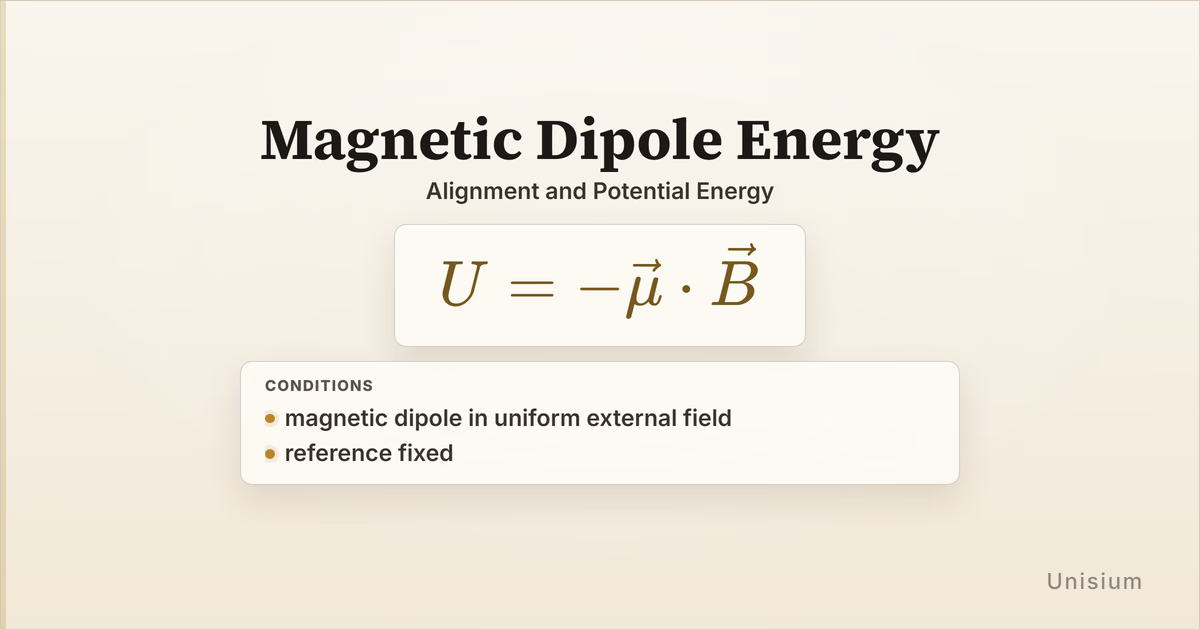
Magnetic Dipole Energy says a magnetic dipole in a uniform external field has potential energy . It applies when the field is uniform across the dipole and the reference is fixed. Use it to compare orientations: aligned dipoles have lower energy, while antiparallel dipoles have higher energy.
This guide follows Magnetic Dipole Moment Of A Current Loop and sits next to Torque On A Magnetic Dipole in the Electromagnetism Principle Map. The surrounding decisions are defining , choosing the angle between and , fixing the reference, and deciding whether the target is energy or torque. Those choices frame the relation; they are not new principles.
On this page: The Principle | Conditions | Misconceptions | Elaborative Encoding | Retrieval Practice | Worked Example | Solve a Problem | Related Principles | FAQ | Related Guides | How This Fits
The Principle
Statement
Magnetic Dipole Energy gives the potential energy of a magnetic dipole in a uniform external magnetic field. The dot product makes the energy depend on orientation: the part of that points along lowers the energy because of the negative sign.
Mathematical Form
Where:
- is the magnetic potential energy, in joules
- is the magnetic dipole moment, in ampere square meters,
- is the uniform external magnetic field, in tesla
The diagram shows the orientation logic behind the dot product. Only the projection of along contributes to ; as the torque turns the dipole toward the field, that positive projection grows and decreases for the fixed reference used by this principle.
Angle form
When the angle between the vectors is known, the same relation becomes:
This form is often the easiest way to compare orientations. Parallel vectors give , perpendicular vectors give relative to this fixed reference, and antiparallel vectors give .
Conditions of Applicability
Condition: magnetic dipole in uniform external field; reference fixed
Practical modeling notes
- Magnetic dipole means the object is represented by one magnetic dipole moment .
- Uniform external field means the same is used across the dipole, not a field that varies enough to introduce net-force effects.
- Reference fixed means the zero of potential energy has already been chosen, so comparisons between orientations are meaningful within the same convention.
- The energy relation is scalar. Use the torque relation when the target is rotational tendency or direction.
Limits of the simple energy form
- Nonuniform field: the dipole can experience both energy variation and net force, so may not describe the whole interaction by itself.
- No defined dipole moment: first use a definition such as Magnetic Dipole Moment Of A Current Loop when the problem starts from a loop or coil.
- Changing reference: do not compare absolute energy values across different reference conventions.
Want the complete framework behind this guide? Read Masterful Learning.
Common Misconceptions
Misconception 1: Zero torque means zero energy
The truth: A parallel or antiparallel dipole has zero torque, but the energies are different: for alignment and for anti-alignment.
Why this matters: Torque tells you the instantaneous rotational tendency; energy tells you which orientation is lower or higher relative to the fixed reference.
Misconception 2: The magnitude of alone determines the energy
The truth: The energy depends on the component of along , captured by .
Why this matters: A perpendicular dipole can have a large magnetic dipole moment but still have zero energy in this reference.
Misconception 3: The negative sign is optional
The truth: The negative sign encodes that alignment with the external field is lower energy.
Elaborative Encoding
Use these questions to build understanding before memorizing the formula. See Elaborative Encoding for the broader method.
Within the Principle
- What does the dot product measure about the orientation of relative to ?
- Why does the negative sign make aligned dipoles lower in energy?
For the Principle
- What wording in a problem tells you that the field can be treated as uniform across the dipole?
- Before comparing two energy values, what reference or convention has to stay fixed?
Between Principles
- How does this energy relation differ from Torque On A Magnetic Dipole even though both use and ?
Generate an Example
- Describe one dipole orientation with negative energy and one with positive energy under the same fixed reference.
Retrieval Practice
Answer from memory, then reveal the result and check it. See Retrieval Practice for the full study method.
State the principle in words: _____A magnetic dipole in a uniform external magnetic field has orientation-dependent potential energy.
Write the canonical equation: _____
State the canonical condition: _____magnetic dipole in uniform external field; reference fixed
Worked Example
Use this worked example to practice Self-Explanation.
Problem
A magnetic dipole has magnitude . It is placed in a uniform external magnetic field of magnitude . The angle between and is , and the usual fixed reference for is used. Find the magnetic potential energy.
Step 1: Verbal Decoding
Target:
Given: , ,
Constraints: magnetic dipole in uniform external field; reference fixed; angle between dipole moment and field is defined
Step 2: Visual Decoding
Draw to the right and making an obtuse angle with it. Mark between the vectors. (The key visual fact is that the projection of along is negative.)
Step 3: Physics Modeling
Step 4: Mathematical Procedures
Step 5: Reflection
- Dimensional analysis: Ampere square meters times tesla gives joules for magnetic dipole energy.
- Interpretation: The positive energy means the dipole is more opposed than aligned relative to the chosen reference.
- Limiting case: If the angle were , the same relation would give the lower value .
Before moving on: self-explain the model
Try explaining why Step 3 uses the angle form, why an obtuse angle makes the dot product negative, and why the final energy becomes positive.
Physics model with explanation
Principle: We use Magnetic Dipole Energy because the problem asks for scalar potential energy of a dipole in an external field.
Conditions: The field is uniform, the dipole moment is defined, the angle is specified, and the reference convention is fixed.
Relevance: The target is energy, not torque, so the dot-product energy relation is the direct model.
Description: The dipole moment points more against the field than with it, making negative. The leading negative sign then makes the potential energy positive.
Goal: Use the angle between the two vectors to evaluate the dot product and report the energy.
Solve a Problem
Apply what you have learned with Problem Solving.
Problem
A magnetic dipole has magnitude . It is placed in a uniform external magnetic field of magnitude . The angle between and is , with the same fixed reference. Find the magnetic potential energy.
Hint: A small acute angle means the dipole is mostly aligned with the field.
Show Solution
Step 1: Verbal Decoding
Target:
Given: , ,
Constraints: magnetic dipole in uniform external field; reference fixed; angle between dipole moment and field is defined
Step 2: Visual Decoding
Draw to the right and making a small acute angle with it. Mark between the vectors. (The key visual fact is that the projection of along is positive.)
Step 3: Physics Modeling
Step 4: Mathematical Procedures
Step 5: Reflection
- Dimensional analysis: The product has energy units.
- Interpretation: The negative value matches a mostly aligned, lower-energy orientation.
- Limiting case: Rotating the dipole to would raise the energy to zero in this reference.
Related Principles
See Electromagnetism: The Principle Map for where magnetic dipole energy sits in the magnetic potential, energy, and flux lane.
| Principle | Relationship to Magnetic Dipole Energy |
|---|---|
| Magnetic Dipole Moment Of A Current Loop | Defines before any external-field torque or energy relation is used. |
| Torque On A Magnetic Dipole | Uses the same vectors to model rotational tendency instead of scalar potential energy. |
| Magnetic Flux In A Uniform Field | Also uses a dot product with a field and an oriented vector, but for field-through-surface structure. |
See Principle Structures for a broader view of how definitions, torque laws, and energy relations connect.
FAQ
What is magnetic dipole energy?
Magnetic dipole energy is . It gives the orientation-dependent potential energy of a magnetic dipole in a uniform external magnetic field.
When does Magnetic Dipole Energy apply?
It applies under the canonical condition: magnetic dipole in uniform external field; reference fixed. The dipole moment, field, and reference convention must be clear before comparing energies.
Why is the energy lowest when the dipole aligns with the field?
When and align, their dot product is positive and as large as possible. The negative sign in turns that into the most negative energy.
What is the angle form of magnetic dipole energy?
The angle form is , where is the angle between and . It is the same dot-product relation written with magnitudes and angle.
Is magnetic dipole energy the same as torque?
No. Energy is the scalar relation , while torque is the vector relation . Energy compares orientations; torque gives rotational tendency.
Related Guides
- Electromagnetism: The Principle Map - Place magnetic dipole energy in the wider EM structure.
- Torque On A Magnetic Dipole - Compare the energy relation with the rotational-tendency relation.
- Magnetic Dipole Moment Of A Current Loop - Review how a current loop becomes one dipole moment vector.
- Problem Solving - Practice translating angles and conditions into equations and checks.
How This Fits in Unisium
Unisium treats Magnetic Dipole Energy as a principle because the equation is compact but the sign and orientation meaning are easy to blur. The useful learning path is to encode the dot-product projection, retrieve with its condition, self-explain why alignment lowers energy, and solve new problems where the angle is not already interpreted.
Ready to master Magnetic Dipole Energy? Check access and join the Unisium waitlist or explore the full framework in Masterful Learning.

Masterful Learning
The book behind these guides: a study system for physics, math, & programming built on retrieval, connection, explanation, and problem solving.
Ready to apply this strategy?
Unisium turns these evidence-based techniques into guided study sessions for math and physics. Places are limited during early access. Check current availability to start a trial; joining the mailing list is optional.
See plans and availability Read More GuidesAlready have access? Sign in