Torque On A Magnetic Dipole: Direction, Size, and Alignment
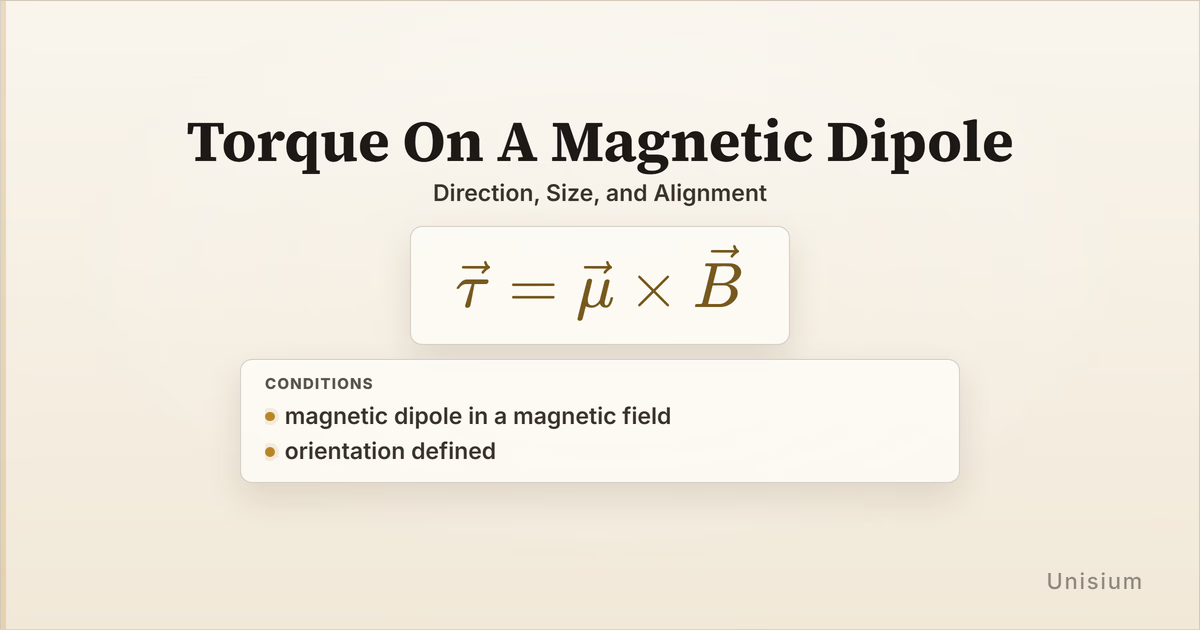
A magnetic dipole in an external magnetic field experiences torque . It applies when the dipole is in a magnetic field and its orientation is defined. Use it to determine the instantaneous rotational tendency and its direction; when nonzero, the torque is perpendicular to both and rather than along either vector.
This guide follows Magnetic Dipole Moment Of A Current Loop in the Electromagnetism Principle Map. The nearby choices are defining the dipole moment, choosing the angle between and , applying the right-hand rule, and deciding whether the problem asks for torque or potential energy. These are setup and interpretation choices, not separate physical laws.
On this page: The Principle | Conditions | Misconceptions | Elaborative Encoding | Retrieval Practice | Worked Example | Solve a Problem | Related Principles | FAQ | Related Guides | How This Fits
The Principle
Statement
Torque On A Magnetic Dipole gives the torque on a magnetic dipole placed in a magnetic field. The vector form says the torque is perpendicular to both the magnetic dipole moment and the magnetic field, with direction set by the cross product.
Mathematical Form
Where:
- is the torque on the magnetic dipole, in newton meters,
- is the magnetic dipole moment, in ampere square meters,
- is the external magnetic field evaluated at the dipole, in tesla
The diagram fixes one standard orientation: points right, is angled above it, and points into the page. The rotation cue shows the physical tendency: the torque tries to align with .
Magnitude form
When you only need the torque size, use:
Here is the angle between and . The torque is zero when the dipole moment is parallel or antiparallel to the field and largest when the two vectors are perpendicular. The scalar form gives size only; it does not decide the torque direction.
Conditions of Applicability
Condition: magnetic dipole in a magnetic field; orientation defined
Practical modeling notes
- Magnetic dipole means the object has a magnetic dipole moment , such as a current loop or a small magnet modeled by one dipole vector.
- Magnetic field means is specified at the dipole location or is treated as locally uniform enough for the torque model.
- Orientation defined means the angle and vector directions of and are clear before the cross product is interpreted.
- In a nonuniform field, torque may not be the whole interaction; the dipole can also experience a net force.
Limits of the simple torque form
- No defined dipole moment: use a current-loop or material model first to determine .
- Ambiguous orientation: define axes, page direction, and the angle between and before using the vector relation.
- Energy question instead of torque question: use the magnetic dipole energy relation when the target is potential energy rather than rotational tendency.
Want the complete framework behind this guide? Read Masterful Learning.
Common Misconceptions
Misconception 1: The torque points with the magnetic field
The truth: When and are not collinear, the nonzero torque is perpendicular to the plane containing them.
Why this matters: Drawing torque along hides the cross product and loses the rotation direction.
Misconception 2: Parallel and antiparallel orientations have the same stability
The truth: Both orientations have zero torque, but alignment is a stable equilibrium and anti-alignment is unstable. The potential energy is minimized when the vectors align and maximized when they are antiparallel.
Why this matters: Zero instantaneous torque does not by itself determine whether a small perturbation returns the dipole to equilibrium or moves it farther away.
Misconception 3: The magnitude formula gives direction
The truth: gives the size of the torque; the cross product or a right-hand-rule setup gives direction.
Elaborative Encoding
Use these questions to build understanding before memorizing the formula. See Elaborative Encoding for the broader method.
Within the Principle
- Why does the torque use a cross product instead of ordinary multiplication?
- What does say about the torque when is parallel, perpendicular, or antiparallel to ?
For the Principle
- What wording in a problem tells you that a magnetic dipole model is already available?
- Before deciding torque direction, what axis or page-direction convention must be clear?
Between Principles
- How does this torque relation build on Magnetic Dipole Moment Of A Current Loop?
Generate an Example
- Describe a dipole-and-field orientation where the torque is zero even though the magnetic field is not zero.
Retrieval Practice
Answer from memory, then reveal the result and check it. See Retrieval Practice for the full study method.
State the principle in words: _____A magnetic dipole in a magnetic field experiences torque equal to magnetic dipole moment cross magnetic field.
Write the canonical equation: _____
State the canonical condition: _____magnetic dipole in a magnetic field; orientation defined
Worked Example
Use this worked example to practice Self-Explanation.
Problem
A small magnetic dipole has magnitude . A uniform magnetic field of magnitude points in the direction. The dipole moment lies in the plane at angle above the direction. Find the torque vector on the dipole.
Step 1: Verbal Decoding
Target:
Given: , , , , ,
Constraints: magnetic dipole in a magnetic field; orientation defined; dipole moment and field lie in the page plane; points out of the page
Step 2: Visual Decoding
Draw to the right, upward, and out of the page. Draw along and above it by angle . (The key visual fact is that points in the direction.)
Step 3: Physics Modeling
Step 4: Mathematical Procedures
Step 5: Reflection
- Dimensional analysis: Ampere square meters times tesla gives newton meters.
- Interpretation: The negative direction means the torque points into the page for this orientation.
- Limiting case: If the dipole moment were already parallel to the field, the sine factor would make the torque zero.
Before moving on: self-explain the model
Try explaining why Step 3 keeps the vector form, why only the perpendicular component of contributes, and why the result points into the page.
Physics model with explanation
Principle: We use Torque On A Magnetic Dipole because the problem asks for the rotational tendency of a dipole in a magnetic field.
Conditions: The dipole is in a magnetic field, and the orientation between and is specified.
Relevance: The target is a torque vector, so the cross-product form is the direct model.
Description: The magnetic field points along , while the dipole moment has both and components. The component parallel to contributes no cross product; the component crossed with gives .
Goal: Combine the magnitude with the cross-product direction to get the torque vector.
Solve a Problem
Apply what you have learned with Problem Solving.
Problem
A magnetic dipole has magnitude . A uniform magnetic field of magnitude points in the direction. The dipole moment lies in the plane at angle below the direction. Find the torque vector on the dipole.
Hint: Compare the direction with the worked example; the dipole moment is below the field direction now.
Show Solution
Step 1: Verbal Decoding
Target:
Given: , , , , ,
Constraints: magnetic dipole in a magnetic field; orientation defined; dipole moment and field lie in the page plane; points out of the page
Step 2: Visual Decoding
Draw to the right, upward, and out of the page. Draw along and below it by angle . (The key visual fact is that points in the direction.)
Step 3: Physics Modeling
Step 4: Mathematical Procedures
Step 5: Reflection
- Dimensional analysis: The product has torque units.
- Interpretation: Moving the dipole moment below the field reverses the torque direction relative to the worked example.
- Verification: The torque is perpendicular to both vectors, not parallel to the field.
Related Principles
See Electromagnetism: The Principle Map for where magnetic-dipole torque sits in the magnetic field-and-force lane.
| Principle | Relationship to Torque On A Magnetic Dipole |
|---|---|
| Magnetic Dipole Moment Of A Current Loop | Defines for a planar current loop before torque or energy work. |
| Magnetic Force On A Wire | Uses a cross product with current direction and magnetic field; the orientation burden is similar. |
| Magnetic Dipole Energy | Uses and to model potential energy rather than torque. |
See Principle Structures for a broader view of how source definitions, force laws, torque laws, and energy relations connect.
FAQ
What is torque on a magnetic dipole?
Torque on a magnetic dipole is . It gives the rotational tendency of a magnetic dipole moment in a magnetic field.
When does Torque On A Magnetic Dipole apply?
It applies when a magnetic dipole is in a magnetic field and its orientation is defined. The direction of , the direction of , and the angle between them must be clear.
What is the magnitude of torque on a magnetic dipole?
The magnitude is , where is the angle between the magnetic dipole moment and the magnetic field. This scalar form gives size only.
Which way does the torque point?
The torque points in the direction of . Use the right-hand rule on the ordered pair then ; reversing the order would reverse the direction.
Why is the torque zero when the dipole is parallel to the field?
When and are parallel or antiparallel, the angle is or , so . There is no instantaneous rotational tendency from this torque relation.
Related Guides
- Electromagnetism: The Principle Map - Place magnetic-dipole torque in the wider EM structure.
- Magnetic Dipole Moment Of A Current Loop - Review how a current loop becomes one magnetic dipole vector.
- Principle Structures - Organize torque, force, energy, and source definitions without flattening them into one formula list.
- Problem Solving - Practice translating orientation choices into equations and checks.
How This Fits in Unisium
Unisium treats Torque On A Magnetic Dipole as a principle because the equation is compact but the orientation work is easy to blur. The useful learning path is to encode the angle and cross-product meaning, retrieve with its condition, self-explain why torque is perpendicular to the input vectors, and solve new problems where the direction is not already decided.
Ready to master Torque On A Magnetic Dipole? Check access and join the Unisium waitlist or explore the full framework in Masterful Learning.

Masterful Learning
The book behind these guides: a study system for physics, math, & programming built on retrieval, connection, explanation, and problem solving.
Ready to apply this strategy?
Unisium turns these evidence-based techniques into guided study sessions for math and physics. Places are limited during early access. Check current availability to start a trial; joining the mailing list is optional.
See plans and availability Read More GuidesAlready have access? Sign in