Magnetic Dipole Moment Of A Current Loop: Area Vector
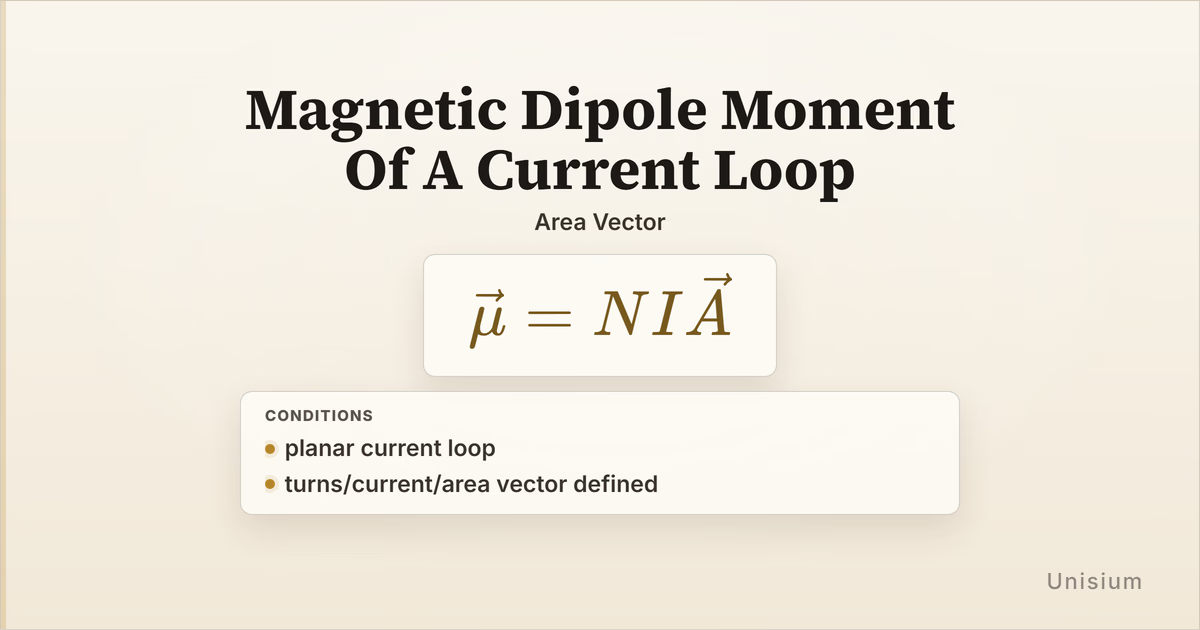
Magnetic Dipole Moment Of A Current Loop says a planar loop carrying current has magnetic dipole moment . It applies when the loop is planar and the turn count, current, and area vector are defined; the right-hand rule ties the vector direction to conventional current. Use it to represent a loop or coil by one dipole-moment vector before applying later torque or energy relations.
This guide sits in the magnetic branch of the Electromagnetism Principle Map, near Magnetic Force On A Wire because both depend on conventional-current direction. The surrounding decisions are conventional-current direction, applying the right-hand rule, and later using that dipole moment in torque or energy relations. These are setup and interpretation choices around the relation, not additional equations to memorize.
On this page: The Principle | Conditions | Misconceptions | Elaborative Encoding | Retrieval Practice | Worked Example | Solve a Problem | Related Principles | FAQ | Related Guides | How This Fits
The Principle
Statement
Magnetic Dipole Moment Of A Current Loop represents a planar current loop by a vector that points normal to the loop’s surface. The magnitude grows with the number of turns , the current , and the loop area . The direction follows the chosen area vector , which is tied to the current-direction convention.
Mathematical Form
Where:
- is the magnetic dipole moment, in ampere square meters,
- is the number of identical turns in the loop or coil
- is the conventional current, in amperes
- is the area vector, with magnitude equal to loop area and direction normal to the loop
The diagram shows how the conventional current determines the shared direction of and through the right-hand rule. No external magnetic field is shown because torque and potential energy require separate relations.
What the area vector carries
The area vector does two jobs at once. Its magnitude is the loop area, and its direction is the normal direction assigned to the loop. For a loop current, is the magnitude of the conventional current. Curl the fingers of your right hand in the current direction; your thumb gives the direction of , and therefore the direction of .
That is why is not just “current times area.” It is a direction-carrying representation of the loop as a magnetic dipole. Once you know , later relations can ask how that dipole interacts with an external magnetic field.
Conditions of Applicability
Condition: planar current loop; turns/current/area vector defined
Practical modeling notes
- Planar current loop means one surface and one normal direction can represent the loop.
- Turns defined means counts how many identical turns carry the same current around the same area.
- Current defined means the current direction is known by the conventional-current convention.
- Area vector defined means the normal direction has been chosen before the sign and direction of are interpreted.
Limits of the simple form
- Nonplanar loops: one flat area vector may not represent the whole current path.
- Unequal turns or changing area: a single factor can hide geometry that should be modeled turn by turn.
Defining is only the first step in external-field problems. Torque and potential energy require separate relations involving the external magnetic field.
Want the complete framework behind this guide? Read Masterful Learning.
Common Misconceptions
Misconception 1: The dipole moment points along the wire
The truth: points normal to the loop’s plane, not tangent to the wire.
Why this matters: Direction errors here carry into torque and energy problems later.
Misconception 2: The number of turns changes the direction
The truth: More turns multiply the magnitude of ; the direction still comes from the chosen area vector.
Why this matters: A coil with ten turns and a coil with one turn can point the same way while having different magnetic dipole moment magnitudes.
Misconception 3: Only the scalar area matters
The truth: The model uses , so the scalar area is paired with a normal direction .
Elaborative Encoding
Use these questions to build understanding before memorizing the formula. See Elaborative Encoding for the broader method.
Within the Principle
- Why does the loop’s area need a vector direction instead of only a scalar area?
- What changes in if you double the current but keep the same loop and turn count?
For the Principle
- What words in a problem tell you that a single planar area vector is a fair model?
- Before using the formula, what convention must be clear about the current direction and the normal direction?
Between Principles
- How does this definition prepare the loop for a future torque-on-a-dipole relation without being the torque relation itself?
Generate an Example
- Describe a two-turn loop and a one-turn loop with the same current and area. What is the same about their dipole moments, and what is different?
Retrieval Practice
Answer from memory, then reveal the result and check it. See Retrieval Practice for the full study method.
State the principle in words: _____A planar current loop has magnetic dipole moment equal to the number of turns times current times the loop's area vector.
Write the canonical equation: _____
State the canonical condition: _____planar current loop; turns/current/area vector defined
Worked Example
Use this worked example to practice Self-Explanation.
Problem
A circular coil has turns, radius , and current . The conventional current circulates so that the right-hand-rule area vector points in the direction. Find the magnetic dipole moment vector.
Step 1: Verbal Decoding
Target:
Given: , , ,
Constraints: planar circular loop; all turns share the same area; current and area-vector direction are defined
Step 2: Visual Decoding
Draw the circular coil as a flat loop, mark the normal direction as , and label the radius . (The key visual fact is that points in the direction.)
Step 3: Physics Modeling
Step 4: Mathematical Procedures
Step 5: Reflection
- Dimensional analysis: Current times area gives ampere square meters.
- Interpretation: The dipole moment points with the area vector, not around the wire.
- Parameter dependence: Doubling the turn count would double the magnitude of .
Before moving on: self-explain the model
Try explaining why Step 3 uses the area vector instead of a scalar area, why multiplies the result, and why the final direction is .
Physics model with explanation
Principle: We use Magnetic Dipole Moment Of A Current Loop because the setup is a planar current loop with turn count, current, and area vector defined.
Conditions: The coil is circular and planar, all turns share the same area, and the normal direction is stated.
Relevance: The target is the dipole moment vector, so the defining relation is the direct model.
Description: The loop area is , and the direction is supplied by the chosen area vector.
Goal: Combine turn count, current, area magnitude, and direction into one magnetic dipole moment vector.
Solve a Problem
Apply what you have learned with Problem Solving.
Problem
A square coil has turns, side length , and current . The conventional current circulates so that the right-hand-rule area vector points in the direction. Find the magnetic dipole moment vector.
Hint: The area of a square loop is .
Show Solution
Step 1: Verbal Decoding
Target:
Given: , , ,
Constraints: planar square loop; all turns share the same area; current and area-vector direction are defined
Step 2: Visual Decoding
Draw the square coil, mark its side length , and draw the area vector normal to the loop in the direction. (The key visual fact is that points in the direction.)
Step 3: Physics Modeling
Step 4: Mathematical Procedures
Step 5: Reflection
- Dimensional analysis: Ampere times square meters gives the correct unit for magnetic dipole moment.
- Interpretation: The negative sign records the chosen area-vector direction.
- Parameter dependence: A larger turn count or current would increase the magnitude linearly.
Related Principles
See Electromagnetism: The Principle Map for where current-loop dipole moment sits in the magnetic devices-and-networks lane.
| Principle | Relationship to Magnetic Dipole Moment Of A Current Loop |
|---|---|
| Magnetic Force On A Wire | Uses current direction in a conductor; current loops build on the same conventional-current convention. |
| Torque On A Magnetic Dipole | Later uses with an external magnetic field to model rotational tendency. |
| Magnetic Dipole Energy | Later uses and field orientation to model potential energy. |
See Principle Structures for a broader view of how definitions prepare later interaction laws.
FAQ
What is the magnetic dipole moment of a current loop?
It is the vector . The vector represents a planar current loop or coil as one magnetic dipole with magnitude set by turns, current, and area.
When does the current-loop dipole formula apply?
It applies under the canonical condition: planar current loop; turns/current/area vector defined. If the loop is not planar or the turns do not share the same area, the simple form may hide geometry that needs a more careful model.
Which way does the magnetic dipole moment point?
It points with the chosen area vector of the loop. For a current loop, the usual convention connects that area-vector direction to the conventional current direction.
What does the number of turns do?
The turn count multiplies the magnetic dipole moment magnitude. If every turn has the same current and area vector, doubling doubles .
Is magnetic dipole moment the same as torque?
No. Magnetic dipole moment defines the current loop as a vector dipole. Torque on a magnetic dipole is a later relation that uses together with an external magnetic field.
Related Guides
- Electromagnetism: The Principle Map - Place current-loop dipole moment in the wider EM structure.
- Magnetic Force On A Wire - Review how conventional current direction enters magnetic relations.
- Magnetic Flux In A Uniform Field - Compare area-vector meaning in a surface relation.
- Problem Solving - Practice translating a physical setup into equations and constraints.
How This Fits in Unisium
Unisium treats Magnetic Dipole Moment Of A Current Loop as a principle because the equation is compact but the representation is easy to flatten into a scalar. The useful learning path is to encode what the area vector means, retrieve with its condition, self-explain why the loop becomes one vector, and solve new problems where direction is stated rather than guessed.
Ready to master Magnetic Dipole Moment Of A Current Loop? Check access and join the Unisium waitlist or explore the full framework in Masterful Learning.

Masterful Learning
The book behind these guides: a study system for physics, math, & programming built on retrieval, connection, explanation, and problem solving.
Ready to apply this strategy?
Unisium turns these evidence-based techniques into guided study sessions for math and physics. Places are limited during early access. Check current availability to start a trial; joining the mailing list is optional.
See plans and availability Read More GuidesAlready have access? Sign in