Electric Field-Force Relation: Use One Relation in Both Directions
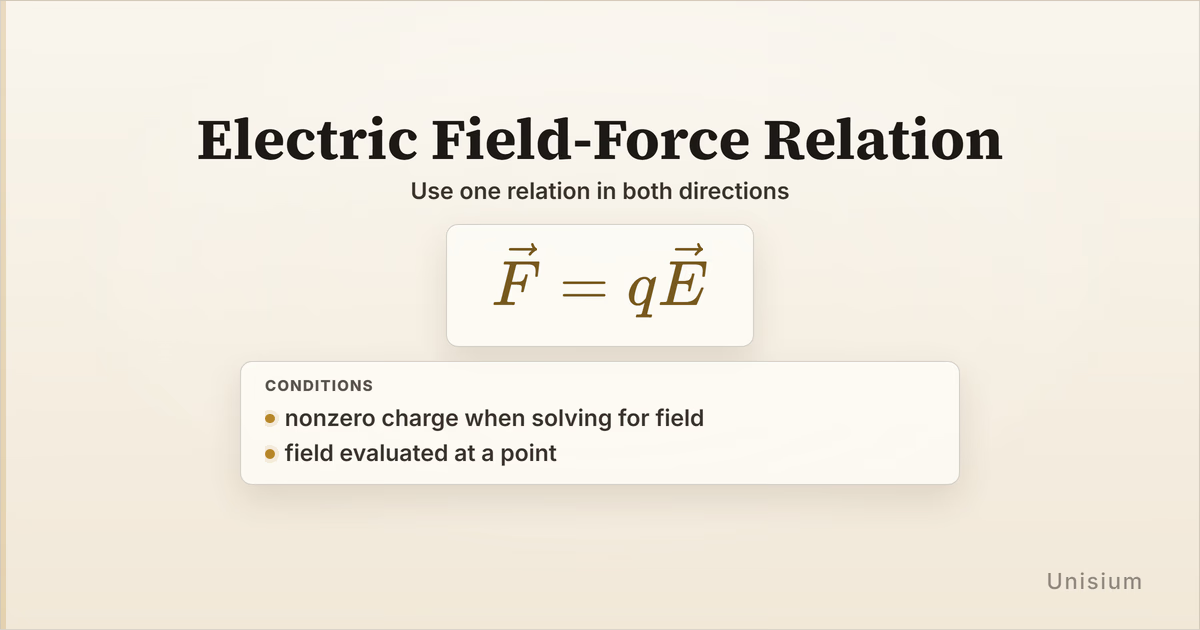
Electric Field-Force Relation says that a charge in an electric field feels a force given by . Use it forward to find force from a known field, or read the same relation backward as force per unit charge when the charge is nonzero. It applies to the field evaluated at a point, and a common mistake is treating field direction and force direction as automatically identical even when the charge is negative.
Electric Field-Force Relation is one pointwise model relation with two common jobs. If the local electric field is already known, it tells you the electric force on a charge. If the electric force on a known nonzero charge is known, the same relation tells you the electric field at that point.
That boundary matters early in electromagnetism. This guide is about translating between local field and force at one point, not about building the field from source geometry and not about adding magnetic effects.
On this page: The Principle · Conditions · Misconceptions · Elaborative Encoding · Retrieval Practice · Worked Example · Solve a Problem · Related Principles · FAQ · Related Guides · How This Fits
The Principle
Statement
Electric Field-Force Relation connects a charge to the electric force it experiences in a local electric field. The force is proportional to the charge and points with the field for a positive charge and against the field for a negative charge. When the charge is nonzero, the same relation can be read backward to define electric field as force per unit charge.
Mathematical Form
Same relation read backward when solving for the field of a known nonzero test charge:
Where:
- is the electric force vector in N
- is the charge in C
- is the electric field vector in
The scene above keeps the principle boundary visible. The local field is the same in both rows; only the sign of the charge changes. That flips the force direction, which is why field direction and force direction are not interchangeable unless the charge sign is already known.
What this relation does and does not say
- It gives the electric force from a local field and a charge.
- It can be rearranged to define field as force per unit charge when the charge is nonzero.
- It does not by itself tell you how the field was created; that comes from source-side relations such as Coulomb Force or from other field models.
Conditions of Applicability
Condition: nonzero charge when solving for field; field evaluated at a point
Practical modeling notes
- Nonzero charge when solving for field matters only for the backward use . If , dividing by the charge is impossible, so this route cannot define the field.
- Field evaluated at a point means the relation uses the local value of the electric field where the charge sits. If the field changes significantly across an extended body, the pointwise form is not the whole model.
- This guide isolates the electric part of the force. If magnetic effects are also part of the situation, you need the larger electromagnetic-force model rather than only the electric term.
When it does not apply directly
- Trying to infer field from a neutral object: the backward use fails because dividing by zero charge is not allowed.
- Extended objects in a nonuniform field: one local field value may not describe the whole object, so the simple pointwise form is incomplete.
- Combined electric and magnetic situations: if velocity-cross-field effects matter, the electric-only force law is not enough.
Want the complete framework behind this guide? Read Masterful Learning.
Common Misconceptions
Misconception 1: and are different principles
The truth: They are the same relation read in different directions. The second form is just the first one rearranged, and it is only legal when the charge is nonzero.
Why this matters: Treating them as different principles hides the real learning target, which is deciding what is known and what is being solved for at one point in the field.
Misconception 2: The force always points in the same direction as the field
The truth: A positive charge feels force with the field, but a negative charge feels force opposite the field.
Why this matters: Many early EM mistakes come from reading the field arrow correctly and then forgetting that the charge sign can reverse the force direction.
Misconception 3: Changing the test charge changes the field in this relation
The truth: In this relation, is the field already present at the point. Changing changes the force on that charge, not the field value being modeled.
Why this matters: If you blur the field with the response of one chosen charge, you lose the distinction between source-side field models and force-on-a-charge models.
Elaborative Encoding
Use these questions to build understanding before you memorize the formula. See Elaborative Encoding for the broader method.
Within the Principle
- If the local field stays fixed but the charge changes sign, what happens to the force direction?
- Why do the units for electric field match force divided by charge?
For the Principle
- What clue in a problem tells you the field is already known at a point, so this relation should come before a source-building law such as Coulomb Force?
- When does the backward use fail immediately?
Between Principles
- How is this relation different from Coulomb Force, which models interaction from source charges rather than from a local field already given?
Generate an Example
- Describe one setup where the same rightward electric field gives opposite force directions for two different charges.
Retrieval Practice
Answer from memory, then reveal the result and check it. See Retrieval Practice for the full study method.
State the principle in words: _____A charge in an electric field experiences a force equal to the charge times the electric field; when the charge is nonzero, the same relation can define electric field as force per unit charge.
Write the canonical equation: _____
State the canonical condition: _____nonzero charge when solving for field; field evaluated at a point
Worked Example
Use this worked example to practice Self-Explanation.
Problem
A particle with charge is at a point where the electric field is to the right. What electric force vector acts on the particle?
Step 1: Verbal Decoding
Target:
Given:
Constraints: field evaluated at a point; one-dimensional horizontal model
Step 2: Visual Decoding
Draw a horizontal axis with right as positive. Place the charge at one point, draw the electric-field arrow to the right, and note that a negative charge will feel force opposite the field.
(The key visual fact is that the sign of the charge decides whether force aligns with or opposes the field.)
Step 3: Physics Modeling
Step 4: Mathematical Procedures
Step 5: Reflection
- Dimensional analysis: cancels, leaving N, so the units match a force.
- Interpretation: The negative sign means the force points opposite the rightward field because the charge is negative.
- Parameter dependence: If either the field magnitude or the charge magnitude doubled, the force magnitude would double too.
Before moving on: self-explain the model
Try explaining why the one-dimensional component form is enough here, which part of the condition matters for the backward use but not this forward use, and why the negative charge reverses the force direction without changing the field arrow itself.
Physics model with explanation
Principle: We use Electric Field-Force Relation because the field at the particle’s location is already known and the target is the electric force on that charge.
Conditions: The field is evaluated at the particle’s point, and no extra magnetic term is being modeled in this step.
Relevance: This is the right principle when a problem gives a local electric field and asks what force a charge feels there.
Description: The sign of the charge determines whether the force points with the field or against it. In one dimension, that directional choice is captured by the sign of the component.
Goal: We want the force vector at the point. The whole calculation is one direct substitution into the pointwise force-field relation.
Solve a Problem
Apply what you have learned with Problem Solving.
Problem
A charge of at a point experiences an electric force of upward. What electric field vector is present at that point?
Hint: Check first that the charge is nonzero, then divide force by charge.
Show Solution
Step 1: Verbal Decoding
Target:
Given:
Constraints: nonzero charge; field evaluated at a point; one-dimensional vertical model
Step 2: Visual Decoding
Draw a vertical axis with up as positive. Place the charge at one point and draw the force arrow upward. Because the charge is positive, the electric-field arrow will point in the same direction.
(The key visual fact is that a positive charge makes field and force directions match.)
Step 3: Physics Modeling
Step 4: Mathematical Procedures
Step 5: Reflection
- Verification: Substituting this field back into returns the given upward force.
- Condition check: The division step is valid because the charge is nonzero.
- Interpretation: Since the charge is positive, the field and force point in the same direction in this one-dimensional setup.
Related Principles
See Electromagnetism: The Principle Map for placement in the subdomain and the wider guides library for adjacent study paths.
| Principle | Relationship to Electric Field-Force Relation |
|---|---|
| Coulomb Force | Pairwise source-charge interaction can sit upstream of this relation when you first compute a field or force from source geometry and then apply the local pointwise model. |
| Electric Field From Point Charge | Gives the field created by one source charge at a point; this relation then turns that field into force on another charge placed there. |
| Lorentz Force | Adds the magnetic term when a charge moves through both electric and magnetic fields, so this relation becomes only the electric part of the full force model. |
See Principle Structures for a broader view of how nearby relations connect.
FAQ
What is the electric field-force relation?
It is the pointwise relation between electric force, charge, and electric field. It tells you the electric force on a charge in a known field, and when the charge is nonzero it can also define field as force per unit charge.
When should I use instead of Coulomb’s law?
Use when the field at the point is already known or has already been found by another model. Use Coulomb’s law when the job is to build the interaction directly from source charges and separation.
Can I always solve electric field as force divided by charge?
Only if the charge is nonzero. That is why the canonical condition explicitly names nonzero charge when the guide uses the relation backward to solve for field.
Why does a negative charge feel force opposite the field?
Because the charge multiplies the field in the force relation. A negative charge flips the direction of the resulting force vector relative to the field.
Does this relation include magnetic force?
No. This guide isolates the electric part of the force. If magnetic effects matter too, the full electromagnetic-force model is larger than by itself.
Related Guides
- Coulomb Force — See the source-charge interaction law that often sits upstream of local field reasoning.
- Electromagnetism: The Principle Map — Place this pointwise relation in the full electromagnetism structure.
- Retrieval Practice — Make the pointwise force-field relation quickly available from memory.
- Problem Solving — Use the relation inside structured electromagnetism problem solving.
How This Fits in Unisium
In Unisium, this principle comes right after early source-charge relations because it shifts the learner from pairwise interaction to local field reasoning: first retrieve the pointwise link between field and force, then explain why charge sign flips direction, then practice worked examples that go both forward and backward without turning them into separate principles. Check access and join the Unisium waitlist or see the wider framework in Masterful Learning.

Masterful Learning
The book behind these guides: a study system for physics, math, & programming built on retrieval, connection, explanation, and problem solving.
Ready to apply this strategy?
Unisium turns these evidence-based techniques into guided study sessions for math and physics. Places are limited during early access. Check current availability to start a trial; joining the mailing list is optional.
See plans and availability Read More GuidesAlready have access? Sign in