Kirchhoff Loop Rule: Balance Voltage Around a Closed Path
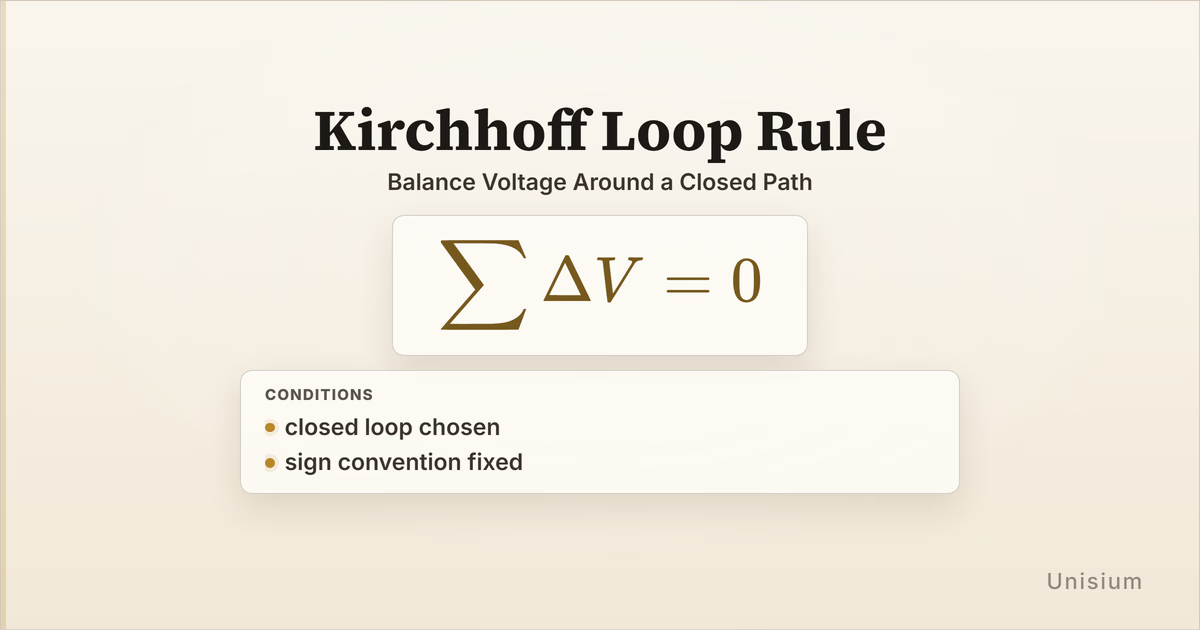
Kirchhoff Loop Rule says that the signed sum of potential changes around a chosen closed loop is zero: . It applies once the closed loop and sign convention are fixed. Use it to balance voltage rises and drops around a closed circuit path; do not confuse it with the junction rule, which balances currents at a node.
This guide follows Ohm’s Law, the resistor-network guides, and Kirchhoff Junction Rule in the circuit branch of the Electromagnetism Principle Map. The surrounding decisions are choosing the loop, choosing a traversal direction, assigning signs to rises and drops, and keeping voltage-loop bookkeeping separate from node-current bookkeeping.
On this page: The Principle | Conditions | Misconceptions | Elaborative Encoding | Retrieval Practice | Worked Example | Solve a Problem | Related Principles | FAQ | Related Guides | How This Fits
The Principle
Statement
Kirchhoff Loop Rule is the voltage bookkeeping rule for one closed path in a circuit. If you start at one point, move around a closed loop, and return to the same point, your final electric potential must equal your starting potential, so the signed potential changes along the way add to zero.
Mathematical Form
Where:
- is the signed potential change across one circuit element or path segment, in volts
- is the total signed potential change after one complete closed loop
- the sign of each term depends on the fixed traversal direction and sign convention
The diagram shows why the setup matters: first choose the closed loop and its direction, then assign each voltage rise or drop a sign. The rule itself is the zero sum after those choices have been made.
Equivalent signed forms
In a one-battery, one-resistor loop, a common sign choice gives:
The same physical circuit could be written with all signs reversed if you traverse the loop the opposite way. That is not a different principle; it is the same loop rule with a different sign convention.
Conditions of Applicability
Condition: closed loop chosen; sign convention fixed
Practical modeling notes
- The loop must return to its starting point. An open path does not give a zero total potential change by this rule.
- Choose a traversal direction before writing signs. Clockwise and counterclockwise are both legal if used consistently.
- A battery crossed from negative to positive is a voltage rise under the usual convention; a resistor crossed in the direction of current is a voltage drop.
- If the solved current is negative, the actual current direction is opposite the direction you assumed.
- In multi-loop circuits, write one loop equation at a time and combine it with node-current equations when needed.
When it does not apply directly
- No closed path chosen: you cannot write a loop equation until the path starts and ends at the same point.
- Changing magnetic flux through the loop: in induction contexts, the simple electrostatic loop sum is replaced or modified by Faraday’s law.
- Node-current questions: if the problem asks how currents split or combine at a junction, use Kirchhoff Junction Rule.
Want the complete framework behind this guide? Read Masterful Learning.
Common Misconceptions
Misconception 1: Every voltage number in the circuit goes into one equation
The truth: A loop equation includes the signed potential changes along one chosen closed path, not every labeled voltage in the whole network.
Why this matters: Pulling in voltages from outside the chosen loop creates equations that do not correspond to a physical path.
Misconception 2: The sign convention changes the answer
The truth: A consistent opposite traversal reverses every sign in the loop equation but leaves the physical result unchanged.
Why this matters: Students often treat sign choice as a hidden rule to guess instead of a convention to state and follow.
Misconception 3: Loop rule and junction rule are interchangeable
The truth: The loop rule balances voltage changes around a closed path. The junction rule balances currents at one node.
Why this matters: Mixing voltage and current bookkeeping often produces equations with correct-looking symbols but the wrong conservation idea.
Elaborative Encoding
Use these questions to build understanding before memorizing the formula. See Elaborative Encoding for the broader method.
Within the Principle
- What does it mean for to be signed rather than only a magnitude?
- Why must the total potential change be zero after returning to the same point?
For the Principle
- What marks in a circuit diagram tell you that a path is a closed loop?
- Which sign decisions must be fixed before writing the first voltage term?
Between Principles
- How does Ohm’s Law provide resistor voltage drops that can appear inside a loop equation?
Generate an Example
- Describe a one-battery, one-resistor loop and state which element gives a voltage rise and which gives a voltage drop under your chosen direction.
Retrieval Practice
Answer from memory, then reveal the result and check it. See Retrieval Practice for the full method.
State the principle in words: _____Around a chosen closed loop, the signed sum of potential changes is zero.
Write the canonical equation: _____
State the canonical condition: _____closed loop chosen; sign convention fixed
Worked Example
Use this worked example to practice Self-Explanation.
Problem
A closed loop contains one ideal battery with emf and two series resistors, and . Choose the clockwise loop direction, take the battery crossing as a rise, and assume the current is clockwise. Find .
Step 1: Verbal Decoding
Target:
Given: , ,
Constraints: one closed loop; clockwise traversal chosen; battery rise; two resistor drops in direction of current; fixed sign convention
Step 2: Visual Decoding
Draw one rectangular loop with the battery on one side and the two resistors in series along the path. Mark the clockwise traversal direction, label the battery rise , and label the resistor drops and . (The key visual fact is that the same closed loop contains one rise and two drops.)
Step 3: Physics Modeling
Step 4: Mathematical Procedures
Step 5: Reflection
- Dimensional analysis: Volts divided by ohms gives amperes.
- Verification: Substituting gives .
- Interpretation: The battery rise is exactly balanced by the two resistor drops around the closed path.
Before moving on: self-explain the model
Try explaining why Step 3 uses a voltage-loop equation, why the sign convention is legal, and why both resistor terms are drops in this traversal direction.
Physics model with explanation
Principle: We use Kirchhoff Loop Rule because the problem asks for a circuit quantity around one closed path.
Conditions: The loop is chosen and the sign convention is fixed before any voltage terms are written.
Relevance: The known battery emf and both resistor drops can be placed on the same closed-loop voltage sum.
Description: Moving clockwise, the battery raises potential by and the two resistors lower potential by and . Returning to the starting point means the total signed change is zero.
Goal: Write the loop equation and solve it for the current through the series path.
Solve a Problem
Apply what you have learned with Problem Solving.
Problem
A closed loop contains one ideal battery with emf and two series resistors. Choose the clockwise loop direction, take the battery crossing as a rise, and assume the current is clockwise. One resistor has resistance , and the other has unknown resistance . Find .
Hint: Write each resistor drop separately in the chosen loop direction.
Show Solution
Step 1: Verbal Decoding
Target:
Given: , ,
Constraints: one closed loop; traversal direction chosen; battery rise; two resistor drops in direction of current; fixed sign convention
Step 2: Visual Decoding
Draw one loop with a battery and two series resistors. Mark the chosen traversal direction, write across the battery, and write and across the resistors. (The key visual fact is that the same loop contains one rise and two drops.)
Step 3: Physics Modeling
Step 4: Mathematical Procedures
Step 5: Reflection
- Dimensional analysis: Volts divided by amperes gives ohms.
- Verification: The total resistor drop is , matching the battery rise.
- Interpretation: The unknown resistor accounts for the remaining drop after the known resistor uses part of the battery rise.
Related Principles
See Electromagnetism: The Principle Map for where the loop rule sits in the circuit-analysis sequence.
| Principle | Relationship to Kirchhoff Loop Rule |
|---|---|
| Kirchhoff Junction Rule | Complements the loop rule by balancing branch currents at nodes instead of voltage changes around paths. |
| Ohm’s Law | Supplies resistor voltage drops such as inside a loop equation. |
| Equivalent Resistance In Series | Helps simplify a one-path resistor chain before writing or solving a loop equation. |
See Principle Structures for a broader view of how conservation rules, element laws, and network relations fit together.
FAQ
What is Kirchhoff Loop Rule?
Kirchhoff Loop Rule is the voltage-balance rule for a closed circuit path. It says the signed sum of potential changes around the loop is zero.
When does Kirchhoff Loop Rule apply?
It applies under the canonical condition: closed loop chosen; sign convention fixed. Choose the loop and traversal direction first, then write each voltage rise or drop with the sign implied by that convention.
Is the loop rule the same as conservation of energy?
In introductory circuit analysis, it acts like an energy-per-charge bookkeeping rule: after a charge completes a closed path, its net potential change is zero in the circuit model.
What if I choose the opposite loop direction?
The signs of the voltage terms may all reverse, but a consistent equation gives the same physical current or resistance. A negative answer means your assumed direction was opposite the actual direction.
How is the loop rule different from the junction rule?
The loop rule balances voltage changes around one closed path. The junction rule balances currents entering and leaving one node.
Related Guides
- Kirchhoff Junction Rule - Balance currents at nodes before or alongside loop equations.
- Ohm’s Law - Relate resistor voltage drops to current and resistance.
- Equivalent Resistance In Series - Simplify resistor chains in a single path.
- Problem Solving - Practice translating a circuit setup into equations.
How This Fits in Unisium
Unisium treats Kirchhoff Loop Rule as a principle because the equation is short but the setup decisions are easy to blur: first choose the closed loop and sign convention, then write the voltage sum. The useful learning path is to encode the zero-sum reason, retrieve the equation and condition, self-explain the sign choices, and solve new loop problems where the unknown changes.
Ready to master Kirchhoff Loop Rule? Check access and join the Unisium waitlist or explore the full framework in Masterful Learning.

Masterful Learning
The book behind these guides: a study system for physics, math, & programming built on retrieval, connection, explanation, and problem solving.
Ready to apply this strategy?
Unisium turns these evidence-based techniques into guided study sessions for math and physics. Places are limited during early access. Check current availability to start a trial; joining the mailing list is optional.
See plans and availability Read More GuidesAlready have access? Sign in