Kirchhoff Junction Rule: Balance Current at a Node
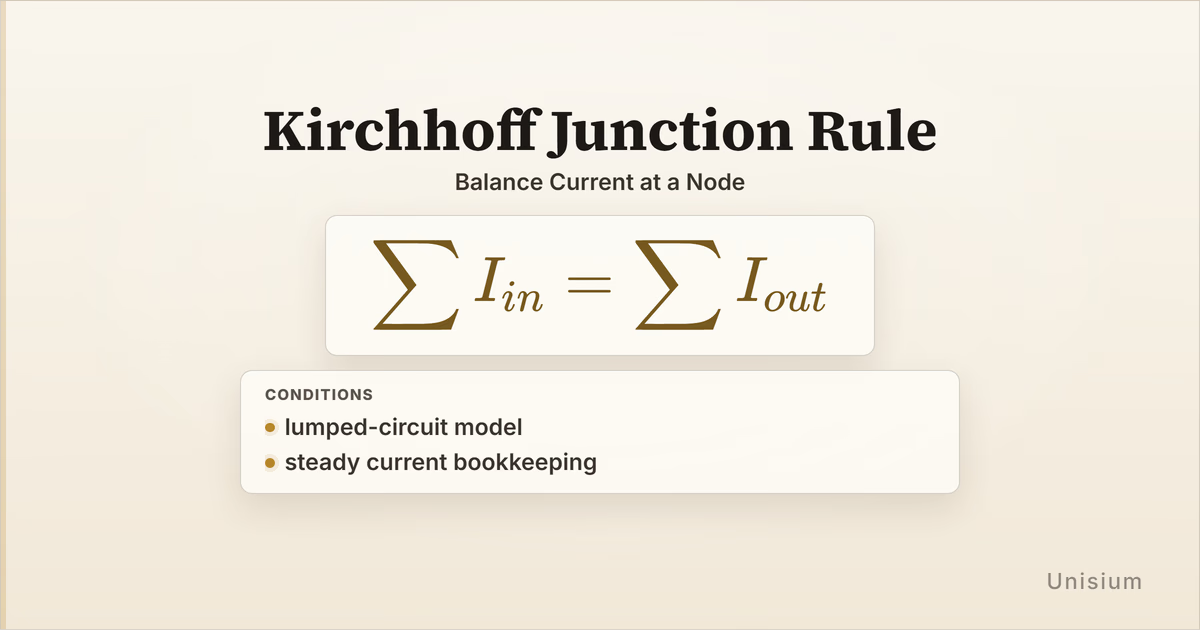
Kirchhoff Junction Rule says the total current entering a circuit junction equals the total current leaving it: . It applies for a lumped-circuit model with steady current bookkeeping. Use it to balance branch currents at a node; do not use it to add voltage changes around a loop, which is the nearby loop-rule job.
This guide follows Electric Current Definition, Ohm’s Law, and the series/parallel resistor guides in the circuit branch of the Electromagnetism Principle Map. The surrounding decisions are identifying the junction, assigning branch-current directions, deciding what counts as entering or leaving, and keeping node bookkeeping separate from loop-voltage bookkeeping.
On this page: The Principle | Conditions | Misconceptions | Elaborative Encoding | Retrieval Practice | Worked Example | Solve a Problem | Related Principles | FAQ | Related Guides | How This Fits
The Principle
Statement
Kirchhoff Junction Rule is the current-conservation rule for one circuit node. In a steady lumped circuit, charge does not accumulate at the junction, so the total rate of charge flow into the node must equal the total rate of charge flow out through the connected branches.
Mathematical Form
Where:
- is the sum of branch currents directed into the junction, in amperes
- is the sum of branch currents directed away from the junction, in amperes
- each current in the sums is counted once according to its chosen direction at that node
The diagram shows the relationship the rule cares about: currents entering the node balance currents leaving the node. Choosing arrow directions and identifying the node are setup decisions around the principle, not new principles.
Equivalent signed form
Many courses write the same bookkeeping as a signed sum:
In that form, currents entering the node get one sign and currents leaving get the opposite sign. This is the same junction rule after a sign convention has been chosen.
Conditions of Applicability
Condition: lumped-circuit model; steady current bookkeeping
Practical modeling notes
- The junction is treated as an ideal node, so it has no meaningful charge storage in the model.
- Currents are branch currents meeting at the same node.
- A current arrow can be guessed; a negative solved value means the real current direction is opposite the guess.
- The rule is local to one junction. Apply it one node at a time in a larger circuit.
- In circuit-analysis problems, combine this rule with element laws such as Ohm’s Law when current values depend on resistance and potential difference.
When it does not apply directly
- Changing charge at the node: if charge is accumulating at a place that cannot be treated as an ideal circuit node, the simple steady-current balance is not the right model.
- Voltage loops: if the task asks for voltage rises and drops around a closed path, use the loop rule rather than a junction current balance.
- Unidentified topology: if the circuit drawing is unclear, first mark the node and branch directions before writing the current balance.
Want the complete framework behind this guide? Read Masterful Learning.
Common Misconceptions
Misconception 1: Current gets used up at a junction
The truth: Current can split among branches, but total current does not disappear at an ideal steady node.
Why this matters: Treating current as consumed at a junction leads to branch-current sums that cannot satisfy charge conservation.
Misconception 2: The largest branch current must keep going straight
The truth: The drawing direction of a wire segment does not decide how current divides; the connected circuit elements and constraints do.
Why this matters: Junction bookkeeping only balances entering and leaving totals. It does not by itself determine every branch current in a network.
Misconception 3: Junction and loop rules are interchangeable
The truth: The junction rule balances currents at a node, while the loop rule balances potential changes around a closed path.
Why this matters: Mixing the two rules often produces equations with the wrong quantities on each side.
Elaborative Encoding
Use these questions to build understanding before memorizing the formula. See Elaborative Encoding for the broader method.
Within the Principle
- What does the phrase “current entering” mean after you choose arrows on the branch currents?
- Why does steady current bookkeeping imply no net charge buildup at the node?
For the Principle
- What evidence in a circuit drawing tells you that several branch currents meet at the same junction?
- What setup decision must you make before deciding which currents belong in and which belong in ?
Between Principles
- How does Electric Current Definition explain why current conservation is a statement about charge flow rate?
Generate an Example
- Describe a node where two currents enter and one current leaves, then state what the leaving current must equal.
Retrieval Practice
Answer from memory, then reveal the result and check it. See Retrieval Practice for the full method.
State the principle in words: _____At a circuit junction, the total current entering the node equals the total current leaving the node.
Write the canonical equation: _____
State the canonical condition: _____lumped-circuit model; steady current bookkeeping
Worked Example
Use this worked example to practice Self-Explanation.
Problem
At one circuit junction, currents and enter the node. Current leaves the node through one branch, and current leaves through another branch. The circuit is modeled as a steady lumped circuit. Find .
Step 1: Verbal Decoding
Target:
Given: , ,
Constraints: one junction; and enter; and leave; steady lumped-circuit bookkeeping
Step 2: Visual Decoding
Draw one node with arrows and pointing into it and arrows and pointing away from it. (The key visual fact is which currents enter the node and which currents leave it.)
Step 3: Physics Modeling
Step 4: Mathematical Procedures
Step 5: Reflection
- Dimensional analysis: Adding and subtracting currents leaves the answer in amperes.
- Verification: The entering total is , and the leaving total is .
- Interpretation: The unknown branch carries the remaining current needed to prevent charge buildup at the node.
Before moving on: self-explain the model
Try explaining why Step 3 uses a node-current balance, why the condition is satisfied, and why is counted on the leaving side.
Physics model with explanation
Principle: We use Kirchhoff Junction Rule because the problem asks for an unknown branch current at one junction.
Conditions: The problem states a steady lumped-circuit model, matching the canonical condition.
Relevance: The known and unknown quantities are branch currents entering or leaving the same node.
Description: Two currents enter the junction and two currents leave it. Since no charge builds up at the ideal node, the entering total must equal the leaving total.
Goal: Write the current balance for that node, then solve the equation for the unknown leaving current.
Solve a Problem
Apply what you have learned with Problem Solving.
Problem
At a steady circuit junction, current enters the node. Currents and leave the node through two branches. Find .
Hint: Balance the total current entering the node with the total current leaving it.
Show Solution
Step 1: Verbal Decoding
Target:
Given: ,
Constraints: one junction; enters; and leave; steady current bookkeeping
Step 2: Visual Decoding
Draw one node with pointing into the node and and pointing away from it. (The key visual fact is that one entering current splits into two leaving currents.)
Step 3: Physics Modeling
Step 4: Mathematical Procedures
Step 5: Reflection
- Dimensional analysis: Current minus current gives current, so the unit remains amperes.
- Verification: The leaving total is .
- Interpretation: The entering current splits between the two outgoing branches.
Related Principles
See Electromagnetism: The Principle Map for where the junction rule sits in the circuit-analysis sequence.
| Principle | Relationship to Kirchhoff Junction Rule |
|---|---|
| Electric Current Definition | Defines current as charge flow rate, which makes node-current conservation meaningful. |
| Ohm’s Law | Connects branch currents to potential differences and resistances once the node equations are part of a circuit model. |
| Kirchhoff Loop Rule | Complements the junction rule by balancing voltage changes around closed loops instead of currents at nodes. |
See Principle Structures for a broader view of how conservation rules, element laws, and network relations fit together.
FAQ
What is Kirchhoff Junction Rule?
Kirchhoff Junction Rule is the current-balance rule for a circuit node. It says the total current entering a junction equals the total current leaving the junction.
When does Kirchhoff Junction Rule apply?
It applies under the canonical condition: lumped-circuit model; steady current bookkeeping. In ordinary introductory circuit problems, this means you treat the junction as an ideal node where charge does not accumulate.
Is the junction rule the same as conservation of charge?
It is a circuit-model version of charge conservation. If charge is not building up at the node, the rate of charge flow into the node must match the rate of charge flow out of it.
What if I guess a current direction incorrectly?
You can still write the node equation using your chosen arrow direction. If the solved current is negative, the physical current points opposite your chosen arrow.
How is the junction rule different from the loop rule?
The junction rule balances currents at one node. The loop rule balances potential changes around one closed path.
Related Guides
- Electric Current Definition - Connect current to charge flow rate before using node-current balances.
- Ohm’s Law - Relate current, voltage, and resistance in a branch.
- Equivalent Resistance In Parallel - See how branch currents connect to parallel topology.
- Problem Solving - Practice translating a circuit setup into equations.
How This Fits in Unisium
Unisium treats Kirchhoff Junction Rule as a principle because the equation is short but the modeling decision matters: first identify the node and branch directions, then balance entering and leaving currents. The useful learning path is to encode the charge-flow reason, retrieve the formula and condition, self-explain the node equation, and solve new current-balance problems where the unknown branch changes.
Ready to master Kirchhoff Junction Rule? Check access and join the Unisium waitlist or explore the full framework in Masterful Learning.
Masterful Learning
The book behind these guides: a study system for physics, math, & programming built on retrieval, connection, explanation, and problem solving.
Ready to apply this strategy?
Unisium turns these evidence-based techniques into guided study sessions for math and physics. Places are limited during early access. Check current availability to start a trial; joining the mailing list is optional.
See plans and availability Read More GuidesAlready have access? Sign in