Inductor Energy: Magnetic Energy Stored by Current
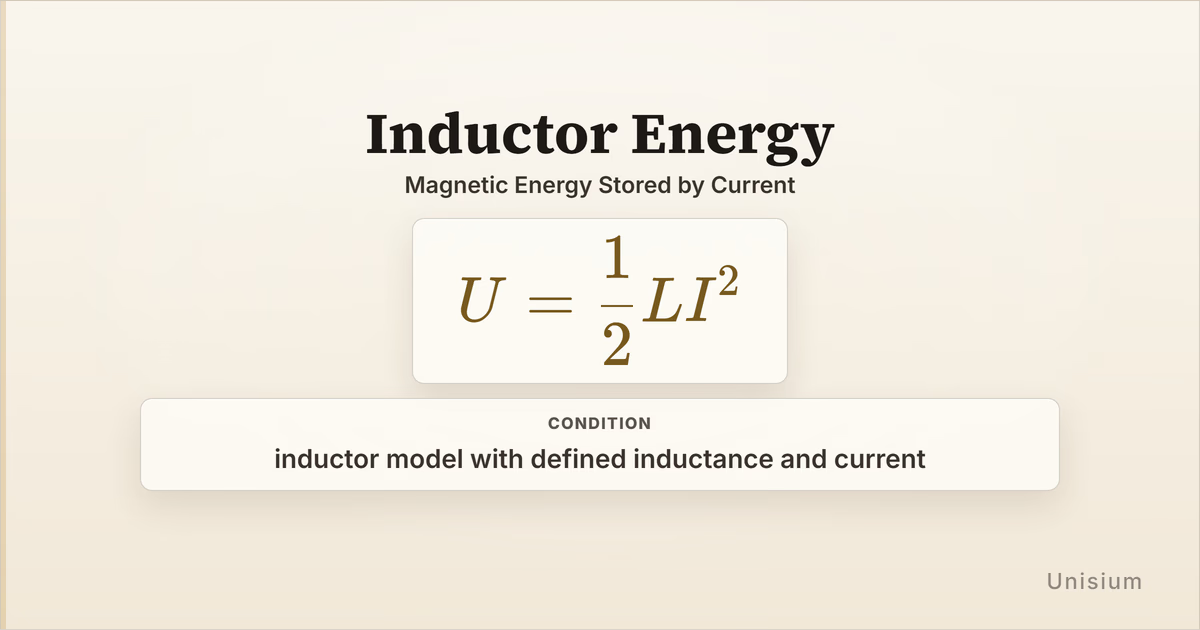
Inductor Energy says an inductor stores magnetic-field energy according to . It applies when an inductor model has defined inductance and current. Use it to find stored energy from current, and do not confuse it with the inductor voltage relation, which depends on how quickly current changes.
This guide sits in the magnetic potential, energy, and flux lane of the Electromagnetism Principle Map, after Inductance-Flux Relation and Inductor Voltage Relation. The surrounding decisions are identifying a lumped inductor model, deciding whether is defined over the stated current range, and separating stored energy from voltage, flux linkage, or transient solving. Those choices support the relation; they are not separate principle keys.
On this page: The Principle | Conditions | Misconceptions | Elaborative Encoding | Retrieval Practice | Worked Example | Solve a Problem | Related Principles | FAQ | Related Guides | How This Fits
The Principle
Statement
Inductor Energy states that the magnetic-field energy stored by an inductor is proportional to its inductance and to the square of its current. The squared current matters: doubling current stores four times as much energy when is unchanged.
Mathematical Form
Where:
- is the stored magnetic-field energy, in joules
- is the inductance, in henries
- is the current through the inductor, in amperes
The diagram shows the intended model boundary. The component is treated as one inductor with defined , current flows through it, and the energy is associated with the magnetic field supported by that current. The equation does not require current to be changing at that instant.
Useful rearrangements
When the relation is valid, you can solve for current or inductance:
These are algebraic rearrangements of the same stored-energy model, not new principles.
Conditions of Applicability
Condition: inductor model with defined inductance and current
Practical modeling notes
- Inductor model means the component or coil is represented by an inductance , rather than by a detailed magnetic-field calculation everywhere in space.
- Defined inductance means is known or treated as fixed for the current range being modeled.
- Defined current means is the current through the inductor used in the model.
- The stored energy depends on current itself, not on . A steady current can store energy even when the ideal inductor voltage is zero.
When it does not apply directly
- No lumped inductor model: a general magnetic-field region may need a field-energy-density relation instead.
- Changing or nonlinear inductance: if changes strongly with current, a single constant- energy formula may not describe the full interval.
- Unknown current path: if the current through the inductor is not defined, the model input is missing.
Want the complete framework behind this guide? Read Masterful Learning.
Common Misconceptions
Misconception 1: Inductor energy depends on voltage
The truth: In this model, stored energy depends on and , not directly on voltage.
Why this matters: Voltage tells you about current-change rate in the ideal inductor model, while energy tells you how much magnetic-field energy corresponds to the current.
Misconception 2: A steady-current inductor stores no energy
The truth: A steady current can store magnetic-field energy. What becomes zero for steady current is the ideal inductor voltage from Inductor Voltage Relation.
Why this matters: Mixing up zero voltage with zero stored energy breaks energy accounting in circuits.
Misconception 3: Current doubling means energy doubling
The truth: Energy scales with , so doubling current quadruples stored energy when is fixed.
Elaborative Encoding
Use these questions to build understanding before memorizing the formula. See Elaborative Encoding for the broader method.
Within the Principle
- Why does the equation use instead of only ?
- What units must have so that has units of joules?
For the Principle
- What words in a problem tell you that a lumped inductor model is intended?
- How would you decide whether the current is defined clearly enough to use this relation?
Between Principles
- How is this energy relation different from Inductor Voltage Relation, even though both use inductance?
Generate an Example
- Describe an inductor situation where current is steady but stored energy is not zero.
Retrieval Practice
Answer from memory, then reveal the result and check it. See Retrieval Practice for the full study method.
State the principle in words: _____For an inductor model with defined inductance and current, stored magnetic-field energy equals one half inductance times current squared.
Write the canonical equation: _____
State the canonical condition: _____inductor model with defined inductance and current
Worked Example
Use this worked example to practice Self-Explanation.
Problem
An inductor has inductance and carries current . Find the magnetic-field energy stored in the inductor.
Step 1: Verbal Decoding
Target:
Given: ,
Constraints: inductor model; inductance and current are defined
Step 2: Visual Decoding
Draw one inductor and label the current through it. Mark the inductor as the energy-storing element, not as a voltage source or resistor. (The key visual fact is that stored energy is attached to the inductor’s magnetic field for the stated current.)
Step 3: Physics Modeling
Step 4: Mathematical Procedures
Step 5: Reflection
- Dimensional analysis: A henry times amperes squared gives joules.
- Parameter dependence: If current doubled, stored energy would become four times larger.
- Interpretation: The result is stored magnetic-field energy, not voltage across the inductor.
Before moving on: self-explain the model
Try explaining why Step 3 uses current rather than current-change rate, why the inductor model matters, and why the answer has energy units.
Physics model with explanation
Principle: We use Inductor Energy because the problem gives a defined inductor model, inductance, and current.
Conditions: The condition is satisfied because and are both defined for the inductor.
Relevance: The target is stored energy, so the stored-energy relation is the direct model.
Description: The current through the inductor supports magnetic-field energy. The inductance sets how much energy corresponds to a given current.
Goal: Substitute the defined inductance and current into .
Solve a Problem
Apply what you have learned with Problem Solving.
Problem
An inductor with stores of magnetic-field energy. Find the current through the inductor.
Hint: Rearrange the energy relation for before substituting numbers.
Show Solution
Step 1: Verbal Decoding
Target:
Given: ,
Constraints: inductor model; inductance and stored energy are defined
Step 2: Visual Decoding
Draw one inductor, label the stored energy , and mark the unknown current through the same inductor. (The key visual fact is that the current is the quantity whose square sets the stored energy.)
Step 3: Physics Modeling
Step 4: Mathematical Procedures
Step 5: Reflection
- Dimensional analysis: Joules divided by henries gives amperes squared before the square root.
- Verification: Substituting gives .
- Interpretation: The positive current magnitude is reported because energy does not distinguish current direction in this formula.
Related Principles
See Electromagnetism: The Principle Map for where inductor energy sits in the magnetic potential, energy, and flux lane.
| Principle | Relationship to Inductor Energy |
|---|---|
| Inductance-Flux Relation | Connects current to flux linkage before energy is modeled from inductance and current. |
| Inductor Voltage Relation | Relates voltage to current-change rate, which is different from stored energy. |
| Capacitor Energy | The capacitor analog stores electric-field energy from capacitance and voltage. |
See Principle Structures for a broader view of how related equations serve different modeling jobs.
FAQ
What is inductor energy?
Inductor energy is the magnetic-field energy stored by an inductor. In the constant-inductance model, it is .
When does the inductor energy formula apply?
It applies under the canonical condition: inductor model with defined inductance and current. The setup must identify the inductor’s and the current through it.
Does an inductor store energy when current is constant?
Yes. A constant current can still correspond to stored magnetic-field energy. The ideal inductor voltage is zero when current is constant, but the stored energy can be nonzero.
Why is current squared in the inductor energy formula?
The magnetic-field energy grows quadratically with current in the constant- inductor model. That is why doubling current gives four times the stored energy.
Is inductor energy the same as inductor voltage?
No. Inductor energy depends on and . Inductor voltage depends on and after the sign convention is fixed.
Related Guides
- Electromagnetism: The Principle Map - Place inductor energy in the broader EM structure.
- Inductance-Flux Relation - Review how current and flux linkage define an inductor model.
- Inductor Voltage Relation - Contrast stored energy with voltage from changing current.
- Retrieval Practice - Make the equation and condition fast to recall.
How This Fits in Unisium
Unisium treats Inductor Energy as a principle because the equation is compact but the modeling boundary is easy to blur. The useful learning path is to encode the defined-inductor condition, retrieve , self-explain why current-change rate is not the target here, and solve new problems where the unknown switches between , , and .
Ready to master Inductor Energy? Check access and join the Unisium waitlist or explore the full framework in Masterful Learning.

Masterful Learning
The book behind these guides: a study system for physics, math, & programming built on retrieval, connection, explanation, and problem solving.
Ready to apply this strategy?
Unisium turns these evidence-based techniques into guided study sessions for math and physics. Places are limited during early access. Check current availability to start a trial; joining the mailing list is optional.
See plans and availability Read More GuidesAlready have access? Sign in