Capacitor Energy: Stored Energy from Voltage
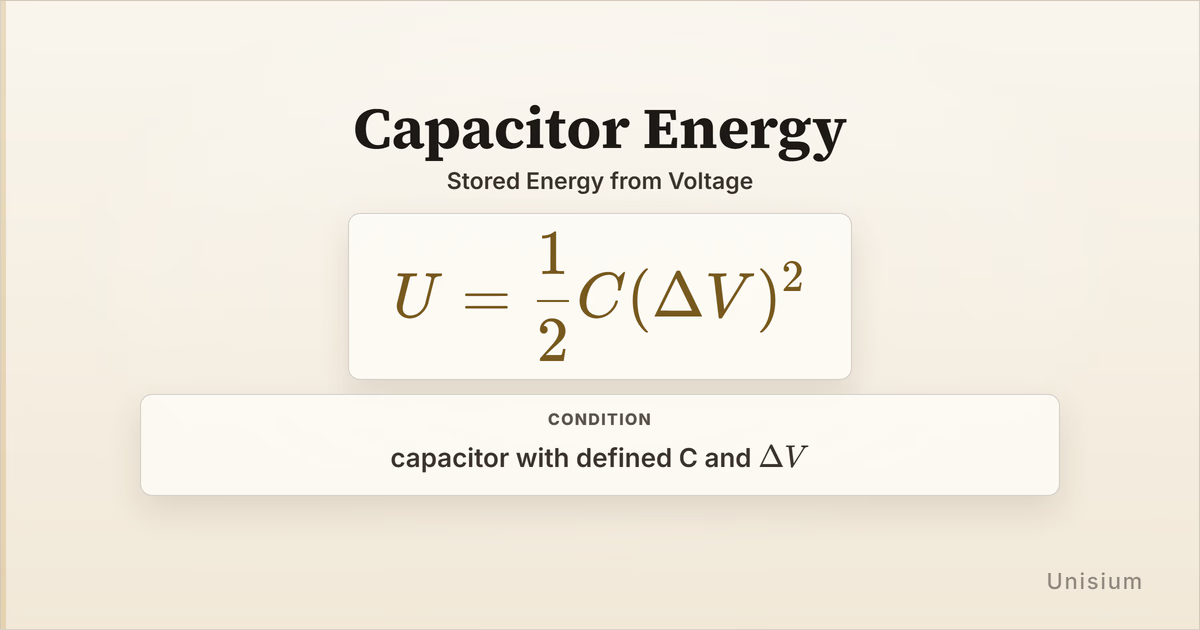
Capacitor Energy says a capacitor stores energy . It applies to a capacitor with defined and . Use it when voltage and capacitance determine stored energy, and remember that doubling voltage makes the stored energy four times larger.
This guide follows Capacitance Definition and Parallel-Plate Capacitance in the device-and-network part of the electromagnetism map. The surrounding decisions are identifying the capacitor as the energy-storing device, deciding which voltage is across that capacitor, and keeping source/battery work separate from the energy finally stored in the field. Those are setup decisions around the principle, not new principles.
On this page: The Principle | Conditions | Misconceptions | Elaborative Encoding | Retrieval Practice | Worked Example | Solve a Problem | Related Principles | FAQ | Related Guides | How This Fits
The Principle
Statement
Capacitor Energy gives the electric potential energy stored in a capacitor’s field from the capacitor’s capacitance and the potential difference across it. The square on means voltage changes dominate: a higher voltage stores much more energy in the same capacitance. The relation is about energy already stored in the capacitor, not about every energy transfer that may occur while charging it.
Mathematical Form
Where:
- is stored energy in joules
- is capacitance in farads
- is the potential difference across the capacitor in volts
The diagram keeps the device property , the voltage across the capacitor, and the stored field energy in one picture. The energy is associated with the charged capacitor state, so the voltage must be the voltage across that same capacitor.
Equivalent Forms
Using , the same stored-energy relation can be written as:
- In terms of charge and voltage:
- In terms of charge and capacitance:
These are not separate principles. They are the same energy relation after substituting the Capacitance Definition.
The one-half appears because stored energy is the area under the charging graph of voltage versus charge: .
Conditions of Applicability
Condition:
Practical modeling notes
- The capacitor must have a defined capacitance for the state or range being modeled.
- The voltage must be the potential difference across that capacitor, not a voltage elsewhere in the circuit.
- For a capacitor connected across an ideal battery at steady state, the capacitor’s equals the battery voltage.
- The formula gives stored energy. If you analyze the charging process, the battery’s supplied energy and any dissipated energy may require additional principles.
When it does not apply directly
- No single capacitor voltage: if the device or network cannot be reduced to one capacitor with one , first identify the relevant equivalent capacitance or individual capacitor voltage.
- Changing capacitance or nonlinear behavior: if changes with voltage or geometry during the process, the compact form may need an energy integral.
- Asking about power or time: the formula gives stored energy at a state, not how fast that energy is delivered.
Want the complete framework behind this guide? Read Masterful Learning.
Common Misconceptions
Misconception 1: Doubling voltage doubles energy
The truth: Doubling makes four times larger when stays fixed because voltage is squared.
Why this matters: Voltage errors are amplified in capacitor-energy problems, so using the correct voltage across the capacitor is essential.
Misconception 2: The formula uses any nearby voltage
The truth: must be the potential difference across the capacitor whose energy you are calculating.
Why this matters: In a network, different capacitors may have different voltages even when they are connected to the same larger circuit.
Misconception 3: Stored energy equals charge times voltage
The truth: For a linear capacitor charged from zero, the stored energy is , not , because the voltage rises from zero to its final value.
Elaborative Encoding
Use these questions to build understanding before memorizing the formula. See Elaborative Encoding for the broader method.
Within the Principle
- Why does the unit reduce to joules?
- If stays fixed, what does the square on say about how energy changes with voltage?
For the Principle
- What wording in a problem tells you that and the voltage across the capacitor are both defined?
- Before using the formula in a circuit, how would you decide which capacitor voltage belongs in ?
Between Principles
- How does this energy relation build on Capacitance Definition, where ?
Generate an Example
- Describe a capacitor situation where increasing the applied voltage from to changes stored energy more than a student might expect.
Retrieval Practice
Answer from memory, then reveal the result and check it. See Retrieval Practice for the full study method.
State the principle in words: _____A capacitor stores energy equal to one half its capacitance times the square of the potential difference across it.
Write the canonical equation: _____
State the canonical condition: _____
Worked Example
Use this worked example to practice Self-Explanation.
Problem
A capacitor is charged so the potential difference across it is . Treat the capacitance as constant. Find the energy stored in the capacitor.
Step 1: Verbal Decoding
Target:
Given:
Constraints: one capacitor; defined capacitance; defined voltage across the capacitor; constant capacitance
Step 2: Visual Decoding
Draw one capacitor with two terminals, label the voltage across those same terminals as , and write next to the device. (The key visual fact is that the voltage belongs to the capacitor storing the energy.)
Step 3: Physics Modeling
Step 4: Mathematical Procedures
Step 5: Reflection
- Dimensional analysis: equals , which is a joule.
- Magnitude: A few hundred microfarads at storing a few hundredths of a joule is plausible.
- Parameter dependence: If the voltage were doubled, the stored energy would become four times larger.
Before moving on: self-explain the model
Try explaining why Step 3 uses the voltage across the capacitor, why the capacitance can be treated as constant, and why voltage appears squared.
Physics model with explanation
Principle: We use Capacitor Energy because the target is stored energy and the problem gives capacitance and voltage.
Conditions: The problem states one capacitor with a defined capacitance and a defined potential difference across it.
Relevance: The variables in match the given quantities directly.
Description: The charged capacitor stores energy in its electric field. The capacitor’s voltage is the state variable that sets how much energy is stored for a fixed .
Goal: Substitute the capacitance and voltage into the stored-energy relation and keep units consistent.
Solve a Problem
Apply what you have learned with Problem Solving.
Problem
A capacitor stores of energy when the potential difference across it is . Treat it as a capacitor with constant capacitance. Find .
Hint: Solve symbolically for before substituting values.
Show Solution
Step 1: Verbal Decoding
Target:
Given:
Constraints: one capacitor; defined stored energy; defined voltage across the capacitor; constant capacitance
Step 2: Visual Decoding
Draw one capacitor, label the voltage across its terminals as , and mark the stored energy as for that same device. (The key visual fact is that both given quantities describe the same capacitor.)
Step 3: Physics Modeling
Step 4: Mathematical Procedures
Step 5: Reflection
- Dimensional analysis: is equivalent to farads because .
- Verification: Substituting and gives .
- Interpretation: A higher voltage would require less capacitance to store the same energy.
Related Principles
See Electromagnetism: The Principle Map for where capacitor energy sits before capacitor networks and circuits.
| Principle | Relationship to Capacitor Energy |
|---|---|
| Capacitance Definition | Defines as charge per voltage, which gives equivalent energy forms. |
| Parallel-Plate Capacitance | Predicts from geometry before this guide uses to compute energy. |
| Equivalent Capacitance in Series and Parallel | Gives the equivalent capacitance or individual capacitor voltages needed before applying capacitor energy in networks. |
See Principle Structures for a broader view of how definitions, geometry models, energy relations, and network relations connect.
FAQ
What is Capacitor Energy?
Capacitor Energy is the stored-energy relation . It says a capacitor’s stored energy depends on capacitance and on the square of the potential difference across the capacitor.
When does the capacitor energy formula apply?
It applies to a capacitor with defined and . The voltage must be the potential difference across the same capacitor whose stored energy is being calculated.
Why is there a one half in capacitor energy?
For a linear capacitor charged from zero, voltage rises as charge accumulates. The average voltage during charging is half the final voltage, which gives and therefore .
Does doubling voltage double stored energy?
No. If capacitance stays fixed, doubling makes stored energy four times larger because voltage is squared.
Which voltage should I use in a circuit?
Use the voltage across the capacitor whose energy you want. In a capacitor network, first determine the individual capacitor voltage or the equivalent capacitance that matches the question.
Related Guides
- Capacitance Definition - Review what capacitance means before using it in an energy relation.
- Parallel-Plate Capacitance - See how geometry can determine the capacitance used here.
- Electromagnetism Principle Map - Place capacitor energy in the broader EM sequence.
- Problem Solving - Practice turning a device condition into a usable model.
How This Fits in Unisium
Unisium treats Capacitor Energy as a principle because the equation is easy to memorize but easy to misuse: the voltage must belong to the capacitor, and the square on voltage changes the scale quickly. The useful learning path is to encode the condition, retrieve , self-explain why the one-half appears, and solve new problems where the target variable changes.
Ready to master Capacitor Energy? Check access and join the Unisium waitlist or explore the full framework in Masterful Learning.
Masterful Learning
The book behind these guides: a study system for physics, math, & programming built on retrieval, connection, explanation, and problem solving.
Ready to apply this strategy?
Unisium turns these evidence-based techniques into guided study sessions for math and physics. Places are limited during early access. Check current availability to start a trial; joining the mailing list is optional.
See plans and availability Read More GuidesAlready have access? Sign in