The Illusion of Competence in Math and Physics
You reread a textbook section on conservation of energy. On the second reading, every sentence feels familiar and the explanation seems clear, but when you close the book, you cannot explain when the principle applies or use it in a new problem. The illusion of competence is mistaking the ease of following information while it is present for evidence that you can retrieve, explain, and use the knowledge without that support.
On this page: Why information can feel learned | Match practice to the target | How cues hide the gap | Use the first breakdown | Use the learning loop | Start now | FAQ
Why Information Can Feel Learned While It Is Still in Front of You
A textbook supplies statements and relationships. A lecturer selects, organizes, and explains the ideas, while your notes make previously seen information familiar. A worked solution can go further by supplying the relevant principles, representation, and step order.
You can pay close attention and learn genuine declarative knowledge under these conditions. The problem is that following organized information requires less independent production than retrieving it later, explaining it from scratch, or using it to solve a problem.
The illusion occurs when the conditions under which you judge your learning do not match the conditions under which you will need to use it. The mismatch commonly takes three forms:
- Information-present mismatch: You judge your ability to retrieve, explain, or solve while the relevant information and organization remain visible.
- Output mismatch: You practise one cognitive output, such as describing a principle, and infer competence in another, such as solving with it.
- Cue mismatch: A label, hint, nearby example, or repeated problem format supplies a decision that you will later need to make yourself.
The illusion is the mistaken judgment, not the missing knowledge itself. Later failure may reflect knowledge that was never learned, declarative knowledge that is difficult to retrieve in the new context, procedural knowledge that has not developed sufficiently, or a combination of these.
Koriat and Bjork’s study of knowledge monitoring demonstrates the information-present mismatch with paired associates. Learners judged knowledge while target information was present, although the later task required them to produce it when absent. The study supports this monitoring mechanism, not every detail of mathematics or physics problem solving.
Worked examples can be one of the best ways to learn a new kind of problem. If you merely follow the visible transformations, the source continues to supply most of the reasoning. When you self-explain the example, you produce its hidden structure: the principle, the conditions that make it applicable, the representation, and the goal of each important step.
This builds explicit solution knowledge that can guide later work. You must still solve problems yourself to develop fluent procedural skill and test whether you can generate a solution without the example.
The key distinction: The illusion is not another type of knowledge deficit. It is the mistaken inference that the evidence available during study demonstrates the performance you will need later.
Want the complete framework behind this guide? Read Masterful Learning.
Match Your Practice to What You Need to Produce
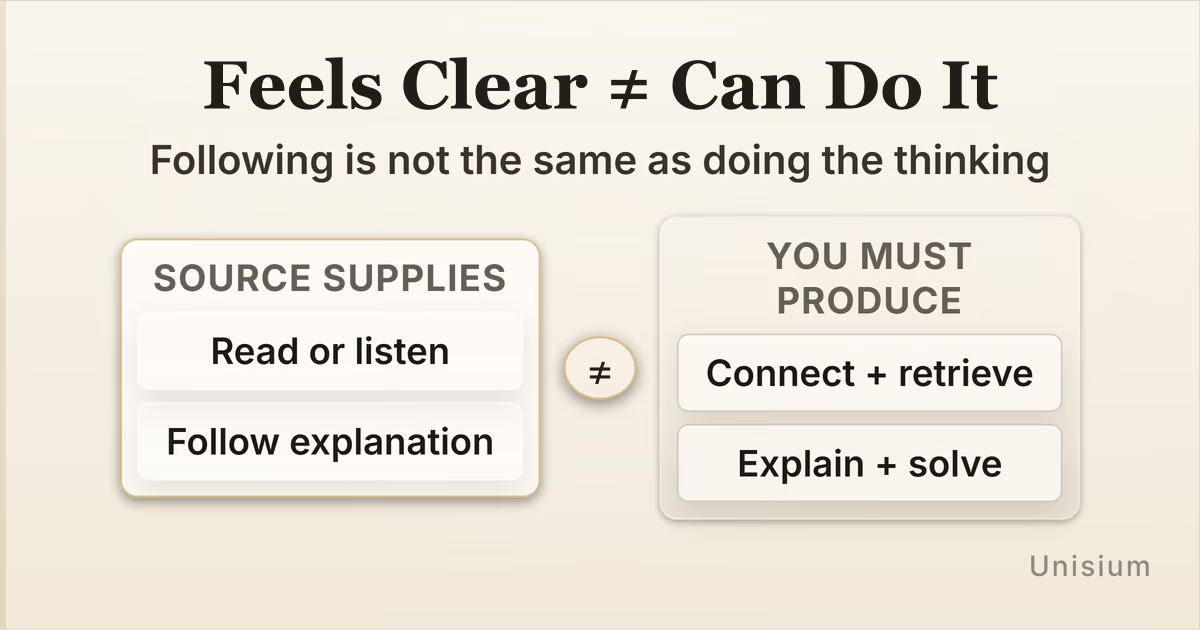
While information is visible, you may only need to notice that it makes sense. Later, you may need to connect ideas, retrieve knowledge, explain reasoning, or solve a problem. Success at following the information is not yet evidence that you can produce those operations yourself.
| Target capability | What can create the illusion | A task-matched check |
|---|---|---|
| Connect | A relationship seems obvious after the textbook or lecturer states it. | Generate the connection yourself, justify why it holds, and distinguish it from a plausible near-miss. |
| Retrieve | A principle, equation, or condition looks familiar while it is visible. | Retrieve its name, form, meaning, conditions, and relevant relationships without looking. |
| Explain | A lecture, textbook explanation, or worked solution makes sense while you follow it. | Explain the concept or hidden reasoning yourself, including the principles, conditions, setup, and goals. |
| Solve | You can follow someone else’s method or repeat a method that has already been identified. | Choose the relevant principles and method, construct the model, and carry out the solution without the reasoning path being supplied. |
Here, testing means attempting the target cognitive operation without its answer or reasoning path available. It does not require a formal quiz, score, timer, or exam atmosphere.
Understanding is the broader state built from sufficiently rich and usable declarative and procedural knowledge. Method selection is one action within solving, not a separate learning operation. Transfer provides stronger evidence because the wording, representation, surface features, or context have changed while the relevant underlying knowledge remains applicable.
If you want to know whether you can do something, stop looking at the information that tells you how and try to do it.
A Hidden Answer Can Still Give Away the Method
Producing an answer does not prove that the practice matches the target. The exercise may still supply decisions that you will later need to make yourself.
Ten exercises under “Integration by Parts” may test whether you can execute integration by parts without testing whether you would select it instead of substitution or partial fractions. A physics set labelled “Conservation of Energy” has already supplied a decision that an unfamiliar problem may require you to make.
Support can be reduced through a genuinely ordered progression:
- Study a complete worked solution. Follow the visible route while recognizing that this is supported performance, not yet evidence that you can generate the reasoning.
- Self-explain its reasoning. Produce the principles, conditions, setup, transformations, and goals that the solution leaves implicit.
- Complete missing steps. Work through a partially completed solution while some structure remains available.
- Reconstruct the reasoning. Hide the complete solution and reproduce its important decisions.
- Solve a related problem of a known type. Generate the full method when the category is still supplied.
- Choose among plausible problem types. Use a mixed set without method labels, then solve each problem.
- Solve varied problems after a delay. Change the wording, representation, surface details, or context after immediate familiarity has faded.
This progression does not mean that a novice should begin with mixed, unfamiliar problems. Complete examples and completion problems can provide necessary support while a method is new. Once the method is usable, interleaving related problem types makes discrimination and selection part of the solving task.
A minimal hint supplies part of the missing cognition. After using one, restart before the point where the hint became necessary, then attempt the task again later without the hint. Record a hinted solution as supported performance, not independent performance.
Immediate success can also depend on information that remains active from the explanation or preceding problem. Evidence becomes stronger as support is removed, time passes, and the context changes. One different-looking problem is evidence for transfer to that case, not proof of broad transfer.
Research supports this narrower calibration claim, with important limits. In heredity and genetics learning environments, practice problems after worked examples improved the accuracy of learners’ judgments and their later regulation without improving final-test performance, while completion problems with reduced support could lessen misjudgments depending on the task and learners’ prior knowledge.
A 2024 meta-analysis of 35 studies found a small average improvement in problem-solving monitoring accuracy, with meaningful differences among intervention types. Merely delaying a judgment or completing one answer-hidden attempt does not guarantee accurate calibration.
Use the First Breakdown to Find What to Learn Next
An unsuccessful attempt gives you information that another pass through the answer usually does not: where your independent thinking first breaks down. The first point where you need a cue shows the immediate bottleneck in your performance.
You do not need to assign yourself a permanent category. Identify what you could not produce at that moment, then check your provisional explanation against feedback, a worked solution, or another attempt.
A vague failure can send you searching for another book, video, course, app, or AI explanation. Before adding another resource, use the first breakdown to identify what is missing. If you still need another resource, you now know what job it needs to do.
| Where support becomes necessary | What may be missing | Productive next move |
|---|---|---|
| You cannot retrieve a relevant principle, equation, relationship, or condition. | The required declarative knowledge was not learned sufficiently or is not retrievable in this context. | Study and connect the missing knowledge, then use retrieval practice. |
| You can name the principle but cannot explain why it applies. | The relevant relationships, conditions, or goals are incomplete or weakly connected. | Compare cases and near-misses, then explain the principle and its conditions using elaborative encoding. |
| You can follow a worked step but cannot explain its purpose. | The solution’s hidden declarative structure was not made sufficiently explicit or retrievable. | Self-explain the principle, conditions, setup, action, and goal. |
| You cannot turn the situation into a useful diagram, model, or equations. | Relevant declarative knowledge may be missing, or the procedures for constructing a representation may be weak. | Compare representations, explain the setup choices, and practise constructing the model before doing the algebra. |
| You can describe what should happen but cannot execute it fluently. | You can describe the method, but the relevant condition-action procedures are still weak or insufficiently fluent. | Use completion problems and focused problem-solving practice with feedback. |
| You solve only familiar or labelled variants. | The learned procedures may depend on narrow cues. | Use mixed and varied problems that require method selection. |
In ACT-R, declarative knowledge includes information you can explicitly retrieve and manipulate: facts, equations, examples, relationships, conditions, goals, and descriptions of methods. Procedural knowledge consists of less explicit condition-action knowledge that controls what cognitive action occurs in a given problem state. Problem solving depends on both because procedural knowledge guides actions and brings relevant declarative knowledge to bear, a distinction described in Anderson and Schunn’s account of ACT-R learning theory.
Constructing a representation is therefore not a separate kind of stored knowledge. It is an activity that can fail because you lack relevant declarative knowledge, effective procedures for constructing the representation, or both.
More practice strengthens what the practice requires you to do. Repeating the same familiar procedure may make that procedure faster, but it may leave a missing principle, weak representation process, or narrow method-selection rule untouched. To develop broader procedural skill, practise the actions required by new problem states, not only more repetitions of the same visible pattern.
Use a Task-Matched Learning Loop
The following sequence describes increasing demands, not a mechanical checklist for every small fact. Focus on the operation your current goal requires, then add less support, more variation, or a delay when you need stronger evidence.
- Receive enough instruction to begin. Read the principle, attend the explanation, or study a worked example.
- Connect the new knowledge. Relate it to relevant prior knowledge and distinguish the conditions under which it applies.
- Retrieve what you need. Produce the principle, relationship, equation, and conditions without relying on the source.
- Explain the reasoning. Explain the concept or worked solution, including its hidden setup and goals.
- Solve the problem. Choose relevant knowledge, construct a representation, and execute the solution.
- Use feedback at the first breakdown. Expose and fill knowledge that is missing or unavailable, then restart before the point where support became necessary.
- Strengthen the evidence. Reduce support, mix problem types, vary the context, and repeat after a delay.
Failed attempts serve two roles. They reveal what needs to be learned, and the effort to retrieve or generate can strengthen usable knowledge when followed by accurate feedback. The loop breaks when you keep struggling without instruction, reveal the answer before making a meaningful attempt, or repeat an identical solution until its sequence is memorized.
The worked-example research gives this loop a useful boundary. In a classic study of mechanics examples, students who generated stronger self-explanations developed more example-independent knowledge than students who relied heavily on the examples. A later physics education study of retrieval and self-explanation reported that retrieving principles and conditions before self-explaining could improve explanation quality and later problem-solving performance in introductory mechanics.
Start Now: Test One Target for 10 Minutes
Choose one idea or worked problem that felt clear today, then name the operation you need: connect, retrieve, explain, or solve. Remove the information that would perform that operation for you and make a 10-minute attempt. If your goal is solving, reconstructing the original worked reasoning is a useful first check, while solving a related but non-identical problem is stronger evidence.
At the first cue you need, write one sentence about what you could not produce. Check the missing part, study or self-explain it, then restart before the breakdown. Your first win can arrive in 10 minutes: a vague feeling of “I do not get this” becomes a specific piece of knowledge or skill you can work on.
The trade-off is discomfort and slower page coverage. You must stop following information long enough to let your own thinking fail, then spend time repairing what the attempt exposes.
Common Mistakes and Better Checks
| Mistake | Better check |
|---|---|
| Rereading until the text feels familiar | Retrieve: Close the book and produce the principle, meaning, and conditions. |
| Rewatching a lecture and treating ease of following as recall or explanation ability | Retrieve and explain: Pause before the lecturer’s explanation, produce it yourself, then compare. |
| Narrating visible actions in a worked solution | Explain: Produce the hidden principle, conditions, setup, action, and goal. |
| Using equation recall as evidence of problem-solving skill | Solve: Choose and use the equation in an unlabeled problem. |
| Practising descriptions when the later task requires solving | Solve: Construct the model and complete the solution without the route supplied. |
| Completing blocks in which every problem has the same named method | Solve: Mix plausible problem types so method selection becomes part of the task. |
| Counting performance after a hint as independent | Explain or solve: Restart before the hint and reproduce the missing cognition without it. |
| Repeating only the same surface pattern | Connect and solve: Justify the shared structure across changes in wording, representation, or context. |
| Testing only immediately after instruction | Retrieve, explain, or solve: Repeat the target operation after a delay, when immediate familiarity has faded. |
FAQ
Why can’t I solve math problems on my own after understanding the lesson?
The lesson may have made sense and given you some genuine knowledge, but following it did not require all the actions involved in solving. Independent problem solving requires you to retrieve relevant knowledge, decide what applies, construct a representation, and execute the solution without those decisions being supplied. Your study may therefore have produced less knowledge than you thought, knowledge that is difficult to retrieve in the problem context, insufficient procedural skill, or a combination of these.
Why do I understand physics but struggle with problems?
Understanding is not all-or-nothing. You may understand the statements and relationships that were presented while still lacking some of the declarative knowledge and procedural skill needed to use them flexibly. If you repeatedly cannot solve relevant problems, your understanding is real but incomplete for that goal; one failed problem alone does not show that you understand nothing.
Receiving an explanation and following it is not the same performance as producing the explanation or solving the problem yourself. In ACT-R terms, flexible understanding depends on having enough declarative and procedural knowledge to use a concept in meaningful situations.
Why does a solution seem obvious only after I see it?
Once the solution is visible, it supplies the route and each step cues the next. You can follow that route without having generated the principles, representation, or sequence yourself. Hide the solution, explain its important decisions, then solve a related problem without the route supplied.
Is the illusion of competence the same as the Dunning-Kruger effect?
Not necessarily. This guide uses illusion of competence for a study-specific monitoring error: the evidence available during study does not match the later performance. That narrower mechanism does not require a broad claim about a person’s overall ability or self-awareness.
Does self-testing create missing prerequisite knowledge?
No. An attempt can reveal a missing prerequisite and the effort can strengthen knowledge, but you still need instruction, examples, feedback, or prerequisite study to fill what is absent. Use the attempt to decide what to learn next, then repeat the target operation without support.
How long should I try before checking the solution?
Try long enough to make the target operation and first breakdown visible, but not so long that you repeat unproductive moves. For a short step, 2–5 minutes may be enough; for a full unfamiliar problem, 10–20 minutes is a reasonable first bound. Check only what you need, then restart before the point where support became necessary.
Related Guides
- Self-Explanation: learn the hidden reasoning in worked examples.
- Problem Solving: develop independent modelling, method selection, and execution.
- Retrieval Practice: make principles, equations, relationships, and conditions available without notes.
- Elaborative Encoding: build and justify connections, conditions, and distinctions.
- Interleaving: mix plausible problem types so practice requires method selection and discrimination.
- Ineffective Study Techniques: replace familiarity-based study with task-relevant learning actions.
Browse the learning guide library for related strategies and domain-specific study workflows.
How This Fits in Unisium
The Unisium Study System asks learners to connect, retrieve, explain, and solve instead of continually viewing an answer. Unisium keeps principles, retrieval, self-explanation, worked solutions, problem solving, feedback, and progression in one guided system, so you spend less time assembling the study loop yourself. These mechanics can expose whether a learner can perform the target operation without the source, but they do not prove transfer or remove the need for prerequisite instruction and feedback. See Unisium’s 14-day free trial, or use Masterful Learning for the broader study framework.
Masterful Learning
The book behind these guides: a study system for physics, math, & programming built on retrieval, connection, explanation, and problem solving.
Ready to apply this strategy?
Unisium turns these evidence-based techniques into guided study sessions for math and physics. Places are limited during early access. Check current availability to start a trial; joining the mailing list is optional.
See plans and availability Read More GuidesAlready have access? Sign in