Electromagnetic Wave Speed: Vacuum Constants Set c
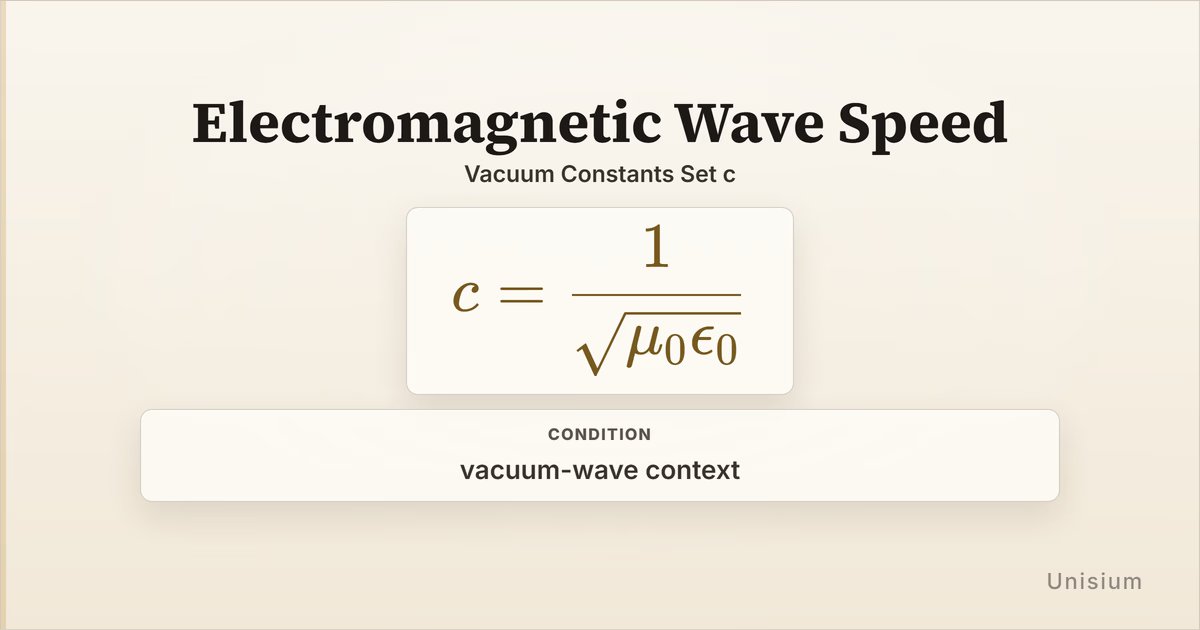
Electromagnetic Wave Speed says an electromagnetic wave in vacuum travels at . It applies in a vacuum-wave context, where the electric constant and magnetic constant set the wave speed. Use it to connect Maxwell-style field constants to light speed, but do not use it as the speed of light in a material medium.
This guide sits in the induction-and-waves branch of the Electromagnetism Principle Map. The surrounding ideas are wave propagation direction, polarization, medium effects, and later field-calculus laws. Those ideas explain where the relation comes from; the principle here is the vacuum speed relation itself.
On this page: The Principle | Conditions | Misconceptions | Elaborative Encoding | Retrieval Practice | Worked Example | Solve a Problem | Related Principles | FAQ | Related Guides | How This Fits
The Principle
Statement
Electromagnetic Wave Speed states that the speed of an electromagnetic wave in vacuum is fixed by the magnetic constant and electric constant . The relation shows that electric-field and magnetic-field behavior are not separate clocks; together they determine the vacuum propagation speed.
Mathematical Form
Where:
- is electromagnetic wave speed in vacuum, in meters per second
- is the magnetic constant, in newtons per ampere squared or henries per meter
- is the electric constant, in farads per meter
Alternative Forms
When solving for a constant instead of speed, the same relation can be rearranged:
- Solve for the product:
- Solve for one constant:
Conditions of Applicability
Condition: vacuum-wave context
Practical modeling notes
- Vacuum-wave context means the wave is treated as propagating through vacuum, not through glass, water, plasma, or a material dielectric.
- Use tabulated SI values consistently. Common intro-physics tables use and .
- The equation gives the propagation speed in vacuum. It does not decide polarization, amplitude, energy flow, or direction by itself.
When it does not apply directly
- Material medium: light in matter usually travels more slowly than ; medium properties replace the vacuum constants.
- Circuit signal speed: a signal on a wire depends on the surrounding transmission-line geometry and materials, not only on and .
- Wave amplitude questions: speed does not tell you field amplitude, intensity, or energy density without additional wave relations.
Want the complete framework behind this guide? Read Masterful Learning.
Common Misconceptions
Misconception 1: The equation says all light always travels at c
The truth: The canonical condition is vacuum-wave context. In materials, the wave speed depends on the medium.
Why this matters: Using for a material-medium problem can make wavelength, travel time, or refractive-index reasoning wrong.
Misconception 2: The constants are only unit-conversion factors
The truth: and encode how magnetic and electric fields behave in vacuum, and their product sets a physical speed scale.
Why this matters: The equation is a conceptual bridge between field laws and wave motion, not a random formula for memorizing .
Misconception 3: Speed depends on wave frequency in vacuum
The truth: In the ideal vacuum model, electromagnetic waves of different frequencies share the same speed .
Elaborative Encoding
Use these questions to build understanding before memorizing the formula. See Elaborative Encoding for the broader method.
Within the Principle
- Why does increasing the product make the computed wave speed smaller?
- What units must have so that becomes meters per second?
For the Principle
- What words in a problem tell you the vacuum-wave condition is being used?
- If a problem gives a refractive index or material permittivity, why should you pause before using this vacuum relation?
Between Principles
- How does this relation connect the induction branch after Faraday Law Finite Change to later Maxwell-equation forms?
Generate an Example
- Describe one vacuum electromagnetic wave situation where the relation applies and one material-medium situation where it should not be used directly.
Retrieval Practice
Answer from memory, then reveal the result and check it. See Retrieval Practice for the full study method.
State the principle in words: _____Electromagnetic wave speed in vacuum is set by the electric constant and magnetic constant.
Write the canonical equation: _____
State the canonical condition: _____vacuum-wave context
Worked Example
Use this worked example to practice Self-Explanation.
Problem
In a vacuum-wave context, use and to estimate the electromagnetic wave speed .
Step 1: Verbal Decoding
Target:
Given:
Constraints: vacuum-wave context; SI constants supplied
Step 2: Visual Decoding
Draw a small dependency map with and feeding into . Mark that the relation is for vacuum, not a material medium. (The key visual fact is that speed depends on the product .)
Step 3: Physics Modeling
Step 4: Mathematical Procedures
Step 5: Reflection
- Dimensional analysis: The product has units of , so the inverse square root has units of .
- Magnitude: The estimate matches the standard vacuum light speed scale.
- Interpretation: The result comes from field constants, not from choosing a wave frequency.
Before moving on: self-explain the model
Try explaining why Step 3 uses only the vacuum speed relation, why the constants must be in SI units, and why no wavelength or frequency information is needed.
Physics model with explanation
Principle: We use Electromagnetic Wave Speed because the problem asks for the wave speed from vacuum electromagnetic constants.
Conditions: The problem states a vacuum-wave context and supplies the constants in compatible SI units.
Relevance: The target is speed, and directly connects the given constants to that speed.
Description: Multiplying the constants gives a time-squared-per-length-squared scale. Taking the inverse square root turns that scale into a speed.
Goal: Estimate the vacuum electromagnetic wave speed and recognize it as the light-speed scale.
Solve a Problem
Apply what you have learned with Problem Solving.
Problem
In a vacuum-wave context, suppose and . Estimate .
Hint: Rearrange the same relation for before substituting numbers.
Show Solution
Step 1: Verbal Decoding
Target:
Given:
Constraints: vacuum-wave context; SI constants supplied
Step 2: Visual Decoding
Draw the same dependency map, but circle as the unknown and mark and as known. (The key visual fact is that the product must equal .)
Step 3: Physics Modeling
Step 4: Mathematical Procedures
Step 5: Reflection
- Dimensional analysis: The rearranged units reduce to farads per meter for .
- Magnitude: The result is close to the common tabulated value .
- Verification: Substituting this value back into the speed equation gives about .
Related Principles
See Electromagnetism: The Principle Map for where electromagnetic wave speed sits after induction and before field-calculus wave relations.
| Principle | Relationship to Electromagnetic Wave Speed |
|---|---|
| Faraday Law Finite Change | Introduces changing magnetic flux and induction, part of the route toward coupled electric and magnetic fields. |
| Motional EMF | Shows one earlier induction model where magnetic fields and motion create an electric effect. |
| Ampere-Maxwell Law | Later completes the coupled-field picture that supports electromagnetic waves in vacuum. |
See Principle Structures for a broader way to organize source laws, induction relations, and wave relations.
FAQ
What is Electromagnetic Wave Speed?
Electromagnetic Wave Speed is the principle that an electromagnetic wave in vacuum travels at . It connects the vacuum electric and magnetic constants to the speed of light in vacuum.
When does the electromagnetic wave speed formula apply?
It applies under the canonical condition: vacuum-wave context. If the wave travels through a material, use the model your course gives for that medium instead of automatically using the vacuum relation.
Why do and determine c?
They describe how magnetic and electric fields behave in vacuum. In Maxwell-style wave reasoning, the coupled field changes propagate at a speed determined by their product.
Is this the same as wavelength times frequency?
No. The relation connects speed, frequency, and wavelength for a wave. Electromagnetic Wave Speed gives the vacuum speed from electromagnetic constants before you choose a particular frequency or wavelength.
Does this formula work inside glass or water?
Not directly. In materials, electromagnetic waves interact with the medium, so the speed is usually lower than and depends on material properties.
Related Guides
- Electromagnetism: The Principle Map - Place wave speed in the induction-and-waves branch.
- Faraday Law Finite Change - Review an earlier induction relation before later coupled-field laws.
- Motional EMF - Compare a compact induction model with the later wave-speed bridge.
- Problem Solving - Practice converting conditions and constants into a usable model.
How This Fits in Unisium
Unisium treats Electromagnetic Wave Speed as a principle because the formula is short but the condition carries the meaning. The useful learning path is to encode the vacuum-wave condition, retrieve , self-explain why constants can set a speed, and solve problems where medium wording changes the model choice.
Ready to master Electromagnetic Wave Speed? Check access and join the Unisium waitlist or explore the full framework in Masterful Learning.
Masterful Learning
The book behind these guides: a study system for physics, math, & programming built on retrieval, connection, explanation, and problem solving.
Ready to apply this strategy?
Unisium turns these evidence-based techniques into guided study sessions for math and physics. Places are limited during early access. Check current availability to start a trial; joining the mailing list is optional.
See plans and availability Read More GuidesAlready have access? Sign in