Motional EMF: Moving Conductors in Magnetic Fields
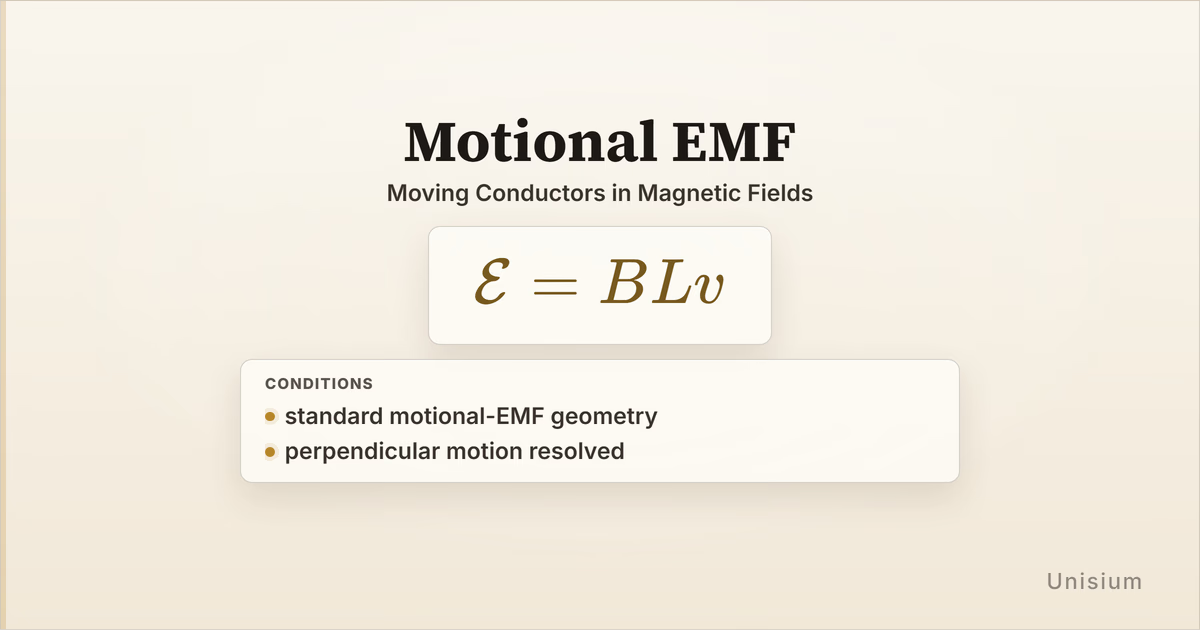
Motional EMF says a conductor moving through a magnetic field develops an induced emf in the standard geometry. It applies when the moving length, magnetic field, and relevant velocity component are perpendicular or have already been resolved into that form. Use it to find the voltage generated by a moving rod, rail, or conductor segment before deciding current direction or circuit details.
This guide follows Magnetic Flux In A Uniform Field in the induction branch of the Electromagnetism Principle Map. The surrounding decisions are rail-and-rod geometry recognition, choosing the length inside the field, resolving velocity perpendicular to the field and conductor, charge-separation polarity, Lenz-law current direction, and sign convention. Those decisions support the principle; they are not separate principle keys.
On this page: The Principle | Conditions | Misconceptions | Elaborative Encoding | Retrieval Practice | Worked Example | Solve a Problem | Related Principles | FAQ | Related Guides | How This Fits
The Principle
Statement
Motional EMF gives the induced emf across a conducting segment when motion through a magnetic field separates charge along the conductor. In the standard motional-EMF geometry, the active length , magnetic field magnitude , and speed combine as a scalar product after the perpendicular motion has been resolved.
Mathematical Form
Where:
- is the induced emf in volts,
- is the magnetic field strength in tesla,
- is the active conductor length in the magnetic field, in meters
- is the relevant speed perpendicular to the conductor and magnetic field, in meters per second
The diagram is a guide-level orientation scaffold. It shows the common sliding-rod case: a conducting rod of length moves through an into-page magnetic field with speed . The small plus and minus marks are a polarity cue for charge separation; deciding polarity or loop current is surrounding direction work, not the scalar principle itself.
Relation to magnetic flux
For a rod sliding on rails, the loop area changes as the rod moves. That makes Motional EMF closely connected to changing magnetic flux, but this guide uses the compact standard-geometry model directly. Later Faraday-law guides make the flux-change sign and Lenz-law direction explicit.
Conditions of Applicability
Condition: standard motional-EMF geometry; perpendicular motion resolved
Practical modeling notes
- Standard motional-EMF geometry means a conducting segment cuts magnetic-field lines in a way that lets one active length represent the segment.
- Perpendicular motion resolved means is the component of the conductor’s velocity that contributes to charge separation in this geometry.
- If the conductor moves at an angle, resolve the motion into the component perpendicular to the active length and magnetic field first; do not put the total speed into unless it is the perpendicular speed.
- If the field or geometry changes along the conductor, the compact scalar model may need a more general line-integral or flux-change treatment.
When it does not apply directly
- No effective cutting motion: if the relevant velocity component is zero, the motional emf is zero in this model.
- Nonstandard geometry: curved conductors, varying fields, or changing orientation may require a more general model.
- Current direction questions: the scalar equation gives emf magnitude; polarity and induced-current direction require an additional sign or Lenz-law convention.
Want the complete framework behind this guide? Read Masterful Learning.
Common Misconceptions
Misconception 1: Any motion through a field gives
The truth: The speed in the formula is the resolved motion for the standard geometry, not automatically the object’s total speed.
Why this matters: Using the wrong velocity component can overstate the induced emf.
Misconception 2: Motional EMF automatically gives current
The truth: EMF is a voltage-like source. Current also depends on whether there is a closed conducting path and on the circuit resistance.
Why this matters: A moving rod can have charge separation and emf even before you compute any current.
Misconception 3: The sign is contained in
The truth: The scalar form gives magnitude in the standard setup. Sign, polarity, and current direction come from the chosen orientation convention and surrounding direction work.
Elaborative Encoding
Use these questions to build understanding before memorizing the formula. See Elaborative Encoding for the broader method.
Within the Principle
- Why does doubling the active rod length double the induced emf in the standard geometry?
- What does the velocity symbol mean after “perpendicular motion resolved” has been applied?
For the Principle
- What wording in a problem tells you the setup is the standard sliding-conductor geometry?
- Before using , what must be decided about which part of the conductor counts as ?
Between Principles
- How does Motional EMF connect to Magnetic Flux In A Uniform Field when a sliding rod changes loop area?
Generate an Example
- Describe a moving conductor setup where the rod moves faster but the induced emf stays zero because the relevant perpendicular velocity component is zero.
Retrieval Practice
Answer from memory, then reveal the result and check it. See Retrieval Practice for the full study method.
State the principle in words: _____In the standard motional-EMF geometry, induced emf equals magnetic field strength times active conductor length times the resolved perpendicular speed.
Write the canonical equation: _____
State the canonical condition: _____standard motional-EMF geometry; perpendicular motion resolved
Worked Example
Use this worked example to practice Self-Explanation.
Problem
A conducting rod of length stands perpendicular to two conducting rails and slides to the right through a uniform magnetic field of magnitude . The magnetic field is perpendicular to both the rod and the rod’s motion, and the rod moves at . Find the magnitude of the motional emf across the rod.
Step 1: Verbal Decoding
Target:
Given:
Constraints: standard sliding-rod motional-EMF geometry; field, active length, and motion are mutually perpendicular; asking for magnitude
Step 2: Visual Decoding
Draw two rails, a vertical rod of length , magnetic-field markers perpendicular to the page, and a velocity arrow along the rails. (The key visual fact is that the given speed is already the perpendicular speed for .)
Step 3: Physics Modeling
Step 4: Mathematical Procedures
Step 5: Reflection
- Dimensional analysis: Tesla times meter times meter per second gives volts.
- Interpretation: Faster motion separates charge more strongly, so the induced emf increases with .
- Limiting case: If the rod stopped moving, the model would give zero motional emf.
Before moving on: self-explain the model
Try explaining why Step 3 uses the scalar standard-geometry form, what counts as , and why no current direction is needed to find the emf magnitude.
Physics model with explanation
Principle: We use Motional EMF because the problem gives a conducting rod moving through a magnetic field in the standard geometry.
Conditions: The rod length, magnetic field, and relevant velocity component are already perpendicular, so the given speed is the resolved speed.
Relevance: The target is induced emf magnitude, so directly connects the given quantities to the answer.
Description: The moving rod sweeps through the field; magnetic forces on charges in the conductor separate charge until an emf appears across the rod.
Goal: Compute the voltage-like induced emf across the moving conductor.
Solve a Problem
Apply what you have learned with Problem Solving.
Problem
A conducting rod of active length stands perpendicular to two conducting rails and moves through a uniform magnetic field of magnitude . The field is perpendicular to both the rod and the rod’s motion. The measured motional emf is . Find the rod’s speed.
Hint: Rearrange the same motional-EMF relation for .
Show Solution
Step 1: Verbal Decoding
Target:
Given:
Constraints: rod, field, and motion are mutually perpendicular; asking for speed
Step 2: Visual Decoding
Draw the rod perpendicular to the rails, mark its active length , show the magnetic field perpendicular to both the rod and the motion, and draw a velocity arrow for the unknown speed. (The key visual fact is that the given setup makes the rod’s speed the perpendicular speed used in .)
Step 3: Physics Modeling
Step 4: Mathematical Procedures
Step 5: Reflection
- Dimensional analysis: Volts divided by tesla meters gives meters per second.
- Magnitude: A one-volt-scale emf from a short rod in a moderate field requires several meters per second of motion.
- Verification: Substituting into returns .
Related Principles
See Electromagnetism: The Principle Map for where Motional EMF sits between magnetic-field models, flux models, and induction.
| Principle | Relationship to Motional EMF |
|---|---|
| Magnetic Flux In A Uniform Field | A sliding rod changes loop area, so this scalar model often agrees with a flux-change view. |
| Magnetic Force On A Moving Charge | Charge separation in the rod comes from magnetic force on moving charges. |
| Faraday Law Finite Change | induction relation that handles average induced emf from changing magnetic flux. |
See Principle Structures for a broader view of how source, force, flux, and induction relations connect.
FAQ
What is Motional EMF?
Motional EMF is the induced emf produced when a conductor moves through a magnetic field in the standard geometry. Its canonical scalar form is .
When does apply?
It applies under the canonical condition: standard motional-EMF geometry; perpendicular motion resolved. If the motion is angled, first use the velocity component that fits the standard geometry.
Does motional emf require a closed circuit?
No. A moving conductor can develop an emf through charge separation even before you compute a circuit current. A closed circuit is needed if you want sustained induced current.
Which length is in motional emf?
is the active conductor length in the magnetic field that participates in the standard geometry. In the common sliding-rod setup, it is the rod length between the rails.
How is motional emf related to Faraday’s law?
In a sliding-rod loop, rod motion changes the loop area and therefore changes magnetic flux. Faraday’s law handles that flux-change view, while this guide uses the compact standard-geometry model.
Related Guides
- Electromagnetism: The Principle Map - Place motional emf in the wider induction branch.
- Magnetic Flux In A Uniform Field - Review the flux relation that connects to changing loop area.
- Magnetic Force On A Moving Charge - Connect charge motion in a field to force and charge separation.
- Problem Solving - Practice turning a physical setup into a usable model.
How This Fits in Unisium
Unisium treats Motional EMF as a principle because the formula is short but the setup is easy to misread. The useful learning path is to encode the geometry, retrieve with its condition, self-explain which speed and length are active, and solve new problems where the perpendicular component is not hidden inside the wording.
Ready to master Motional EMF? Check access and join the Unisium waitlist or explore the full framework in Masterful Learning.

Masterful Learning
The book behind these guides: a study system for physics, math, & programming built on retrieval, connection, explanation, and problem solving.
Ready to apply this strategy?
Unisium turns these evidence-based techniques into guided study sessions for math and physics. Places are limited during early access. Check current availability to start a trial; joining the mailing list is optional.
See plans and availability Read More GuidesAlready have access? Sign in