Faraday Law Finite Change: Average Induced EMF
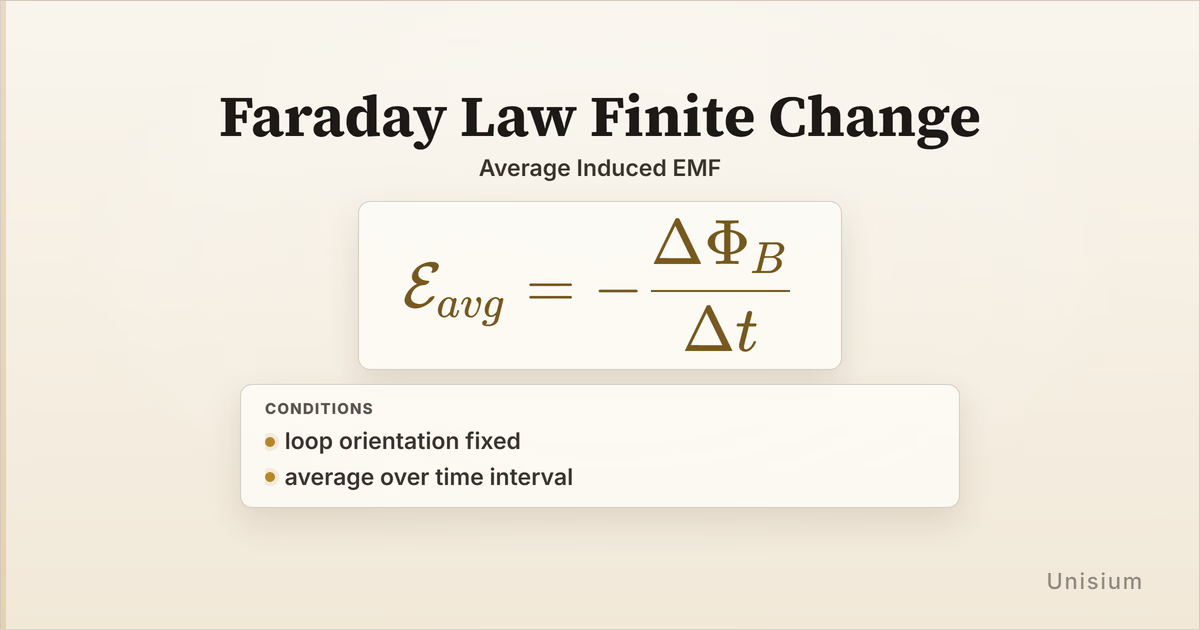
Faraday Law Finite Change says the average induced EMF around a loop is the negative magnetic-flux change per time interval. The model is , and it applies when the loop orientation stays fixed while you average over a time interval. Use it when flux changes through a chosen loop direction; the minus sign is about that orientation, not a separate current calculation.
This guide follows Magnetic Flux In A Uniform Field and Motional EMF in the induction branch of the Electromagnetism Principle Map. The surrounding decisions are loop orientation, flux-change sign, and Lenz-law direction. Those choices support the principle; they are not separate principle keys.
On this page: The Principle | Conditions | Misconceptions | Elaborative Encoding | Retrieval Practice | Worked Example | Solve a Problem | Related Principles | FAQ | Related Guides | How This Fits
The Principle
Statement
Faraday Law Finite Change models the average induced EMF around a fixed-oriented loop from the magnetic flux change through that loop. The negative sign means the induced EMF is negative relative to the chosen positive loop orientation when the signed flux through that orientation increases.
Mathematical Form
Where:
- is the average induced EMF around the loop, in volts
- is the final magnetic flux minus the initial magnetic flux, in webers
- is the elapsed time interval, in seconds
The diagram is a guide-level orientation scaffold. It shows one sign case: the chosen area vector and positive loop direction stay fixed, the signed magnetic flux increases, and the average induced EMF is negative relative to that chosen positive loop direction. Deciding the physical current direction in a circuit uses the same sign information plus Lenz-law reasoning and circuit details.
Average, not instant
This finite-change form averages over an interval. If flux changes steadily, the average value also represents the constant induced EMF during that interval. If flux changes unevenly, the formula gives the interval average, not the exact value at each instant.
Conditions of Applicability
Condition: loop orientation fixed; average over time interval
Practical modeling notes
- Loop orientation fixed means the positive circulation direction and its matching area-vector direction do not change while comparing initial and final flux.
- Average over time interval means is a finite elapsed time, so the result is an interval average.
- Use signed magnetic flux. A flux increase in the chosen area-vector direction has positive .
- The minus sign belongs to the orientation convention; do not drop it because the problem asks for “EMF” instead of “sign.”
When it does not apply directly
- Changing orientation convention: if you change the positive loop direction between snapshots, the sign of is no longer meaningful.
- Instantaneous EMF question: if the problem asks for the value at one instant and the flux changes nonlinearly, use the derivative form when your course has introduced it.
- Current magnitude question: induced current also needs circuit resistance or impedance; Faraday law gives the EMF around the loop.
Want the complete framework behind this guide? Read Masterful Learning.
Common Misconceptions
Misconception 1: The minus sign means the answer should always be negative
The truth: The sign depends on the signed flux change and the chosen positive loop orientation.
Why this matters: If is negative, the negative sign makes positive relative to the chosen orientation.
Misconception 2: Flux magnitude is enough
The truth: Faraday law uses signed magnetic flux, so area-vector direction and loop orientation matter.
Why this matters: Two setups with the same flux magnitudes can give opposite EMF signs if their chosen orientations differ.
Misconception 3: Average EMF gives the full current story
The truth: EMF is the induced voltage around the loop. Current direction and magnitude require circuit context, resistance, and sign interpretation.
Elaborative Encoding
Use these questions to build understanding before memorizing the formula. See Elaborative Encoding for the broader method.
Within the Principle
- What does the negative sign compare: two flux values, or flux change against a chosen loop orientation?
- Why does have the same units as voltage?
For the Principle
- What wording in a problem tells you the loop orientation has stayed fixed over the interval?
- Before assigning the sign of , what must be chosen about the loop and area vector?
Between Principles
- How does this finite-change relation build on Magnetic Flux In A Uniform Field when the flux is computed from field strength, area, and angle?
Generate an Example
- Describe a loop where the magnetic field strength increases while the loop orientation stays fixed, then predict the sign of the average induced EMF for your chosen positive direction.
Retrieval Practice
Answer from memory, then reveal the result and check it. See Retrieval Practice for the full study method.
State the principle in words: _____The average induced EMF around a fixed-oriented loop equals the negative change in signed magnetic flux divided by the elapsed time interval.
Write the canonical equation: _____
State the canonical condition: _____loop orientation fixed; average over time interval
Worked Example
Use this worked example to practice Self-Explanation.
Problem
A single loop has a fixed chosen positive orientation. The signed magnetic flux through the loop changes from to in . Find the average induced EMF around the loop relative to the chosen positive orientation.
Step 1: Verbal Decoding
Target:
Given:
Constraints: loop orientation fixed; signed magnetic flux values use the same orientation; average over a finite time interval
Step 2: Visual Decoding
The figure fixes the same chosen loop direction in both snapshots and gives the signed initial and final flux values. Use that fixed orientation to form the signed flux change before applying the finite-change law.
Step 3: Physics Modeling
Step 4: Mathematical Procedures
Step 5: Reflection
- Dimensional analysis: Webers per second are volts.
- Interpretation: The negative sign means the induced EMF is opposite the chosen positive loop orientation.
- Verification: Since the signed flux increased, the negative sign should make the average EMF negative.
Before moving on: self-explain the model
Try explaining why Step 3 uses final flux minus initial flux, why the same loop orientation must be kept, and what the negative sign says before any current calculation.
Physics model with explanation
Principle: We use Faraday Law Finite Change because the problem asks for average induced EMF from a magnetic flux change over a finite interval.
Conditions: The loop orientation is fixed, and the flux values are signed using the same orientation throughout the interval.
Relevance: The target is EMF around the loop, so the flux change per time directly connects the given quantities to the answer.
Description: The final flux is larger than the initial flux, so is positive. Faraday’s negative sign makes the induced EMF negative relative to the chosen positive direction.
Goal: Compute the average induced EMF with its sign.
Solve a Problem
Apply what you have learned with Problem Solving.
Problem
A fixed-oriented loop has an average induced EMF of over . Find the signed change in magnetic flux through the loop over that interval.
Hint: Rearrange Faraday Law Finite Change before substituting numbers.
Show Solution
Step 1: Verbal Decoding
Target:
Given:
Constraints: loop orientation fixed; average EMF is signed relative to the chosen positive loop orientation; average over a finite time interval
Step 2: Visual Decoding
No extra geometry is needed here: the problem already states that the loop orientation is fixed and that the average EMF is signed relative to that chosen direction. Treat as a signed circulation value before rearranging Faraday’s finite-change relation.
Step 3: Physics Modeling
Step 4: Mathematical Procedures
Step 5: Reflection
- Dimensional analysis: Volt-seconds are webers.
- Interpretation: A positive average EMF corresponds to decreasing signed magnetic flux.
- Verification: Substituting into Faraday law gives .
Related Principles
See Electromagnetism: The Principle Map for where Faraday Law Finite Change sits between magnetic flux and later field-calculus induction forms.
| Principle | Relationship to Faraday Law Finite Change |
|---|---|
| Magnetic Flux In A Uniform Field | Supplies one common way to compute the signed flux values that later change. |
| Motional EMF | Handles a common moving-conductor geometry that can also be interpreted through changing flux. |
| Faraday Law Integral | Generalizes induction to a line integral around a loop and changing magnetic flux through a surface. |
See Principle Structures for a broader view of how flux, induction, and sign conventions fit into one map.
FAQ
What is Faraday Law Finite Change?
Faraday Law Finite Change is the finite-interval form of electromagnetic induction. It says the average induced EMF around a fixed-oriented loop equals the negative signed magnetic-flux change divided by the elapsed time interval.
When does Faraday Law Finite Change apply?
It applies under the canonical condition: loop orientation fixed; average over time interval. The same positive loop direction and matching area-vector orientation must be used for the initial and final flux values.
What does the minus sign mean in Faraday law?
The minus sign says the induced EMF is oriented to oppose the signed flux change relative to the chosen loop orientation. It is the mathematical sign convention behind the direction idea often taught with Lenz’s law.
Is this the same as motional EMF?
No. Motional EMF is a compact geometry-specific model, such as for a moving rod. Faraday Law Finite Change uses magnetic-flux change over time and can describe broader induction setups.
What if the flux changes nonlinearly?
The finite-change formula still gives the average induced EMF over the interval. For an instantaneous value, use the derivative form after it has been introduced.
Related Guides
- Electromagnetism: The Principle Map - Place finite-change Faraday law in the induction branch.
- Magnetic Flux In A Uniform Field - Review signed magnetic flux before using its change.
- Motional EMF - Compare the flux-change view with a standard moving-conductor model.
- Problem Solving - Practice turning sign conventions and quantities into a usable model.
How This Fits in Unisium
Unisium treats Faraday Law Finite Change as a principle because the equation is compact but the orientation meaning is easy to flatten into a memorized minus sign. The useful learning path is to encode the fixed-loop condition, retrieve , self-explain the sign convention, and solve problems where the flux change is signed rather than guessed.
Ready to master Faraday Law Finite Change? Check access and join the Unisium waitlist or explore the full framework in Masterful Learning.

Masterful Learning
The book behind these guides: a study system for physics, math, & programming built on retrieval, connection, explanation, and problem solving.
Ready to apply this strategy?
Unisium turns these evidence-based techniques into guided study sessions for math and physics. Places are limited during early access. Check current availability to start a trial; joining the mailing list is optional.
See plans and availability Read More GuidesAlready have access? Sign in