Electric Power: Current, Voltage, and Energy Rate
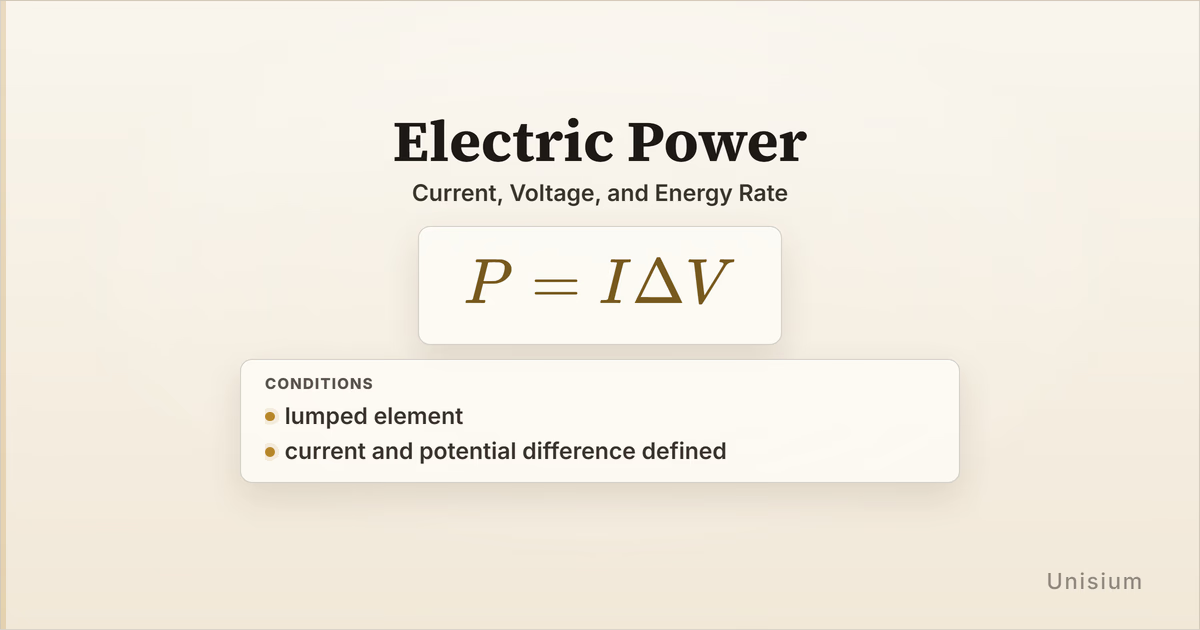
Electric Power says the power associated with one lumped element is current through the element times potential difference across it. The model is , and it applies when the element is lumped and both current and potential difference are defined for that same element. Use it to find the rate of electrical energy transfer, not to mix a total circuit voltage with the current through an unrelated branch.
This guide follows Electric Current Definition, Resistance From Geometry, and Ohm’s Law in the circuit branch of the Electromagnetism Principle Map. The surrounding decisions are choosing the element boundary, pairing current with the voltage across that same element, choosing a sign convention, and deciding whether a problem asks for power absorbed, delivered, or only a positive magnitude.
On this page: The Principle | Conditions | Misconceptions | Elaborative Encoding | Retrieval Practice | Worked Example | Solve a Problem | Related Principles | FAQ | Related Guides | How This Fits
The Principle
Statement
Electric Power models how quickly electrical energy is transferred at one lumped circuit element. If current flows through the element and potential difference is measured across that same element, then the power associated with that element is their product. The relation is local to the chosen element, so the current and potential difference must refer to the same object boundary.
Mathematical Form
Where:
- is electric power in watts
- is current through the element in amperes
- is potential difference across the element in volts
The diagram shows the bookkeeping that makes the formula meaningful: goes through one lumped element, while is measured across the terminals of that same element. The sign of depends on the current direction and voltage polarity convention; many introductory problems ask for the positive rate of energy transfer, but signed circuit equations still need a consistent convention.
Useful Ohm-derived forms
When Ohm’s Law also applies to the same ohmic element, electric power can be rewritten as:
- Current-resistance form:
- Voltage-resistance form:
These are not separate power principles. They require the extra ohmic-element condition from Ohm’s Law.
Conditions of Applicability
Condition: lumped element; current and potential difference defined
Practical modeling notes
- Lumped element means the device or circuit part is treated as one element with terminals, rather than as an extended field distribution.
- The current must be the current through the selected element.
- The potential difference must be measured across the same selected element.
- Use signed power only after choosing current direction and voltage polarity. With the passive sign convention, positive means the element absorbs power.
- For magnitude-only questions, use the positive current and voltage magnitudes and state the power as a rate in watts.
When it does not apply directly
- Mismatched quantities: total battery voltage with current through only one branch may not describe one element’s power.
- Distributed or wave behavior: if voltage and current cannot be assigned to one lumped element, a local field or circuit model may be needed instead.
- Missing sign convention: a signed answer for delivered or absorbed power is not meaningful until current direction and voltage polarity are paired.
Want the complete framework behind this guide? Read Masterful Learning.
Common Misconceptions
Misconception 1: Power is just voltage or just current
The truth: Electric power depends on both current through an element and potential difference across it.
Why this matters: A large voltage with tiny current, or a large current with tiny voltage, may transfer much less power than the larger-looking single number suggests.
Misconception 2: Any voltage in the circuit can be multiplied by any current
The truth: pairs the current through one selected element with the potential difference across that same element.
Why this matters: Mixing quantities from different circuit parts gives the power of no clear physical object.
Misconception 3: The resistance power formulas always apply
The truth: and come from combining electric power with Ohm’s Law, so they require an ohmic element as well.
Elaborative Encoding
Use these questions to build understanding before memorizing the formula. See Elaborative Encoding for the broader method.
Within the Principle
- Why does doubling double when stays fixed?
- Why do amperes times volts reduce to watts, or joules per second?
For the Principle
- Before using , how do you check that the current and potential difference belong to the same element?
- What wording tells you whether the problem wants signed power absorbed or just a positive power magnitude?
Between Principles
- How does Ohm’s Law create the extra forms and ?
Generate an Example
- Describe one device that absorbs electric power and one source that delivers electric power, using current and potential difference language.
Retrieval Practice
Answer from memory, then reveal the result and check it. See Retrieval Practice for the full study method.
State the principle in words: _____Electric power equals the current through a lumped element times the potential difference across that same element.
Write the canonical equation: _____
State the canonical condition: _____lumped element; current and potential difference defined
Worked Example
Use this worked example to practice Self-Explanation.
Problem
A lamp has a potential difference of across it while a steady current of flows through it. Find the electric power absorbed by the lamp.
Step 1: Verbal Decoding
Target:
Given:
Constraints: lumped element; current is through the lamp; potential difference is across the lamp
Step 2: Visual Decoding
Draw one lamp as a single circuit element, mark the two terminals where is measured, and draw current through that same lamp. (The key visual fact is that the voltage and current are paired to one element.)
Step 3: Physics Modeling
Step 4: Mathematical Procedures
Step 5: Reflection
- Dimensional analysis: Amperes times volts gives watts, so the units match power.
- Magnitude: A small lamp using a few watts is plausible.
- Interpretation: The lamp absorbs electrical energy at a rate of .
Before moving on: self-explain the model
Try explaining why Step 3 uses the lamp’s current and the lamp’s potential difference together, and why the chosen element boundary matters before multiplying.
Physics model with explanation
Principle: We use Electric Power because the problem gives current through one lumped element and potential difference across that same element.
Conditions: The lamp is treated as one element, and both and are defined for the lamp, so the canonical condition is satisfied.
Relevance: The target is directly related to the given current and voltage by .
Description: The lamp is the object where electrical energy is being transferred, so the current-voltage pair describes the lamp’s power.
Goal: Multiply current by potential difference to find the rate of energy transfer.
Solve a Problem
Apply what you have learned with Problem Solving.
Problem
A small heater uses electric power when the potential difference across it is . Find the current through the heater.
Hint: Rearrange the electric power relation for current before substituting numbers.
Show Solution
Step 1: Verbal Decoding
Target:
Given:
Constraints: lumped element; current is through the heater; potential difference is across the heater
Step 2: Visual Decoding
Draw one heater element, label the potential difference across its terminals, and draw the current through it. (The key visual fact is that the given power belongs to that same current-voltage pair.)
Step 3: Physics Modeling
Step 4: Mathematical Procedures
Step 5: Reflection
- Dimensional analysis: Watts divided by volts gives amperes because .
- Verification: Substituting and gives .
- Interpretation: At the same voltage, larger power would require larger current through the heater.
Related Principles
See Electromagnetism: The Principle Map for where electric power sits in the simple circuit-model sequence.
| Principle | Relationship to Electric Power |
|---|---|
| Electric Current Definition | Defines current before it is used in the power relation. |
| Ohm’s Law | Can combine with electric power to produce resistance-based power forms. |
| Equivalent Resistance In Series | Later circuit simplification helps identify current and voltage for resistor networks. |
See Principle Structures for a broader view of how definitions, element laws, and energy-rate relations connect.
FAQ
What is Electric Power?
Electric Power is the relation . It says the power associated with a lumped element equals the current through it times the potential difference across it, with sign determined by the chosen current direction and voltage polarity.
When does Electric Power apply?
It applies for a lumped element when current and potential difference are defined. In practice, check that the current and voltage belong to the same selected element.
What is the difference between electric power and Ohm’s Law?
Electric power relates energy-transfer rate to current and voltage. Ohm’s Law relates voltage, current, and resistance for an ohmic element; combining the two gives and .
Is electric power always positive?
No. Signed power depends on the chosen current direction and voltage polarity. Many introductory problems ask for a positive magnitude, but circuit analysis may distinguish power absorbed from power delivered.
What is the most common mistake with electric power?
The most common mistake is multiplying a voltage from one part of a circuit by a current from another part. The formula needs the current through and potential difference across the same lumped element.
Related Guides
- Electric Current Definition - Review what current means before using it in a power relation.
- Ohm’s Law - Connect voltage and current through resistance when an element is ohmic.
- Electromagnetism Principle Map - Place electric power in the broader circuit sequence.
- Problem Solving - Practice turning a physical setup into the right model.
How This Fits in Unisium
Unisium treats Electric Power as a principle because the formula is short but the object boundary does real work: select one lumped element, pair its current with its potential difference, and decide whether the sign or magnitude is being requested. The useful learning path is to encode that boundary, retrieve with its condition, self-explain examples where the target changes, and solve new circuit problems before adding resistor networks or Kirchhoff rules.
Want to study physics principles this way? Check access and join the Unisium waitlist or read the full framework in Masterful Learning.
Masterful Learning
The book behind these guides: a study system for physics, math, & programming built on retrieval, connection, explanation, and problem solving.
Ready to apply this strategy?
Unisium turns these evidence-based techniques into guided study sessions for math and physics. Places are limited during early access. Check current availability to start a trial; joining the mailing list is optional.
See plans and availability Read More GuidesAlready have access? Sign in