Resistance From Geometry: Length, Area, and Material
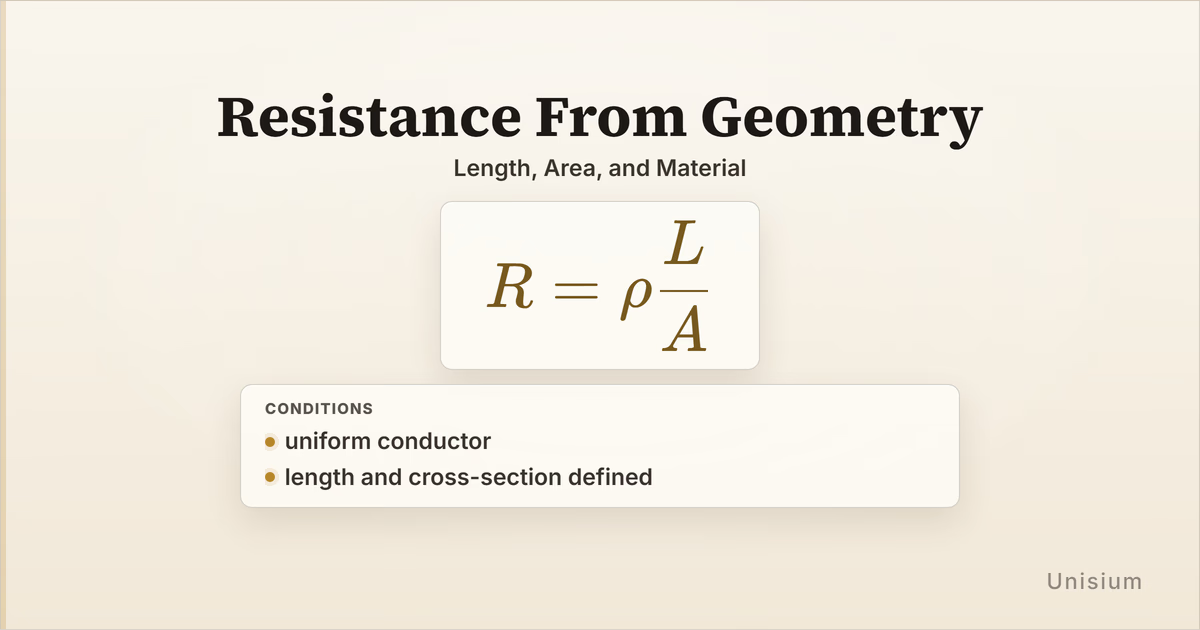
Resistance From Geometry says a uniform conductor has resistance . It applies when the conductor is uniform and its length and cross-section are defined. Use it when resistance comes from material and shape: longer conductors resist more, wider cross-sections resist less, and resistivity belongs to the material.
This guide sits near Electric Current Definition in the resistor-and-circuit branch of the Electromagnetism Principle Map. The surrounding decisions are identifying the current path length, choosing the effective cross-section perpendicular to current, and deciding whether one resistivity value can represent the conductor; those are setup decisions around the principle, not separate principles.
On this page: The Principle | Conditions | Misconceptions | Elaborative Encoding | Retrieval Practice | Worked Example | Solve a Problem | Related Principles | FAQ | Related Guides | How This Fits
The Principle
Statement
Resistance From Geometry predicts the resistance of a uniform conductor from the material it is made of and the shape of the current path. Resistivity tells how strongly the material resists current, length tells how much material the current must pass through, and cross-sectional area tells how much room the current has to flow. The principle is a geometry model for resistance before later circuit relations connect that resistance to voltage and current.
Mathematical Form
Where:
- is resistance in ohms, with
- is resistivity in ohm-meters,
- is conductor length along the current path in meters
- is cross-sectional area perpendicular to the current in square meters
The diagram shows the bookkeeping choices the formula needs. The same material fills the conductor, the length is measured along the current path, and the area is the cross-section available to the current.
Common equivalent form
Conductivity is the reciprocal of resistivity, so the same model can be written:
This is not a new principle. It is the same geometry relation with the material parameter written as conductivity instead of resistivity.
Conditions of Applicability
Condition: uniform conductor; length and cross-section defined
Practical modeling notes
- Uniform conductor means one material resistivity and one effective cross-section can represent the current path.
- Measure along the path current takes, not merely the straight-line distance between two visible points.
- Use the cross-sectional area perpendicular to current. For a round wire with radius , that area is .
- Resistivity is a material property. Changing length or area changes resistance without changing .
- If temperature changes enough to change resistivity, treat that as a separate material-model question before using one value of .
When it does not apply directly
- Nonuniform material: if resistivity changes along the conductor, one value may not describe the whole path.
- Changing cross-section: if the area varies strongly along the path, the compact model may need a segmented or integral treatment.
- Unclear current path: if the geometry does not define the direction and cross-section of current flow, the variables in the formula are not yet meaningful.
Want the complete framework behind this guide? Read Masterful Learning.
Common Misconceptions
Misconception 1: Resistivity and resistance are the same thing
The truth: Resistivity belongs to the material, while resistance belongs to a particular object made with a particular length and area.
Why this matters: A copper wire and a copper busbar can have the same resistivity but sharply different resistances because their geometry differs.
Misconception 2: A longer wire has lower resistance because it has more material
The truth: A longer current path increases resistance in this model because charge carriers move through more conducting material along the path.
Why this matters: Treating length as “more room” reverses the parameter dependence. More cross-sectional area lowers resistance; more length raises it.
Misconception 3: Area means the surface area of the outside of the wire
The truth: is the cross-sectional area perpendicular to current flow, not the outside surface area of the conductor.
Elaborative Encoding
Use these questions to build understanding before memorizing the formula. See Elaborative Encoding for the broader method.
Within the Principle
- Why does doubling double when and stay fixed?
- Why does doubling halve when and stay fixed?
For the Principle
- What wording or diagram evidence tells you which direction should count as the conductor length?
- Before using , how would you check that the conductor can be treated as uniform?
Between Principles
- How does this geometry model prepare for Ohm’s Law, where resistance later relates voltage and current?
Generate an Example
- Describe two conductors made of the same material where geometry alone makes one have larger resistance.
Retrieval Practice
Answer from memory, then reveal the result and check it. See Retrieval Practice for the full study method.
State the principle in words: _____A uniform conductor's resistance equals material resistivity times conductor length divided by cross-sectional area.
Write the canonical equation: _____
State the canonical condition: _____uniform conductor; length and cross-section defined
Worked Example
Use this worked example to practice Self-Explanation.
Problem
A uniform copper wire has resistivity , length , and cross-sectional area . Find the resistance of the wire.
Step 1: Verbal Decoding
Target:
Given:
Constraints: uniform conductor; length is along the current path; cross-section is defined
Step 2: Visual Decoding
Draw the wire as a long uniform cylinder, label the end-to-end current path length , and mark the circular cross-section as . (The key visual fact is that is in the numerator and the perpendicular cross-section is in the denominator.)
Step 3: Physics Modeling
Step 4: Mathematical Procedures
Step 5: Reflection
- Dimensional analysis: times meters divided by leaves ohms.
- Magnitude: A low resistance is plausible for a short copper wire with a square-millimeter-scale cross-section.
- Parameter dependence: Doubling the wire length would double the resistance if material and area stayed fixed.
Before moving on: self-explain the model
Try explaining why Step 3 uses a geometry model rather than voltage and current, why the material is represented by , and why the area must be perpendicular to the current path.
Physics model with explanation
Principle: We use Resistance From Geometry because the problem gives material, length, and cross-sectional area, and asks for resistance.
Conditions: The wire is uniform, its length is measured along the current path, and its cross-section is defined, so the canonical condition is satisfied.
Relevance: The target is exactly the quantity modeled by .
Description: The wire acts like one uniform conducting path: longer path increases resistance, while wider cross-section lowers it.
Goal: Substitute the material and geometry values into the resistance formula to find the object’s resistance.
Solve a Problem
Apply what you have learned with Problem Solving.
Problem
A uniform wire has resistance , resistivity , and length . Find its cross-sectional area .
Hint: Rearrange the geometry relation for before substituting numbers.
Show Solution
Step 1: Verbal Decoding
Target:
Given:
Constraints: uniform conductor; length is along the current path; cross-section is defined
Step 2: Visual Decoding
Draw a uniform conductor with length and mark the unknown cross-section perpendicular to the current path. (The key visual fact is that a larger cross-section would lower the same material-and-length resistance.)
Step 3: Physics Modeling
Step 4: Mathematical Procedures
Step 5: Reflection
- Dimensional analysis: times meters divided by ohms leaves square meters.
- Verification: Substituting back into the formula gives .
- Interpretation: A larger required area would mean the same material and length need more conducting width to keep resistance low.
Related Principles
See Electromagnetism: The Principle Map for where resistance geometry starts the resistor branch.
| Principle | Relationship to Resistance From Geometry |
|---|---|
| Electric Current Definition | Defines current before resistance is connected to voltage and current in circuits. |
| Ohm’s Law | Uses resistance as the proportionality between voltage and current for an ohmic element. |
| Electric Power | Uses voltage and current, or circuit substitutions involving resistance, to calculate power. |
See Principle Structures for a broader view of how geometry models, definitions, and circuit laws connect.
FAQ
What is Resistance From Geometry?
Resistance From Geometry is the relation . It says a uniform conductor’s resistance depends on material resistivity, conductor length, and cross-sectional area.
When does the resistance geometry formula apply?
It applies for a uniform conductor when the length and cross-section are defined. If material or cross-section changes along the path, one compact model may not describe the whole conductor.
What is the difference between resistance and resistivity?
Resistance is the property of a specific object. Resistivity is the property of the material used to make that object.
Does increasing wire length increase resistance?
Yes. In this model, resistance is proportional to length when material and cross-sectional area stay fixed.
Does increasing cross-sectional area decrease resistance?
Yes. A larger cross-sectional area gives current more conducting width, so resistance decreases when material and length stay fixed.
Related Guides
- Electric Current Definition - Review current before using resistance in circuit relations.
- Electromagnetism Principle Map - Place this geometry relation in the broader EM sequence.
- Problem Solving - Practice turning a physical setup into the right model.
- Retrieval Practice - Make the equation and condition easier to recall.
How This Fits in Unisium
Unisium treats Resistance From Geometry as a principle because the formula is short but the modeling choice matters: first identify the uniform conductor, the current path length, and the cross-section, then use the material resistivity. The useful learning path is to encode the parameter dependence, retrieve with its condition, self-explain examples where the target changes, and solve new problems before adding Ohm’s Law or circuit networks.
Want to study physics principles this way? Check access and join the Unisium waitlist or read the full framework in Masterful Learning.
Masterful Learning
The book behind these guides: a study system for physics, math, & programming built on retrieval, connection, explanation, and problem solving.
Ready to apply this strategy?
Unisium turns these evidence-based techniques into guided study sessions for math and physics. Places are limited during early access. Check current availability to start a trial; joining the mailing list is optional.
See plans and availability Read More GuidesAlready have access? Sign in