Coulomb Force: Start With Magnitude, Keep Direction Explicit
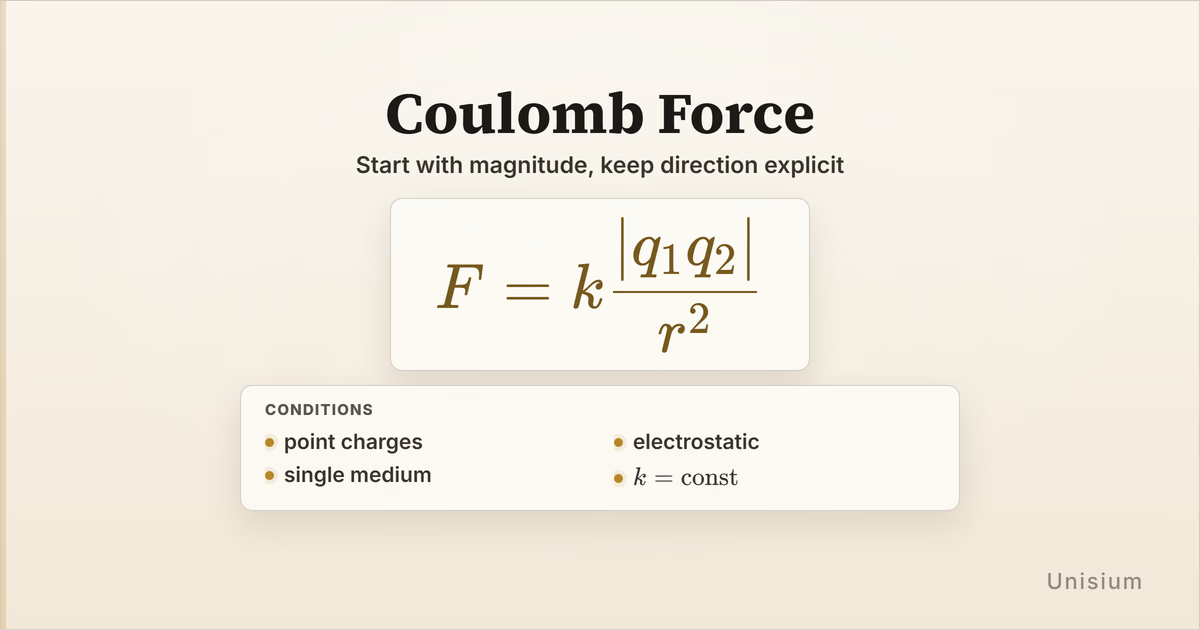
Coulomb Force gives the electrostatic interaction between two point charges. A common first form is , which gives force size. Use that scalar form in point-charge, electrostatic, single-medium problems with constant , then keep attraction, repulsion, and vector direction explicit when a full force description is needed.
Coulomb force is one principle with multiple accepted forms. The scalar magnitude form isolates how charge size and separation set force size, while the vector form carries the same inverse-square relation together with source-to-target direction.
That boundary matters in early electromagnetism. Many mistakes come from mixing two separate jobs: using the inverse-square law to compute force size, and then using charge signs plus geometry to decide attraction, repulsion, and direction.
On this page: The Principle · Conditions · Misconceptions · Elaborative Encoding · Retrieval Practice · Worked Example · Solve a Problem · Related Principles · FAQ · Related Guides · How This Fits
The Principle
Statement
Coulomb force follows an inverse-square relation between two point charges. In the common scalar magnitude form, the force size is proportional to the product of the charge magnitudes and inversely proportional to the square of their separation. Bigger charges interact more strongly, while larger separation weakens the interaction quickly because the distance enters as .
Mathematical Form
Accepted Forms
Common scalar form:
Direction-aware vector form:
This guide starts with the scalar form because it keeps the inverse-square dependence visible. Use the vector form when source-to-target direction must be part of the modeled step.
Where:
- is the electrostatic force magnitude in N
- is the proportionality constant for the medium in
- and are the two charges in C
- is the center-to-center separation in m
The visual model above fixes the one geometric input the scalar law needs: the center-to-center separation between the two charge locations. It does not decide attraction, repulsion, or vector direction, which stay outside the scalar magnitude relation.
What This Form Does And Does Not Say
- It gives the size of the force only.
- The absolute value keeps the magnitude nonnegative.
- Attraction, repulsion, and direction belong to the vector interpretation of the same Coulomb-force relation, not to this scalar formula by itself.
Conditions of Applicability
Condition: point charges; electrostatic; single medium;
Practical modeling notes
- Point charges means the objects are either physically tiny compared with their separation or are modeled so that only the center-to-center separation matters for the force calculation.
- Electrostatic means the charge distribution is treated as fixed in time; you are not modeling changing fields, magnetic effects, or radiation.
- Single medium means the interaction is not crossing a material boundary that changes the effective proportionality constant.
- means one constant fits the whole setup, so the inverse-square relation is applied with one medium-dependent value of .
When it does not apply directly
- Extended charge distributions close together: if the bodies cannot be approximated as point charges, you need charge-distribution modeling or integration.
- Time-varying electromagnetic situations: if charges are moving in ways that make magnetic effects or changing fields central, this scalar electrostatic model is not enough.
- Multiple media or interfaces: if the environment changes across the path of interaction, one constant no longer tells the whole story.
Want the complete framework behind this guide? Read Masterful Learning.
Common Misconceptions
Misconception 1: Opposite charges make the force magnitude negative
The truth: The scalar magnitude is always nonnegative because the formula uses . Opposite signs matter for direction and attraction, not for making the magnitude itself negative.
Why this matters: If you let the sign leak into the scalar magnitude, you blur the difference between “how strong is the force?” and “which way does it point?” That confusion spreads into vector problems later.
Misconception 2: The distance in the denominator is surface-to-surface distance
The truth: In a point-charge model, is the separation between the charge locations, which is the center-to-center distance in a two-particle sketch.
Why this matters: Using the wrong distance changes the force dramatically because the relation is inverse-square. A small distance error can become a large force error.
Misconception 3: The scalar law already gives the full force answer
The truth: The scalar law gives only the size. You still need separate reasoning for whether the force is attractive or repulsive and for what direction the force vector points.
Why this matters: Electromagnetism problems often fail at the boundary between magnitude and direction. Keeping that boundary explicit is part of using the principle correctly.
Elaborative Encoding
Use these questions to build understanding before you memorize the formula. See Elaborative Encoding for the broader method.
Within the Principle
- Why does the magnitude form use instead of by itself?
- If the separation triples while both charge magnitudes stay fixed, what happens to the force magnitude?
For the Principle
- What evidence in a problem tells you that the point-charge approximation is reasonable?
- When should you stop with this scalar relation and switch to vector or component reasoning?
Between Principles
- How is this relation structurally similar to Newton’s Law of Gravitation, and what physical quantities change between the two laws?
Generate an Example
- Describe a setup where this magnitude law is valid, but a complete final answer still needs separate direction reasoning.
Retrieval Practice
Answer from memory, then reveal the result and check it. See Retrieval Practice for the full study method.
State the principle in words: _____The electrostatic force between two point charges follows an inverse-square relation; the common magnitude form is proportional to the product of the charge magnitudes and inversely proportional to the square of their separation.
Write the canonical equation: _____
State the canonical condition: _____
Worked Example
Use this worked example to practice Self-Explanation.
Problem
Two small beads carry charges of and and are held apart in air. Using , what is the magnitude of the electrostatic force between them?
Step 1: Verbal Decoding
Target:
Given:
Constraints: point charges; electrostatic; air treated as a single medium
Step 2: Visual Decoding
Draw the two charges on one horizontal line. Label the center-to-center separation as and mark the charges as opposite in sign.
(The drawing should help you identify the separation used in the scalar law; it should not replace the separate direction question.)
Step 3: Physics Modeling
Step 4: Mathematical Procedures
Step 5: Reflection
- Dimensional analysis: times reduces to N, so the units match a force.
- Magnitude check: A sub-newton force is reasonable for microcoulomb charges separated by a few tenths of a meter.
- Connection to concept: The opposite signs tell you the interaction is attractive, but they do not make the magnitude negative because this guide isolates force size.
Before moving on: self-explain the model
Try explaining why the scalar magnitude law is enough for this target, which parts of the setup satisfy the canonical condition, and which part of the physics is still outside the equation because this problem only asks for magnitude.
Physics model with explanation
Principle: We use Coulomb Force in its scalar magnitude form because the target is the size of the electrostatic interaction between two point charges.
Conditions: The beads are modeled as point charges, the setup is electrostatic, the medium is treated as one uniform region, and one constant is used throughout the calculation.
Relevance: This is the right principle when the problem gives two charges and a separation and asks how strong the interaction is.
Description: The absolute value keeps the scalar force nonnegative. The sign pattern of the charges still matters physically, but it matters for attraction versus repulsion, not for the magnitude calculation itself.
Goal: We want the numerical force size. The whole calculation is one direct substitution into the inverse-square law because the separation and both charges are already given.
Solve a Problem
Apply what you have learned with Problem Solving.
Problem
Two small insulating spheres carry charges of and and are held apart in vacuum. Using , what is the magnitude of the electrostatic force between them?
Hint: Use the center-to-center separation and keep the sign interpretation separate from the scalar magnitude calculation.
Show Solution
Step 1: Verbal Decoding
Target:
Given:
Constraints: point charges; electrostatic; single medium
Step 2: Visual Decoding
Draw the two spheres on one line and label the separation between their charge locations. Since the target is magnitude, do not let the repulsive direction question replace the scalar calculation.
(The same-sign charges affect direction, but the magnitude still comes from the same inverse-square relation.)
Step 3: Physics Modeling
Step 4: Mathematical Procedures
Step 5: Reflection
- Dimensional analysis: The units still reduce cleanly to N.
- Interpretation: The charges are both positive, so the interaction is repulsive, but the magnitude remains positive.
- Parameter dependence: If the distance doubled, the force magnitude would drop to one quarter of this value.
Related Principles
See Electromagnetism: The Principle Map for placement in the subdomain and the wider guides library for adjacent study paths.
| Principle | Relationship to Coulomb Force |
|---|---|
| Newton’s Law of Gravitation | Both are inverse-square force laws: product of source quantities in the numerator and distance squared in the denominator. |
| Electric Field From Point Charge | Dividing the pairwise force by a test-charge magnitude turns the interaction law into a field-strength relation at a point. |
| Electric Field-Force Relation | A known electric field produces force through , so Coulomb force can feed later field-based modeling instead of staying only as a pairwise interaction law. |
See Principle Structures for a broader view of how nearby relations connect.
FAQ
What is Coulomb force?
Coulomb force is the electrostatic interaction between two point charges. A common first form is the scalar magnitude relation , which answers how strong the interaction is before you add explicit direction through the vector form.
When does the Coulomb force formula apply?
It applies when the charges can be treated as point charges, the situation is electrostatic, the interaction stays in one medium, and one constant describes that medium. If those conditions fail, this scalar first form is not enough by itself.
Why does the common scalar form use the absolute value of the charge product?
Because this version of the law is a magnitude relation. The absolute value keeps the scalar force nonnegative while leaving the attraction-or-repulsion interpretation to separate direction reasoning.
Does this formula tell me whether the force is attractive or repulsive?
Not by itself. The sign pattern of the two charges tells you whether the force is attractive or repulsive, but that is a surrounding interpretation step, not part of the scalar magnitude output.
What is the most common mistake with Coulomb force?
The most common mistakes are using the wrong distance, letting charge sign leak into the scalar magnitude, or forgetting that the scalar form gives force size while direction still needs separate reasoning.
Related Guides
- Principle Structures — Place Coulomb force in a wider map of related physics principles.
- Retrieval Practice — Make the scalar inverse-square law quickly available from memory.
- Problem Solving — Use the relation inside structured electromagnetism problem solving.
How This Fits in Unisium
In Unisium, this principle belongs near the front of the electromagnetism sequence: first retrieve the inverse-square relation in its scalar form, then keep magnitude separate from direction, then explain worked examples where the point-charge, electrostatic, and single-medium assumptions are explicit. That progression matters because many early EM errors are boundary errors about when this scalar form applies and when the same principle needs the vector form instead. Check access and join the Unisium waitlist or see the wider framework in Masterful Learning.

Masterful Learning
The book behind these guides: a study system for physics, math, & programming built on retrieval, connection, explanation, and problem solving.
Ready to apply this strategy?
Unisium turns these evidence-based techniques into guided study sessions for math and physics. Places are limited during early access. Check current availability to start a trial; joining the mailing list is optional.
See plans and availability Read More GuidesAlready have access? Sign in