Electric Potential Energy Of Two Point Charges: Track Sign And Reference
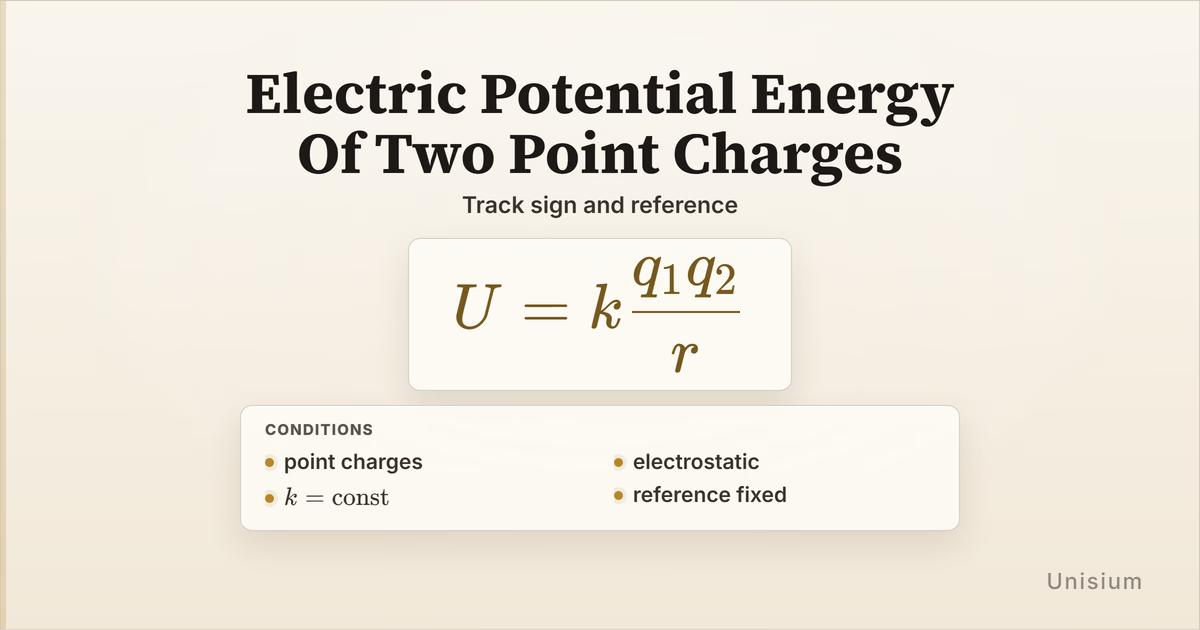
Electric potential energy of two point charges gives the interaction energy of a charge pair. In the fixed-reference electrostatic model, , so sign comes from the product of the charges and size comes from their separation. Use it for the energy of the two-charge system, not for the force on one charge or the scalar potential at an empty point.
Electric potential energy belongs to the system of charges. That boundary matters because the same two charges can also appear in Coulomb Force problems, where the target is interaction force, or in Electric Potential Of A Point Charge, where the target is scalar potential created by one source charge.
The surrounding decisions are system boundary and reference state. This principle gives the pair energy after you have decided which two point charges form the system and which reference for zero energy is being held fixed.
On this page: The Principle | Conditions | Misconceptions | Elaborative Encoding | Retrieval Practice | Worked Example | Solve a Problem | Related Principles | FAQ | Related Guides | How This Fits
The Principle
Statement
Electric Potential Energy Of Two Point Charges gives the electric potential energy associated with a pair of point charges in an electrostatic setup. With the reference held fixed, the energy is proportional to the product of the two charges and inversely proportional to their separation. Like charges make this pair energy positive in the common zero-at-infinity convention, while opposite charges make it negative.
Mathematical Form
Where:
- is electric potential energy in J
- is the proportionality constant for the medium in
- and are the two point charges in C
- is the separation between the two charges in m
The diagram marks the system boundary because this energy belongs to the pair, not to either charge alone. It also keeps the model scalar: no force arrows are needed for this relation, even though force is a nearby way to describe the same two-charge geometry.
What this relation does and does not say
- It gives the interaction energy of a two-charge system.
- The sign of comes from , not from a direction arrow.
- It depends on separation as , not as .
- It does not give the force magnitude, field at a point, or potential from one source charge by itself.
Common reference convention
In many introductory electrostatics problems, the fixed reference is . Under that convention, a finite like-charge pair has positive potential energy, while a finite opposite-charge pair has negative potential energy. Moving like charges together from infinity requires external work; moving opposite charges together can release energy, and separating opposite charges back to infinity requires external work. The canonical condition is broader than the word “infinity”: one reference must be fixed and used consistently.
Conditions of Applicability
Condition: point charges; electrostatic; ; reference fixed
Practical modeling notes
- Point charges means each object is small enough, or modeled simply enough, that only the separation between two charge locations matters.
- Electrostatic means the charges are treated as fixed while the energy state is evaluated, so radiation and induction effects are outside the model.
- means one proportionality constant describes the medium throughout the setup.
- Reference fixed means the zero of potential energy is chosen once and kept unchanged while interpreting .
When it does not apply directly
- More than two charges: compute the energy for each unique pair once, then sum the pair contributions.
- Extended charge distributions: if the sources cannot be treated as point charges, an integral or another model is needed.
- Force or field targets: if the problem asks for force or field, use the appropriate force or field relation rather than treating energy as a vector.
- Changing reference mid-problem: if the reference state changes, absolute energy values cannot be compared directly.
Want the complete framework behind this guide? Read Masterful Learning.
Common Misconceptions
Misconception 1: Electric potential energy is always positive
The truth: The sign comes from . Like charges give positive pair energy relative to the common zero-at-infinity reference, while opposite charges give negative pair energy.
Why this matters: Dropping the sign hides whether the interaction is repulsive or attractive in energy terms.
Misconception 2: This is the same as Coulomb force with one less power of r
The truth: The formulas are related, but they answer different questions. Electric potential energy is scalar system energy, while Coulomb force is a vector interaction or magnitude of force.
Why this matters: Energy reasoning tracks system states and work, while force reasoning tracks interaction direction and acceleration.
Misconception 3: The reference choice can be ignored
The truth: Absolute potential energy values depend on the fixed reference. The common formula is normally read with a zero-at-infinity reference, but the condition only says the reference must be fixed.
Elaborative Encoding
Use these questions to build understanding before memorizing the formula. See Elaborative Encoding for the broader method.
Within the Principle
- What does the product control, and what does the separation control?
- Why is a scalar even though the charges may repel or attract along a line?
For the Principle
- What clue tells you that the target is energy of the two-charge system rather than force on one charge?
- Why must the reference state be fixed before an absolute value of means anything?
Between Principles
- How is this relation different from Electric Potential Of A Point Charge, which gives scalar potential at a point before a second charge is included?
Generate an Example
- Describe a two-charge setup where the electric potential energy is negative relative to the common zero-at-infinity reference.
Retrieval Practice
Answer from memory, then reveal the result and check it. See Retrieval Practice for the full study method.
State the principle in words: _____Two point charges have electric potential energy proportional to the product of their charges and inversely proportional to their separation, with a fixed reference.
Write the canonical equation: _____
State the canonical condition: _____
Worked Example
Use this worked example to practice Self-Explanation.
Problem
Two point charges, and , are fixed apart in air. Taking the electric potential energy to be zero at infinite separation, find the electric potential energy of the two-charge system. Use .
Step 1: Verbal Decoding
Target:
Given:
Constraints: point charges; electrostatic; one medium; reference fixed at infinite separation
Step 2: Visual Decoding
Draw the two charges on one line, label the separation as , and mark the charges as opposite signs. Note that the whole pair is the system whose energy is being evaluated.
(The key visual fact is that one separation links the pair, while opposite signs make the energy negative relative to the chosen reference.)
Step 3: Physics Modeling
Step 4: Mathematical Procedures
Step 5: Reflection
- Dimensional analysis: times reduces to .
- Interpretation: The negative sign matches an attractive opposite-charge pair relative to zero energy at infinite separation.
- Parameter dependence: If the same charges were twice as far apart, the energy would have half the magnitude.
Before moving on: self-explain the model
Try explaining why the target is the energy of the charge pair, why the sign comes from , and why a fixed reference is part of the model rather than decorative wording.
Physics model with explanation
Principle: We use Electric Potential Energy Of Two Point Charges because the problem asks for the scalar energy of a two-charge system.
Conditions: The charges are modeled as point charges, the situation is electrostatic, one constant is used, and the reference is fixed by taking zero energy at infinite separation.
Relevance: This is the right relation when the target is system energy, not force, field, or potential at a field point.
Description: The separation sets the distance scale, and the product sets both sign and size. Because the charges have opposite signs, the pair energy is negative under the stated reference.
Goal: We want one scalar energy value for the pair, so one direct substitution into is enough after the system boundary and reference are stated.
Solve a Problem
Apply what you have learned with Problem Solving.
Problem
Two point charges, and , are fixed apart in air. Taking the electric potential energy to be zero at infinite separation, find the electric potential energy of the two-charge system. Use .
Hint: Keep the charge signs in the product .
Show Solution
Step 1: Verbal Decoding
Target:
Given:
Constraints: point charges; electrostatic; one medium; reference fixed at infinite separation
Step 2: Visual Decoding
Draw the two charges on one line with separation , and mark that both charges are positive. Treat the two charges together as the system whose energy is being evaluated.
(The key visual fact is that like signs make the energy positive relative to the chosen reference.)
Step 3: Physics Modeling
Step 4: Mathematical Procedures
Step 5: Reflection
- Interpretation: The positive result matches a like-charge pair under the zero-at-infinity reference.
- Magnitude check: A value on the order of tenths of a joule is reasonable for microcoulomb charges separated by a fraction of a meter.
- Connection to concept: This result is scalar energy of the pair, not a force direction or field value.
Related Principles
See Electromagnetism: The Principle Map for placement in the subdomain and the wider guides library for adjacent study paths.
| Principle | Relationship to Electric Potential Energy Of Two Point Charges |
|---|---|
| Electric Potential Of A Point Charge | Gives scalar potential from one source charge; multiplying by a second charge leads into pair energy reasoning. |
| Coulomb Force | Uses the same two-charge geometry for force, while this guide uses it for scalar system energy. |
| Electric Potential Energy From Potential | Connects a charge in a potential difference to energy change, which is the next bridge after two-charge pair energy. |
See Principle Structures for a broader view of how nearby relations connect.
FAQ
What is electric potential energy of two point charges?
It is the scalar interaction energy of a two-charge system. In the fixed-reference electrostatic model, it is written .
When does the two-charge potential energy formula apply?
It applies when the sources are modeled as point charges, the situation is electrostatic, one constant describes the medium, and the reference for potential energy is fixed.
Why can electric potential energy be negative?
It can be negative because the sign comes from . Opposite charges give a negative value relative to the common zero-at-infinity reference.
Is this the same as electric potential of a point charge?
No. Electric potential of a point charge gives scalar potential from one source at a point, while this relation gives the energy of a pair of charges.
Is this the same as Coulomb force?
No. Coulomb force models interaction force and direction, while this relation models scalar energy of the pair. They use the same separation variable but answer different physical questions.
Related Guides
- Electric Potential Of A Point Charge - Compare scalar potential with scalar pair energy.
- Coulomb Force - Separate two-charge energy from two-charge force.
- Electromagnetism: The Principle Map - Place this relation in the electromagnetism progression.
- Problem Solving - Use system boundaries and reference states cleanly in new setups.
How This Fits in Unisium
In Unisium, this principle sits where scalar potential language becomes system-energy language. The progression is to retrieve the pair-energy relation, keep the reference and system boundary explicit, then explain worked examples where sign, separation, and reference each do one job. Check access and join the Unisium waitlist or see the wider framework in Masterful Learning.
Masterful Learning
The book behind these guides: a study system for physics, math, & programming built on retrieval, connection, explanation, and problem solving.
Ready to apply this strategy?
Unisium turns these evidence-based techniques into guided study sessions for math and physics. Places are limited during early access. Check current availability to start a trial; joining the mailing list is optional.
See plans and availability Read More GuidesAlready have access? Sign in