Electric Flux In A Uniform Field: Use the Area Vector
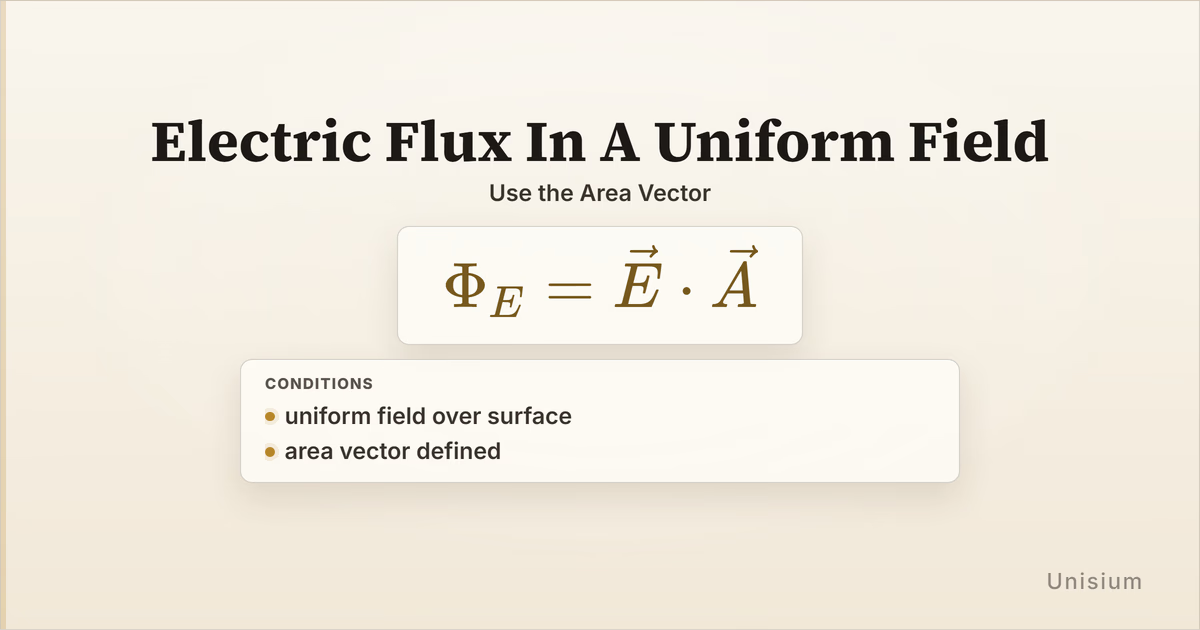
Electric Flux In A Uniform Field says electric flux equals the dot product of electric field and area vector. The model is , and it applies when the field is uniform over the surface and the area vector is defined. Use it when surface orientation matters: the angle is measured to the area vector, not to the surface itself.
This guide comes after Uniform-Field Potential Difference in the early electromagnetism sequence, but it changes the geometric focus. The surrounding decisions are area-vector orientation and angle choice. Those choices are setup work around the principle, not new principles.
On this page: The Principle | Conditions | Misconceptions | Elaborative Encoding | Retrieval Practice | Worked Example | Solve a Problem | Related Principles | FAQ | Related Guides | How This Fits
The Principle
Statement
Electric Flux In A Uniform Field measures the signed field-through-surface product for an oriented surface. For a flat surface in a uniform field, the surface is represented by an area vector whose magnitude is the area and whose direction is normal to the surface. The flux is the dot product of the field vector and that area vector.
Mathematical Form
Where:
- is electric flux in
- is the uniform electric field in
- is the area vector, with magnitude equal to surface area in
The diagram shows the orientation-care issue. The angle belongs between and , so the equivalent scalar form is:
For an open surface, the normal direction is a convention; for a closed surface, the outward normal is normally fixed.
What the area vector does
The area vector compresses two pieces of information into one object:
- Area size: tells how large the surface is.
- Surface orientation: the direction of is perpendicular to the surface.
- Sign convention: for an open surface, the chosen normal direction sets the sign of flux; for a closed surface, the outward normal is the usual convention.
This means field arrows can cross the drawn surface yet still give positive, negative, or zero flux depending on the chosen area-vector direction. Maximum positive flux occurs when and point the same way. Zero flux occurs when the field is parallel to the surface, because then it is perpendicular to the area vector.
Conditions of Applicability
Condition: uniform field over surface; area vector defined
Practical modeling notes
- Uniform field over surface means is constant enough across the surface that one field vector represents the whole surface.
- Area vector defined means you know or choose the surface normal direction before assigning the sign of flux.
- If only the surface itself is described, first translate its orientation into an area vector normal to the surface.
- If the field varies over the surface, this compact dot product becomes the seed for a later surface-integral model.
- If the surface is curved, split it into small area vectors or use the integral version when the course has introduced it.
When it does not apply directly
- Nonuniform field: one constant does not represent the whole surface.
- Undefined orientation: the magnitude may be computable, but the sign is not meaningful until a normal direction is chosen.
- Closed-surface net flux: use the outward-normal convention on every piece of the closed surface; for nonuniform fields, use the integral form.
Want the complete framework behind this guide? Read Masterful Learning.
Common Misconceptions
Misconception 1: The angle is measured to the surface
The truth: In , is the angle between the electric field and the area vector, which is normal to the surface.
Why this matters: Measuring the angle to the surface instead of the normal swaps sine and cosine behavior.
Misconception 2: Flux is always positive
The truth: Flux is signed. Reversing the area vector reverses the sign of .
Why this matters: The sign tells whether the field points with or against the chosen normal direction.
Misconception 3: A larger surface always gives more flux
The truth: A larger area increases the possible flux, but orientation can reduce the dot product or make it zero.
Elaborative Encoding
Use these questions to build understanding before memorizing the formula. See Elaborative Encoding for the broader method.
Within the Principle
- Why does the area vector have units of area but a direction normal to the surface?
- What does the dot product keep that a simple product would miss?
For the Principle
- What wording in a problem tells you the electric field is uniform over the whole surface?
- Before computing sign, what must be decided about the area vector?
Between Principles
- How is this relation different from Electric Field Superposition, where vectors add at a point instead of being dotted with a surface vector?
Generate an Example
- Describe a flat surface in a uniform electric field where reversing the chosen area vector changes the sign but not the magnitude of flux.
Retrieval Practice
Answer from memory, then reveal the result and check it. See Retrieval Practice for the full study method.
State the principle in words: _____For a uniform electric field over an oriented surface, electric flux equals the dot product of the electric field vector and the area vector.
Write the canonical equation: _____
State the canonical condition: _____uniform field over surface; area vector defined
Worked Example
Use this worked example to practice Self-Explanation.
Problem
A square surface has side length . A uniform electric field of magnitude crosses the surface. The chosen area vector makes a angle with the electric field. Find the electric flux through the surface using that area-vector direction.
Step 1: Verbal Decoding
Target:
Given:
Constraints: uniform field over a flat square surface; area vector direction is chosen; angle is between field and area vector
Step 2: Visual Decoding
Draw a tilted square surface, draw normal to the surface, draw as uniform parallel arrows, and mark between and . (The key visual fact is that the given angle is to the area vector.)
Step 3: Physics Modeling
Step 4: Mathematical Procedures
Step 5: Reflection
- Dimensional analysis: times gives .
- Interpretation: A angle cuts the maximum possible flux in half because .
- Limiting case: If the area vector were perpendicular to the field, the flux would be zero.
Before moving on: self-explain the model
Try explaining why Step 3 uses the scalar dot-product form, why the surface area enters through , and why the angle must be measured to the area vector.
Physics model with explanation
Principle: We use Electric Flux In A Uniform Field because the problem gives a constant field over one flat surface with a defined area-vector direction.
Conditions: The field is uniform over the surface, and the area vector is explicitly defined by the stated angle.
Relevance: The target is flux, so the direct model is the dot product .
Description: The square side length sets the magnitude of through , while the angle tells how much of the field points along that area vector.
Goal: We compute the signed flux through the chosen orientation of the surface.
Solve a Problem
Apply what you have learned with Problem Solving.
Problem
A circular surface has radius . A uniform electric field has magnitude . The chosen area vector makes a angle with the electric field. Find the electric flux through the surface using that area-vector direction.
Hint: A angle means the area vector points partly against the field.
Show Solution
Step 1: Verbal Decoding
Target:
Given:
Constraints: uniform field over a flat circular surface; area vector direction is chosen; angle is between field and area vector
Step 2: Visual Decoding
Draw the circular surface, draw normal to it, draw uniform arrows, and mark between and . (The key visual fact is that has a component opposite the field.)
Step 3: Physics Modeling
Step 4: Mathematical Procedures
Step 5: Reflection
- Dimensional analysis: Field times area gives flux units.
- Interpretation: The negative sign means the field points mostly opposite the chosen area-vector direction.
- Verification: Since is negative, the flux must be negative.
Related Principles
See Electromagnetism: The Principle Map for where this surface relation sits in the subdomain.
| Principle | Relationship to Electric Flux In A Uniform Field |
|---|---|
| Uniform-Field Potential Difference | Also uses a uniform electric field, but across a displacement instead of through an oriented surface. |
| Electric Flux Integral | generalization: handles nonuniform fields and curved surfaces by summing local area-vector pieces. |
| Gauss Law | later relation: connects net electric flux through a closed surface to enclosed charge. |
See Principle Structures for a broader view of how these relations connect.
FAQ
What is electric flux in a uniform field?
Electric flux in a uniform field is the dot product of the electric field vector and the surface’s area vector. In canonical form, .
When does electric flux equal electric field dot area vector?
It applies when the electric field is uniform over the surface and the area vector is defined. The area vector supplies both the surface area and the orientation convention.
Is the angle in electric flux measured from the surface or the normal?
It is measured between the electric field and the area vector. Since the area vector is normal to the surface, measuring from the surface itself gives the complementary angle.
Why can electric flux be negative?
Flux is negative when the electric field points mostly opposite the chosen area vector. Reversing the area vector reverses the sign of the dot product.
What if the electric field is not uniform?
Then this compact uniform-field formula does not apply directly. You need the electric-flux integral, which adds the contributions from many small area elements.
Related Guides
- Electromagnetism: The Principle Map - Place flux in the wider EM structure.
- Uniform-Field Potential Difference - Compare a uniform field across displacement with a uniform field through area.
- Electric Field Superposition - Review electric-field vectors before using them in dot products.
- Problem Solving - Practice turning a diagram and condition into a usable model.
How This Fits in Unisium
Unisium treats electric flux as a principle because the formula is short but the orientation meaning is easy to lose. The useful learning path is to encode the area-vector convention, retrieve with its condition, self-explain the angle choice, and solve new problems where the sign is not already decided for you.
Ready to master Electric Flux In A Uniform Field? Check access and join the Unisium waitlist or explore the full framework in Masterful Learning.

Masterful Learning
The book behind these guides: a study system for physics, math, & programming built on retrieval, connection, explanation, and problem solving.
Ready to apply this strategy?
Unisium turns these evidence-based techniques into guided study sessions for math and physics. Places are limited during early access. Check current availability to start a trial; joining the mailing list is optional.
See plans and availability Read More GuidesAlready have access? Sign in