Equivalent Capacitance In Series: Shared Charge Rule
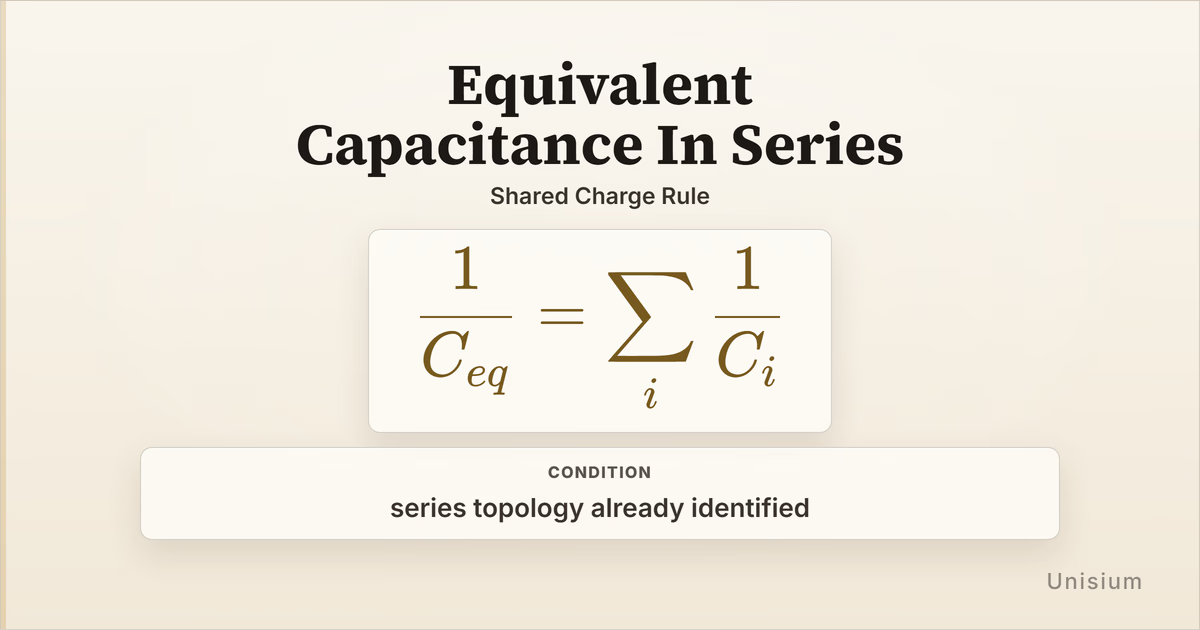
Equivalent Capacitance In Series says capacitors connected in series combine by reciprocal capacitances: . It applies after the series topology is already identified. Use it to replace a chain of series capacitors with one equivalent capacitance, and remember that the equivalent capacitance is smaller than the smallest individual capacitance.
This guide follows Capacitor Energy in the device-and-network part of the electromagnetism map. The surrounding decisions are recognizing that each capacitor lies in the same series branch, deciding which terminals define the whole network voltage, and separating topology identification from the reciprocal-sum relation itself.
On this page: The Principle | Conditions | Misconceptions | Elaborative Encoding | Retrieval Practice | Worked Example | Solve a Problem | Related Principles | FAQ | Related Guides | How This Fits
The Principle
Statement
Equivalent Capacitance In Series replaces a series chain of capacitors with one capacitor that has the same terminal charge-voltage behavior for the whole chain. In a series connection, each capacitor carries the same charge magnitude, while the total potential difference is the sum of the individual potential differences. That structure is why reciprocal capacitances add.
Mathematical Form
Where:
- is the equivalent capacitance of the series chain in farads
- is the capacitance of capacitor in farads
- the sum runs over all capacitors in the identified series chain
The diagram shows the key structure: each capacitor in the series chain has the same charge magnitude, while the total voltage is shared across the capacitors. The equivalent capacitor is chosen to match the whole chain from the outside terminals.
Two-capacitor form
For two capacitors in series, the reciprocal sum becomes:
This is not a separate principle. It is the same reciprocal relation simplified for two capacitors.
Conditions of Applicability
Condition: series topology already identified
Practical modeling notes
- Series topology means the capacitors lie along one branch so the same charge magnitude is associated with each capacitor in the chain.
- The capacitance values must be defined for the state or network being reduced.
- Use the relation after the circuit topology has been reduced to a series capacitor group.
- The total voltage across the equivalent capacitor is the voltage across the entire series chain.
- In a mixed network, combine clear series groups before using the result in a larger reduction.
When it does not apply directly
- Parallel topology: capacitors connected across the same two nodes combine by direct capacitance addition, not reciprocal addition.
- Mixed networks: if some capacitors are neither all in one series chain nor all in one parallel group, reduce one recognizable group at a time.
- Topology not identified: if the circuit drawing is ambiguous, first mark nodes and branches before choosing a series or parallel relation.
Want the complete framework behind this guide? Read Masterful Learning.
Common Misconceptions
Misconception 1: Series capacitors add like series resistors
The truth: Series capacitors add by reciprocals, so .
Why this matters: Directly adding capacitances in series makes the equivalent too large and reverses the physical effect of adding more gaps for charge storage.
Misconception 2: The largest capacitor controls the equivalent
The truth: The equivalent capacitance of a series chain is smaller than the smallest capacitor in the chain.
Why this matters: A small capacitor in series strongly limits how much charge the whole chain stores per volt.
Misconception 3: Any connected chain is automatically series
The truth: Series requires the relevant capacitors to lie in the same branch between the outside terminals, not merely to appear near each other in a drawing.
Elaborative Encoding
Use these questions to build understanding before memorizing the formula. See Elaborative Encoding for the broader method.
Within the Principle
- Why does the reciprocal form make smaller when another capacitor is added in series?
- What does the same charge magnitude explain about the difference between series capacitors and parallel capacitors?
For the Principle
- What evidence in a circuit drawing tells you that the series topology has already been identified?
- Before writing the reciprocal sum, which terminals define the voltage across the whole capacitor chain?
Between Principles
- How does this relation build on Capacitance Definition, where ?
Generate an Example
- Describe a capacitor chain where adding one more capacitor in series would reduce the equivalent capacitance even though it adds another device.
Retrieval Practice
Answer from memory, then reveal the result and check it. See Retrieval Practice for the full study method.
State the principle in words: _____For capacitors in series, the reciprocal of the equivalent capacitance equals the sum of the reciprocals of the individual capacitances.
Write the canonical equation: _____
State the canonical condition: _____series topology already identified
Worked Example
Use this worked example to practice Self-Explanation.
Problem
Two capacitors, and , are connected in series. The series topology has already been identified. Find the equivalent capacitance.
Step 1: Verbal Decoding
Target:
Given:
Constraints: two capacitors; series topology already identified
Step 2: Visual Decoding
Draw two capacitor symbols in one branch, label them and , and mark the outside terminals of the whole chain. (The key visual fact is that both capacitors sit on the same series path.)
Step 3: Physics Modeling
Step 4: Mathematical Procedures
Step 5: Reflection
- Magnitude: The equivalent is smaller than , the smaller capacitor.
- Dimensional analysis: The two-capacitor expression leaves capacitance units because gives .
- Interpretation: Adding capacitors in series reduces the charge stored per volt across the whole chain.
Before moving on: self-explain the model
Try explaining why Step 3 uses a reciprocal sum, why the topology condition is satisfied, and why the answer must be smaller than either capacitor.
Physics model with explanation
Principle: We use Equivalent Capacitance In Series because the problem asks for one capacitance that replaces a series capacitor chain.
Conditions: The problem states that the capacitors are connected in series, so the canonical condition is satisfied.
Relevance: The target is , and the given capacitances are exactly the quantities in the reciprocal-sum relation.
Description: The two capacitors lie in one series branch. Their voltage drops add to the total voltage across the outside terminals.
Goal: Use the series capacitance relation and simplify it into a single equivalent capacitance.
Solve a Problem
Apply what you have learned with Problem Solving.
Problem
Three capacitors, , , and , are connected in series. The series topology has already been identified. Find the equivalent capacitance.
Hint: Work with reciprocals first, then invert at the end.
Show Solution
Step 1: Verbal Decoding
Target:
Given:
Constraints: three capacitors; series topology already identified
Step 2: Visual Decoding
Draw three capacitor symbols in one branch, label them , , and , and mark the outside terminals of the whole chain. (The key visual fact is that the chain is one series group.)
Step 3: Physics Modeling
Step 4: Mathematical Procedures
Step 5: Reflection
- Magnitude: The answer is smaller than , the smallest capacitor.
- Verification: The reciprocal equals .
- Interpretation: The smallest capacitance limits the chain, but the other series capacitors reduce the equivalent further.
Related Principles
See Electromagnetism: The Principle Map for where series capacitor reduction sits before current and resistor-network principles.
| Principle | Relationship to Equivalent Capacitance In Series |
|---|---|
| Capacitance Definition | Defines capacitance as charge per voltage, which explains why the same charge magnitude and added voltage produce reciprocal addition. |
| Capacitor Energy | Uses a capacitance and voltage to compute stored energy after the relevant equivalent or individual capacitor value is known. |
| Equivalent Capacitance In Parallel | The nearby network relation for capacitors connected across the same two nodes. |
See Principle Structures for a broader view of how definitions, energy relations, and network reductions connect.
FAQ
What is Equivalent Capacitance In Series?
Equivalent Capacitance In Series is the reciprocal-sum relation . It replaces a series chain of capacitors with one capacitor that has the same outside-terminal charge-voltage behavior.
When does the series capacitance formula apply?
It applies when the series topology has already been identified. That means the capacitors are being treated as one series chain, so the reciprocal-sum relation is the appropriate network reduction.
Why is the equivalent capacitance smaller in series?
For a series chain, the same charge magnitude is associated with each capacitor while the voltage drops add. More total voltage for the same charge means less capacitance for the whole chain.
Is the series capacitance formula the same as the series resistance formula?
No. Series resistances add directly, but series capacitances add by reciprocals. Capacitors follow the reciprocal rule because each capacitor in the series chain has the same charge magnitude while voltages add.
What should I check before using the formula?
Check that you have identified a series capacitor group and that you are solving for the equivalent capacitance across the outside terminals of that group.
Related Guides
- Capacitance Definition - Review what capacitance measures before combining capacitors.
- Capacitor Energy - Use the resulting capacitance in stored-energy calculations.
- Electromagnetism Principle Map - Place capacitor networks in the broader EM sequence.
- Problem Solving - Practice translating a diagram or setup into the right model.
How This Fits in Unisium
Unisium treats Equivalent Capacitance In Series as a principle because the equation is short but the modeling decision is easy to blur: first identify a series topology, then use the reciprocal sum. The useful learning path is to encode the shared-charge reason, retrieve the formula and condition, self-explain why the equivalent is smaller, and solve new problems where the number of capacitors changes.
Ready to master Equivalent Capacitance In Series? Check access and join the Unisium waitlist or explore the full framework in Masterful Learning.
Masterful Learning
The book behind these guides: a study system for physics, math, & programming built on retrieval, connection, explanation, and problem solving.
Ready to apply this strategy?
Unisium turns these evidence-based techniques into guided study sessions for math and physics. Places are limited during early access. Check current availability to start a trial; joining the mailing list is optional.
See plans and availability Read More GuidesAlready have access? Sign in