Ampere Law: Current Sets Magnetic Circulation
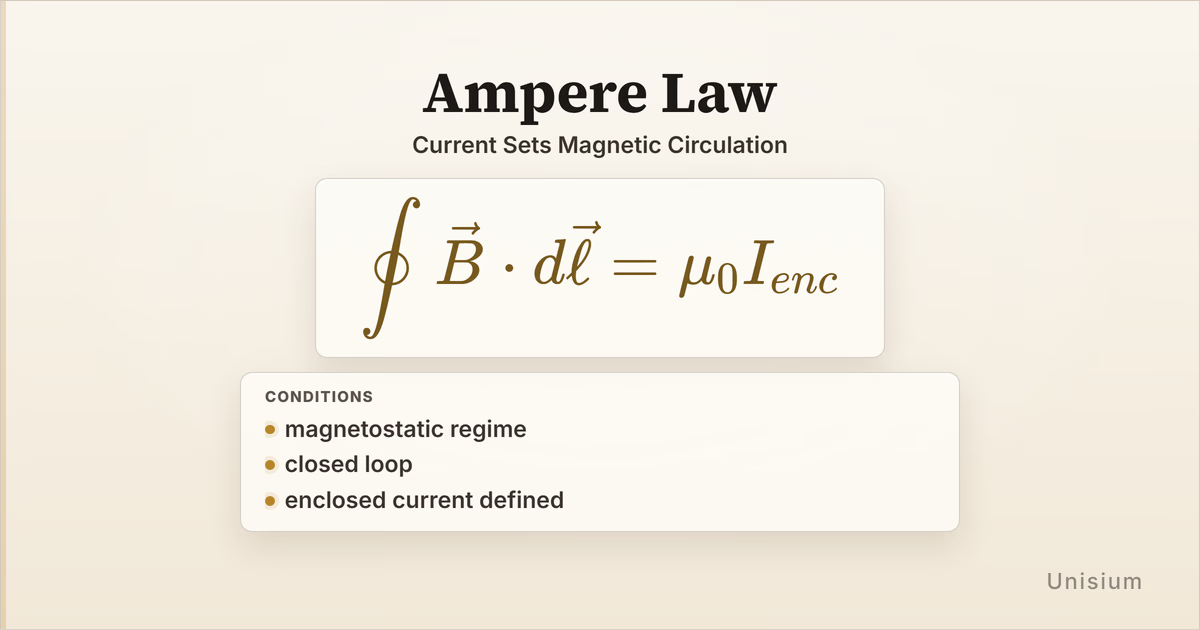
Ampere Law says magnetic-field circulation around a closed loop equals the permeability constant times the enclosed current. The model is , and it applies in magnetostatic setups once the loop and enclosed current are defined. Use it to connect steady current through a loop’s spanning surface to magnetic circulation around that loop.
This guide sits in the field-calculus layer of the Electromagnetism Principle Map. The same relation is often written as Ampere’s law in textbooks; this guide keeps the YAML-canonical Unisium name, Ampere Law. The surrounding decisions are choosing a useful Amperian loop, fixing the positive loop direction, assigning the sign of enclosed current, and using symmetry to simplify the integral. Those decisions support Ampere Law; they are not separate principle keys.
On this page: The Principle | Conditions | Misconceptions | Elaborative Encoding | Retrieval Practice | Worked Example | Solve a Problem | Related Principles | FAQ | Related Guides | How This Fits
The Principle
Statement
Ampere Law connects the signed circulation of magnetic field around a closed loop to the signed current enclosed by a surface bounded by that loop. The left side measures how much runs along the chosen loop direction. The right side says that, in a magnetostatic regime, the net circulation around the loop is determined by times the signed current crossing a spanning surface.
Mathematical Form
Where:
- is the magnetic field along the closed loop, in tesla
- is a directed line element along the chosen positive loop direction
- is the signed current crossing the loop’s spanning surface
- is the permeability constant, in
The diagram is a guide-level orientation scaffold. The chosen positive loop direction pairs with a surface normal by the right-hand convention. Current crossing the surface in that positive normal direction counts as positive , and positive magnetic circulation follows the loop direction.
Relation to special-case magnetic-field formulas
Magnetic Field Near A Long Straight Wire is a common result that Ampere Law can recover when symmetry is strong enough. If a circular loop centered on a long wire makes tangent and constant around the loop, the line integral simplifies to . Ampere Law itself is still the circulation relation; symmetry is the extra setup that turns it into a local field value.
Conditions of Applicability
Condition: magnetostatic regime; closed loop; enclosed current defined
Practical modeling notes
- Magnetostatic regime means the steady-current form is being used, without a changing electric-flux source term.
- Closed loop means the line integral returns to its starting point.
- Enclosed current defined means the current crossing a chosen spanning surface has a clear signed value.
- The law does not choose the loop for you. Loop choice and symmetry recognition are surrounding modeling decisions.
When it does not apply directly
- Changing electric flux matters: use Ampere-Maxwell Law when the displacement-current term must be included.
- Open path: an open line integral of magnetic field is not this closed-loop circulation law.
- No useful symmetry: Ampere Law still holds, but it may not isolate a local value unless the field behavior around the loop is known.
Want the complete framework behind this guide? Read Masterful Learning.
Common Misconceptions
Misconception 1: Ampere Law always gives the magnetic field directly
The truth: The law gives a closed-loop integral. Turning that integral into requires symmetry or other information about the field along the loop.
Why this matters: Without symmetry, pulling outside the integral is an unsupported step.
Misconception 2: Any current nearby is enclosed current
The truth: counts current crossing the surface bounded by the chosen loop, with sign set by the surface orientation.
Why this matters: A current outside the loop can affect the local field, but it is not part of for that loop.
Misconception 3: Ampere Law and Ampere-Maxwell Law are interchangeable
The truth: Ampere Law is the magnetostatic form. Ampere-Maxwell Law adds the changing electric-flux source term.
Elaborative Encoding
Use these questions to build understanding before memorizing the formula. See Elaborative Encoding for the broader method.
Within the Principle
- What does the dot product measure along each small part of the loop?
- Why does the equation use enclosed current rather than total current in the whole region?
For the Principle
- What information must be fixed before the sign of is meaningful?
- Why does a circular loop around a long straight wire make the integral easier than an arbitrary loop?
Between Principles
- How does Ampere Law differ from Biot-Savart Law when both describe magnetic fields from steady currents?
Generate an Example
- Describe a steady-current setup where the current is not enclosed by a chosen loop, even though it is nearby.
Retrieval Practice
Answer from memory, then reveal the result and check it. See Retrieval Practice for the full study method.
State the principle in words: _____In magnetostatics, magnetic-field circulation around a closed loop equals the permeability constant times the enclosed current.
Write the canonical equation: _____
State the canonical condition: _____magnetostatic regime; closed loop; enclosed current defined
Worked Example
Use this worked example to practice Self-Explanation.
Problem
A long straight wire carries steady current out of the page. Use a circular Amperian loop of radius centered on the wire. By symmetry, the magnetic field is tangent to the loop and has constant magnitude around it. Find and the circulation direction.
Step 1: Verbal Decoding
Target: , direction
Given:
Constraints: magnetostatic regime; circular closed loop; current enclosed; tangent field has constant magnitude by symmetry
Step 2: Visual Decoding
Draw the wire as a dot for current out of the page, then draw a circle of radius around it. The field’s circulation sense comes from the right-hand rule applied to the current; we then choose counterclockwise as the positive loop direction to match it, so the paired surface normal points out of the page and the enclosed current is positive.
Step 3: Physics Modeling
Step 4: Mathematical Procedures
- Direction: counterclockwise.
Step 5: Reflection
- Dimensional analysis: has units of tesla.
- Interpretation: Current out of the page gives counterclockwise positive circulation for the chosen orientation.
- Limiting case: Increasing spreads the same circulation over a longer loop, so decreases as .
Before moving on: self-explain the model
Try explaining why the integral becomes only after the circular symmetry is stated, and why the sign of the circulation depends on the chosen orientation.
Physics model with explanation
Principle: We use Ampere Law because the target is magnetic field around a closed loop in a steady-current situation.
Conditions: The regime is magnetostatic, the loop is closed, and the wire current is enclosed by the loop.
Relevance: The field is tangent to the circular loop, so the circulation law can connect the line integral to enclosed current.
Description: Symmetry makes the field tangent to the circular path with the same magnitude at every point. That lets the line integral simplify to field magnitude times circumference.
Goal: Solve the circulation equation for the magnetic-field magnitude and direction.
Solve a Problem
Apply what you have learned with Problem Solving.
Problem
A long straight wire carries steady current into the page. Use a circular Amperian loop of radius centered on the wire. By symmetry, the magnetic field is tangent to the loop and has constant magnitude. Find and the circulation direction.
Hint: Use the right-hand rule to decide the field’s circulation sense, then choose the loop orientation consistently with your sign convention.
Show Solution
Step 1: Verbal Decoding
Target: , direction
Given:
Constraints: magnetostatic regime; circular closed loop; current enclosed; tangent field has constant magnitude by symmetry
Step 2: Visual Decoding
Draw the wire as a cross for current into the page, then draw a circle of radius around it. The field’s circulation sense comes from the right-hand rule applied to the current; we then choose clockwise as the positive loop direction to match it, so the paired surface normal points into the page and the enclosed current is positive.
Step 3: Physics Modeling
Step 4: Mathematical Procedures
Step 5: Reflection
- Dimensional analysis: The expression again reduces to tesla.
- Interpretation: Reversing the current reverses the magnetic-field circulation direction.
- Parameter dependence: A larger loop radius would reduce for the same enclosed current.
Related Principles
See Electromagnetism: The Principle Map for where Ampere Law sits in the magnetic field-and-force branch.
- Magnetic Field Near A Long Straight Wire: a symmetry result that Ampere Law can produce for a steady straight wire.
- Biot-Savart Law: the field-contribution-first route from steady currents; Ampere Law is circulation-first once an enclosing loop is chosen.
- Ampere-Maxwell Law: the broader closed-loop circulation law that adds changing electric flux.
See Principle Structures for a broader view of how source laws and field relations connect.
FAQ
What is Ampere’s Law?
Ampere Law is the magnetostatic closed-loop relation . It says magnetic-field circulation around a closed loop equals the permeability constant times the current enclosed by the loop’s spanning surface.
When does Ampere Law apply?
It applies under the canonical condition: magnetostatic regime; closed loop; enclosed current defined. In practice, you must also know enough about the field along the loop to use the equation for a local field value.
Does Ampere Law require symmetry?
No. The law holds for closed loops in its magnetostatic condition. Symmetry is what often lets you simplify the integral and solve for .
What is enclosed current?
Enclosed current is the signed current crossing a surface bounded by the chosen loop. The sign depends on the loop direction and the paired surface normal.
How is Ampere Law different from Biot-Savart Law?
Ampere Law relates magnetic circulation around a loop to enclosed current. Biot-Savart Law builds the field contribution by contribution from current elements using source geometry.
Related Guides
- Electromagnetism: The Principle Map - Place Ampere Law among the field-calculus magnetic-field relations.
- Magnetic Field Near A Long Straight Wire - Compare the special-case field formula recovered by Ampere Law.
- Biot-Savart Law - Compare a source-integral way to find magnetic fields.
- Problem Solving - Practice turning conditions and givens into a usable model.
How This Fits in Unisium
Unisium treats Ampere Law as a principle because the equation is short but the setup choices are easy to blur. The useful learning path is to encode the magnetostatic condition, retrieve the closed-loop relation, self-explain the loop and current orientation, and solve supported problems where symmetry is explicit.
Ready to study principles this way? Check access and join the Unisium waitlist or explore the full framework in Masterful Learning.

Masterful Learning
The book behind these guides: a study system for physics, math, & programming built on retrieval, connection, explanation, and problem solving.
Ready to apply this strategy?
Unisium turns these evidence-based techniques into guided study sessions for math and physics. Places are limited during early access. Check current availability to start a trial; joining the mailing list is optional.
See plans and availability Read More GuidesAlready have access? Sign in