Ampere-Maxwell Law: Magnetic Circulation From Two Sources
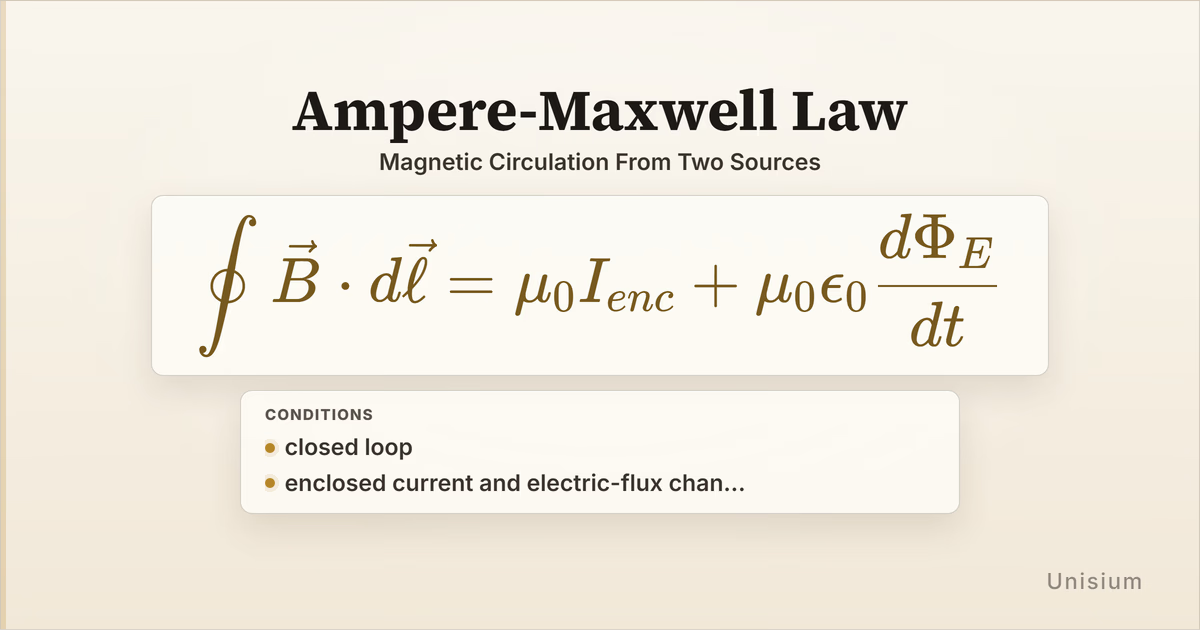
Ampere-Maxwell Law says magnetic-field circulation around a closed loop comes from enclosed current and changing electric flux. The model is , and it applies when the loop is closed and both source terms are defined. Use it when magnetic circulation is driven by conduction current, displacement-current effect, or both.
This guide follows Faraday Law Integral in the field-calculus part of the Electromagnetism Principle Map. The surrounding decisions are loop choice, spanning-surface choice, positive traversal direction, enclosed-current bookkeeping, and electric-flux sign. Those decisions support the principle; they are not separate principle keys.
On this page: The Principle | Conditions | Misconceptions | Elaborative Encoding | Retrieval Practice | Worked Example | Solve a Problem | Related Principles | FAQ | Related Guides | How This Fits
The Principle
Statement
Ampere-Maxwell Law connects magnetic-field circulation around a closed loop to two sources through a surface bounded by that loop: enclosed conduction current and changing electric flux. The line integral on the left measures signed circulation of along the chosen positive loop direction. The two terms on the right add the ordinary current contribution and Maxwell’s electric-flux-change contribution.
Mathematical Form
Where:
- is the magnetic field along the closed loop
- is a directed line element along the chosen positive loop direction
- is the signed current enclosed by the loop’s spanning surface
- is the signed electric flux through that surface
- and are the permeability and permittivity constants
The diagram is a guide-level orientation scaffold. The chosen positive loop direction pairs with the area normal by the right-hand convention. Positive enclosed current through the surface and increasing positive electric flux both contribute to positive magnetic circulation relative to that chosen direction.
Why Maxwell’s term matters
Magnetic Field Near A Long Straight Wire is a special steady-current situation. Ampere-Maxwell Law is broader: it keeps the current source and adds the electric-flux-change source. That added term is what makes the law consistent in places such as the gap of a charging capacitor, where magnetic circulation can exist across a surface even though no conduction current crosses that surface. Different spanning surfaces can shift the bookkeeping between conduction current and changing electric flux, but the summed source term must match the same loop circulation.
Conditions of Applicability
Condition: closed loop; enclosed current and electric-flux change defined
Practical modeling notes
- Closed loop means the line integral returns to its starting point.
- Enclosed current is signed relative to the loop’s chosen spanning surface and orientation.
- Electric-flux change must be defined through the same oriented surface used for the enclosed-current term.
- The law does not choose the loop or surface for you; those are surrounding modeling decisions.
When it does not apply directly
- Open path: this integral form is a closed-loop circulation law. An open line integral is a different quantity and cannot be equated to the enclosed-current and electric-flux-change source terms.
- Undefined source terms: if the problem does not specify or let you infer the enclosed current and electric-flux change, the right side is not usable yet.
- Full field-shape question: the integral law gives circulation around a loop. Recovering the local field may require symmetry or extra field information.
Want the complete framework behind this guide? Read Masterful Learning.
Common Misconceptions
Misconception 1: Only real current can create magnetic circulation
The truth: Enclosed conduction current contributes, but changing electric flux contributes through the term too.
Why this matters: In a charging-capacitor gap, the displacement-current term carries the magnetic-circulation source even where no conduction current crosses the selected surface.
Misconception 2: The loop direction is decoration
The truth: The chosen positive loop direction sets the sign of the line integral and pairs with the positive surface orientation.
Why this matters: A sign for or is meaningless unless the orientation convention is fixed.
Misconception 3: The law automatically gives the whole magnetic field
The truth: The law gives a closed-loop integral. Turning that integral into a local value requires symmetry or other information about the field along the loop.
Elaborative Encoding
Use these questions to build understanding before memorizing the formula. See Elaborative Encoding for the broader method.
Within the Principle
- What does the left side measure along the loop, and why is the dot product with needed?
- Why do and have the same current-like units?
For the Principle
- What information must be fixed before you can assign a sign to ?
- In a charging-capacitor gap, why can the electric-flux-change term be present even when no conduction current crosses the selected surface?
Between Principles
- How does this law mirror Faraday Law Integral, and how is the source term different?
Generate an Example
- Describe a closed loop with no enclosed conduction current but a changing electric flux through its spanning surface.
Retrieval Practice
Answer from memory, then reveal the result and check it. See Retrieval Practice for the full study method.
State the principle in words: _____Magnetic-field circulation around a closed loop is determined by enclosed current and changing electric flux.
Write the canonical equation: _____
State the canonical condition: _____closed loop; enclosed current and electric-flux change defined
Worked Example
Use this worked example to practice Self-Explanation.
Problem
A fixed closed loop has a chosen positive orientation. Relative to the paired surface normal, the enclosed conduction current is , and the electric-flux-change term is . Find around the loop. Use .
Step 1: Verbal Decoding
Target:
Given:
Constraints: closed loop; positive loop orientation fixed; enclosed current and electric-flux change are signed with the paired surface normal
Step 2: Visual Decoding
The figure fixes the chosen loop direction, paired surface normal, and the two source quantities as signed data for that same oriented surface. Use that shared orientation to decide how the source terms enter the Ampere-Maxwell model.
Step 3: Physics Modeling
Step 4: Mathematical Procedures
Step 5: Reflection
- Dimensional analysis: times current gives , the units of magnetic-field circulation.
- Interpretation: The positive result means the circulation aligns with the chosen positive loop direction.
- Limiting case: If the electric-flux-change term were zero, the result would reduce to the ordinary enclosed-current contribution.
Before moving on: self-explain the model
Try explaining why the two source terms can be added before multiplying by , and why the sign of each term depends on the loop and surface orientation.
Physics model with explanation
Principle: We use Ampere-Maxwell Law because the target is magnetic-field circulation around a closed loop.
Conditions: The loop is closed, and the problem defines both the enclosed current and the electric-flux-change term relative to the chosen orientation.
Relevance: The target is exactly the line integral on the left side of the law.
Description: Both source terms are positive in the chosen orientation, so their current-like contributions add before multiplication by .
Goal: Compute the signed magnetic circulation around the loop.
Solve a Problem
Apply what you have learned with Problem Solving.
Problem
A fixed closed loop is chosen in the gap of a charging capacitor. No conduction current crosses the selected surface, so . The electric-flux-change term through the surface is in the positive orientation. Find around the loop. Use .
Hint: The changing electric flux term can contribute even when .
Show Solution
Step 1: Verbal Decoding
Target:
Given:
Constraints: closed loop; positive orientation fixed; no conduction current crosses the chosen surface; electric-flux-change term is positive
Step 2: Visual Decoding
The figure fixes the loop in the capacitor gap and the paired surface orientation. Use it to separate conduction current through the selected surface from changing electric flux through that surface before applying Ampere-Maxwell Law.
Step 3: Physics Modeling
Step 4: Mathematical Procedures
Step 5: Reflection
- Dimensional analysis: The displacement-current-equivalent term has amperes, so multiplying by gives .
- Interpretation: Magnetic circulation can be nonzero even with zero conduction current through the chosen surface.
- Verification: Setting in the canonical equation leaves the Maxwell correction term.
Related Principles
See Electromagnetism: The Principle Map for where Ampere-Maxwell Law sits in the induction and field-calculus layer.
| Principle | Relationship to Ampere-Maxwell Law |
|---|---|
| Faraday Law Integral | Another closed-loop field law where orientation and changing flux control the sign. |
| Electric Flux Integral | Defines the electric flux whose time derivative appears in the Maxwell term. |
| Magnetic Field Near A Long Straight Wire | A steady-current case where the enclosed-current term is the source of magnetic circulation. |
See Principle Structures for a broader view of how circulation, flux, and source terms connect.
FAQ
What is Ampere-Maxwell Law?
Ampere-Maxwell Law states that magnetic-field circulation around a closed loop equals times enclosed current plus times the rate of electric-flux change through the loop’s spanning surface.
When does Ampere-Maxwell Law apply?
It applies under the canonical condition: closed loop; enclosed current and electric-flux change defined. The loop, surface orientation, enclosed current, and electric-flux derivative must be clear before the signs are meaningful.
What did Maxwell add to Ampere’s law?
Maxwell added the term. It lets changing electric flux contribute to magnetic circulation even where no conduction current crosses the chosen surface.
Does this law tell me which loop to choose?
No. Choosing a useful loop is a surrounding modeling decision. The law tells you the relation once a closed loop and its source terms have been defined.
Why is the electric-flux term current-like?
Electric flux has units that make come out in amperes. That is why it can add to inside the parentheses.
Related Guides
- Electromagnetism: The Principle Map - Place the law in the field-calculus induction layer.
- Faraday Law Integral - Compare the other closed-loop Maxwell equation in integral form.
- Electric Flux Integral - Review the flux term before differentiating it.
- Problem Solving - Practice turning givens and conditions into a usable model.
How This Fits in Unisium
Unisium treats Ampere-Maxwell Law as a principle because the equation is compact but the setup can hide several decisions. The useful learning path is to encode the closed-loop condition, retrieve both source terms, self-explain which current or flux change is enclosed, and solve problems where orientation is explicit.
Ready to study principles this way? Check access and join the Unisium waitlist or explore the full framework in Masterful Learning.

Masterful Learning
The book behind these guides: a study system for physics, math, & programming built on retrieval, connection, explanation, and problem solving.
Ready to apply this strategy?
Unisium turns these evidence-based techniques into guided study sessions for math and physics. Places are limited during early access. Check current availability to start a trial; joining the mailing list is optional.
See plans and availability Read More GuidesAlready have access? Sign in