Resistor Impedance: AC Resistance in Phasor Circuits
Resistor Impedance says that a resistor has impedance in sinusoidal steady-state phasor analysis. The impedance is real, so resistor voltage and current phasors are in phase under the chosen convention. Use it when an AC circuit problem asks for the resistor’s phasor voltage-current relation; do not give a resistor the reactive phase shift of a capacitor or inductor.
This guide follows the DC circuit and transient circuit relations in the Electromagnetism Principle Map. The surrounding decisions are choosing the phasor convention, identifying the selected element as a resistor, and pairing that element’s voltage phasor with its current phasor. Those are setup choices around the principle, not new principle keys.
On this page: The Principle | Conditions | Misconceptions | Elaborative Encoding | Retrieval Practice | Worked Example | Solve a Problem | Related Principles | FAQ | Related Guides | How This Fits
The Principle
Statement
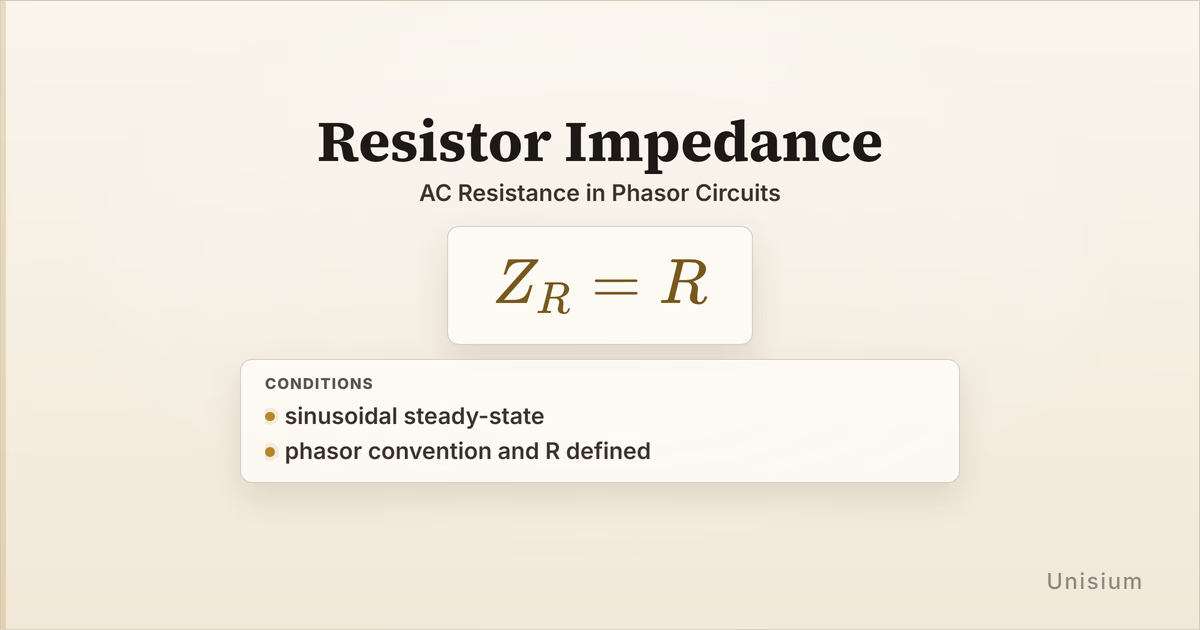
Resistor Impedance says that, in sinusoidal steady-state phasor analysis, a resistor’s impedance is equal to its resistance. The impedance has no imaginary part, so the resistor does not create a phase shift between its voltage phasor and current phasor. It still resists current, but in the phasor model it behaves as a real number.
Mathematical Form
Where:
- is the resistor impedance, in ohms
- is the resistance of the resistor, in ohms
With the passive sign convention, the resistor voltage and current phasors satisfy:
That voltage-current equation is the usual way the impedance enters a phasor circuit calculation. The principle itself is the impedance model .
What “real impedance” means
A real impedance changes amplitude without rotating the phasor. If the current phasor through a resistor is chosen as the phase reference, the resistor voltage phasor points in the same direction. Capacitors and inductors are different because their impedances include the imaginary unit, which creates a phase shift.
Conditions of Applicability
Condition: sinusoidal steady-state; phasor convention and R defined
Practical modeling notes
- Sinusoidal steady-state means the circuit is being analyzed after transients have died away, with all signals at the same angular frequency.
- Phasor convention means the problem has chosen how sinusoidal time functions map to complex amplitudes.
- must be the resistance of the selected resistor, not the total resistance of a network unless the network has already been reduced.
- The sign of a resistor voltage phasor still depends on the chosen polarity and current reference direction.
When it does not apply directly
- Transient circuit response: a switching problem before steady state is not a phasor impedance problem yet.
- Reactive element: a capacitor or inductor has a different impedance relation, so using would erase the phase behavior.
- Non-ohmic or frequency-dependent device: if the device cannot be represented by a constant resistor at the frequency of interest, a more detailed model is needed.
Want the complete framework behind this guide? Read Masterful Learning.
Common Misconceptions
Misconception 1: Every impedance must be complex
The truth: Impedance is allowed to be a real number. A resistor has , which is complex-plane notation for a real resistance.
Why this matters: Adding an imaginary part to a resistor invents a phase shift that the ideal resistor model does not have.
Misconception 2: Resistance disappears in AC analysis
The truth: A resistor still opposes current in AC analysis. Phasors change the representation, not the resistor’s resistance.
Why this matters: AC circuit problems often mix resistors with capacitors or inductors; the resistor still contributes the real part of the impedance.
Misconception 3: Use the whole circuit’s impedance for one resistor
The truth: describes one resistor or an already reduced equivalent resistor.
Why this matters: Mixing one element’s voltage or current with the whole circuit impedance gives the wrong phasor relation.
Elaborative Encoding
Use these questions to build understanding before memorizing the formula. See Elaborative Encoding for the broader method.
Within the Principle
- What does it mean geometrically that has no imaginary part?
- Why do and have the same unit even though one is used in a phasor equation?
For the Principle
- What wording in a problem tells you the circuit is being treated in sinusoidal steady state?
- Before writing , how would you check that belongs to the resistor whose phasor voltage and current you are relating?
Between Principles
- How does Ohm’s Law prepare the voltage-current relation that resistor impedance uses in phasor form?
Generate an Example
- Describe an AC circuit element for which applies and one nearby element where it would not apply.
Retrieval Practice
Answer from memory, then reveal the result and check it. See Retrieval Practice for the full study method.
State the principle in words: _____In sinusoidal steady-state phasor analysis, a resistor has real impedance equal to its resistance.
Write the canonical equation: _____
State the canonical condition: _____sinusoidal steady-state; phasor convention and R defined
Worked Example
Use this worked example to practice Self-Explanation.
Problem
An AC circuit is in sinusoidal steady state using a phasor convention. A resistor has resistance , and the current phasor through it is . Find the resistor impedance and the voltage phasor across the resistor using the passive sign convention.
Step 1: Verbal Decoding
Target:
Given:
Constraints: sinusoidal steady-state; phasor convention chosen; resistor voltage and current use the passive sign convention
Step 2: Visual Decoding
Draw one resistor, mark the current reference through it, and mark the voltage polarity so the current enters the positive terminal. Sketch the current phasor at and place the resistor voltage phasor in the same direction. (The key visual fact is that a resistor changes phasor magnitude but not phase.)
Step 3: Physics Modeling
Step 4: Mathematical Procedures
Step 5: Reflection
- Dimensional analysis: Ohms times amperes gives volts, so the voltage phasor unit is correct.
- Interpretation: The voltage phasor has the same phase angle as the current phasor because the impedance is real.
- Magnitude: A resistor carrying gives a phasor magnitude, which matches the DC-style scale.
Before moving on: self-explain the model
Try explaining why Step 3 includes both the resistor impedance relation and the phasor voltage-current relation, but no capacitor or inductor impedance.
Physics model with explanation
Principle: We use Resistor Impedance because the problem asks for the phasor-domain model of one resistor.
Conditions: The circuit is in sinusoidal steady state, the phasor convention is given, and the resistance is defined, so the canonical condition is satisfied.
Relevance: The target is directly equal to the given resistance, and that impedance then links the resistor’s current phasor to its voltage phasor.
Description: The resistor is one selected element. Under the passive sign convention, multiplying its current phasor by the real impedance gives the resistor voltage phasor without changing phase.
Goal: Identify the resistor impedance, then use it as the multiplier in the element’s phasor voltage-current relation.
Solve a Problem
Apply what you have learned with Problem Solving.
Problem
In a sinusoidal steady-state phasor circuit, a resistor has . The resistor voltage phasor is using the passive sign convention. Find and the current phasor through the resistor.
Hint: Use first, then rearrange .
Show Solution
Step 1: Verbal Decoding
Target:
Given:
Constraints: sinusoidal steady-state; phasor convention chosen; passive sign convention for the resistor
Step 2: Visual Decoding
Draw one resistor with the chosen voltage polarity and current reference. Sketch the voltage phasor at and put the resistor current phasor on the same ray. (The key visual fact is that resistor voltage and current phasors stay in phase.)
Step 3: Physics Modeling
Step 4: Mathematical Procedures
Step 5: Reflection
- Dimensional analysis: Volts divided by ohms gives amperes, so the current unit is correct.
- Verification: Multiplying by returns .
- Interpretation: The current keeps the voltage phase angle because the resistor impedance has no imaginary part.
Related Principles
See Electromagnetism: The Principle Map for where resistor impedance begins the AC impedance sequence.
| Principle | Relationship to Resistor Impedance |
|---|---|
| Ohm’s Law | Gives the resistor voltage-current relation before it is written in phasor form. |
| Capacitor Impedance | Uses a complex, frequency-dependent impedance, so it contrasts with the resistor’s real impedance. |
| Inductor Impedance | Uses an imaginary, frequency-dependent impedance, so it creates a different phase relation. |
See Principle Structures for a broader way to organize DC relations, transient relations, and phasor-domain device models.
FAQ
What is resistor impedance?
Resistor impedance is . In sinusoidal steady-state phasor analysis, an ideal resistor’s impedance is its resistance written as a real phasor-domain quantity.
When does Z sub R equals R apply?
It applies under the canonical condition: sinusoidal steady-state; phasor convention and R defined. The problem must be using phasors, and must be the resistance of the selected resistor or equivalent resistor.
Does a resistor shift phase in an AC circuit?
An ideal resistor does not shift phase between its own voltage and current phasors. With the passive sign convention, the voltage and current phasors are in phase because is real.
Is resistor impedance different from resistance?
For an ideal resistor in phasor analysis, the numerical value is the same: . The word impedance signals that the value is being used in the AC phasor voltage-current relation.
How is resistor impedance different from capacitor or inductor impedance?
Resistor impedance is real and frequency independent in the ideal model. Capacitor and inductor impedances include the imaginary unit and depend on angular frequency, so they affect phase differently.
Related Guides
- Electromagnetism Principle Map - Place resistor impedance in the AC circuits lane.
- Ohm’s Law - Review the voltage-current-resistance relation behind the resistor phasor model.
- Problem Solving - Practice turning circuit wording into the right model.
- Retrieval Practice - Make the equation and condition easier to recall.
How This Fits in Unisium
Unisium treats Resistor Impedance as a principle because the equation is short but the representation boundary matters: it belongs to sinusoidal steady-state phasor analysis, and it applies to the selected resistor or equivalent resistor. The useful learning path is to encode why the impedance is real, retrieve with its condition, self-explain voltage-current phasor examples, and solve new AC circuit problems before adding capacitor or inductor impedance.
Ready to study physics principles this way? Check access and join the Unisium waitlist or explore the full framework in Masterful Learning.

Masterful Learning
The book behind these guides: a study system for physics, math, & programming built on retrieval, connection, explanation, and problem solving.
Ready to apply this strategy?
Unisium turns these evidence-based techniques into guided study sessions for math and physics. Places are limited during early access. Check current availability to start a trial; joining the mailing list is optional.
See plans and availability Read More GuidesAlready have access? Sign in