RC Discharging Voltage: Exponential Decay from Initial Voltage
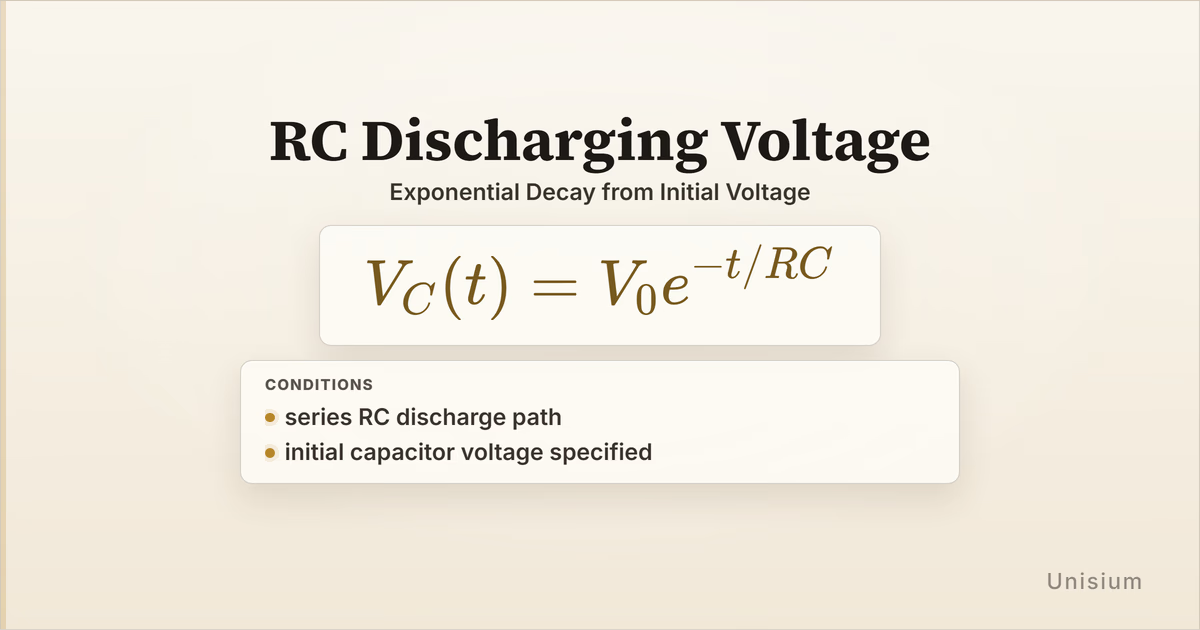
RC Discharging Voltage says the capacitor voltage in a series RC discharge falls as . It applies when a charged capacitor discharges through a series RC path and the initial capacitor voltage is specified. Use it to find capacitor voltage or discharge time; do not use the charging formula or assume the voltage drops to zero instantly.
This guide sits in the device-and-network lane of the Electromagnetism Principle Map, after Capacitor Time Constant and RC Charging Voltage. The surrounding decisions are recognizing the discharge path, identifying the initial voltage, choosing the effective resistance, and separating a falling discharge curve from a rising charging curve. Those are setup decisions around the relation, not new principle keys.
On this page: The Principle | Conditions | Misconceptions | Elaborative Encoding | Retrieval Practice | Worked Example | Solve a Problem | Related Principles | FAQ | Related Guides | How This Fits
The Principle
Statement
RC Discharging Voltage gives the capacitor voltage as a function of time while an initially charged capacitor releases stored charge through a resistor. The voltage starts at when the discharge begins and decays exponentially toward zero. The product sets how quickly the decay happens.
Mathematical Form
Where:
- is the capacitor voltage at time
- is the initial capacitor voltage at the start of the discharge
- is the effective discharge resistance
- is the capacitance
- is the discharge time scale
The diagram pairs the discharge path with the voltage curve. Once the source is removed or the capacitor is connected to a discharge path, the capacitor voltage does not jump to zero. It falls by a constant fraction each time interval of length .
Useful equivalent forms
Because , the same relation is often written as:
To solve for the time when the capacitor reaches a specified voltage, rearrange the same equation:
For the usual positive-voltage convention, this time form applies when ; more generally, must be between 0 and 1.
Conditions of Applicability
Condition: series RC discharge path; initial capacitor voltage specified
Practical modeling notes
- Series RC discharge path means the capacitor has a resistive path for releasing stored charge.
- The initial voltage is the capacitor voltage at the moment you start measuring time.
- The effective resistance and capacitance are treated as constant during the discharge interval.
- Circuit topology recognition happens before this principle is applied.
When it does not apply directly
- Charging: use the RC charging-voltage relation when a step source charges an initially uncharged capacitor.
- Nonzero final voltage: a shifted transient form is needed if the capacitor decays toward a final voltage other than zero.
- Different topology: reduce the circuit to the effective discharge model before using the compact exponential form.
- Changing components: if or changes during the interval, one constant may not describe the full discharge.
Want the complete framework behind this guide? Read Masterful Learning.
Common Misconceptions
Misconception 1: Discharging means the voltage becomes zero immediately
The truth: The capacitor voltage approaches zero exponentially.
Why this matters: Instant discharge ignores the finite current set by the resistance and erases the time dependence.
Misconception 2: Charging and discharging use the same formula
The truth: Charging from zero rises toward a source voltage; discharging from an initial voltage falls by multiplying by .
Why this matters: Mixing the formulas reverses the curve shape and often gives impossible voltages.
Misconception 3: The initial voltage is always the battery voltage
The truth: is whatever capacitor voltage exists at the start of the discharge.
Why this matters: A capacitor can begin discharging from a measured voltage, not only from a source value printed in the problem.
Elaborative Encoding
Use these questions to build understanding before memorizing the formula. See Elaborative Encoding for the broader method.
Within the Principle
- Why does equal one at the start of the discharge?
- Why does increasing or make the voltage fall more slowly?
For the Principle
- What words in a problem tell you the capacitor is discharging rather than charging?
- Before using this formula, how would you identify the initial voltage ?
Between Principles
- How does Capacitor Time Constant explain the speed of the decay, while RC Charging Voltage explains the opposite curve direction?
Generate an Example
- Describe a discharge setup where the initial voltage stays the same but the voltage takes longer to fall because one circuit parameter changes.
Retrieval Practice
Answer from memory, then reveal the result and check it. See Retrieval Practice for the full study method.
State the principle in words: _____In a standard series RC discharge path with specified initial capacitor voltage, the capacitor voltage decays exponentially from its initial value.
Write the canonical equation: _____
State the canonical condition: _____series RC discharge path; initial capacitor voltage specified
Worked Example
Use this worked example to practice Self-Explanation.
Problem
A capacitor is initially charged to and then discharges through a series resistor. The resistance is and the capacitance is . Find the capacitor voltage at after the discharge begins.
Step 1: Verbal Decoding
Target:
Given:
Constraints: series RC discharge path; initial capacitor voltage specified; constant resistance and capacitance
Step 2: Visual Decoding
Draw a capacitor connected to a resistor in one discharge path, then sketch a voltage curve starting at and falling toward zero. (The key visual fact is that the asked voltage lies on the falling capacitor-voltage curve.)
Step 3: Physics Modeling
Step 4: Mathematical Procedures
Step 5: Reflection
- Dimensional analysis: The exponent is unitless because seconds divide by seconds.
- Magnitude: The answer is below the initial voltage, as a discharging capacitor should be.
- Limiting case: After two time constants, the voltage should be about of its starting value, which matches the result.
Before moving on: self-explain the model
Try explaining why Step 3 uses the discharging formula rather than the charging formula, what means, and why controls the decay rate.
Physics model with explanation
Principle: We use RC Discharging Voltage because the problem asks for capacitor voltage after an initially charged capacitor begins discharging through a resistor.
Conditions: The problem states a series RC discharge path and gives the initial capacitor voltage, so the canonical condition is satisfied.
Relevance: The target is exactly the quantity modeled by .
Description: The capacitor releases stored charge through the resistor, and the resistor limits current so the voltage falls exponentially rather than all at once.
Goal: Compute , substitute the requested time, and check that the result is between zero and the initial voltage.
Solve a Problem
Apply what you have learned with Problem Solving.
Problem
A capacitor with starts a discharge at through an effective resistance of . Find the time when the capacitor voltage reaches .
Hint: Solve for before substituting values.
Show Solution
Step 1: Verbal Decoding
Target:
Given:
Constraints: series RC discharge path; initial capacitor voltage specified; target voltage is positive and below the initial voltage
Step 2: Visual Decoding
Draw a falling capacitor-voltage curve from toward zero, then mark the horizontal level and the time where the curve reaches it. (The key visual fact is that the target time occurs during the decay.)
Step 3: Physics Modeling
Step 4: Mathematical Procedures
Step 5: Reflection
- Domain check: The target voltage is between zero and , so the logarithm input is valid.
- Verification: Substituting gives about .
- Interpretation: The target is one-sixth of the starting voltage, so the time is longer than one time constant.
Related Principles
See Electromagnetism: The Principle Map for where RC discharge sits in the device-and-network sequence.
| Principle | Relationship to RC Discharging Voltage |
|---|---|
| Capacitor Time Constant | Defines the time scale that appears in the discharging exponent. |
| RC Charging Voltage | Uses the same time scale but describes a rising capacitor voltage from an uncharged start. |
| Ohm’s Law | Explains the resistor relation that limits discharge current. |
See Principle Structures for a broader way to organize time scales, transient relations, and circuit models.
FAQ
What is RC Discharging Voltage?
RC Discharging Voltage is the relation . It gives the capacitor voltage over time when an initially charged capacitor discharges through a resistive path.
When does the RC discharging formula apply?
It applies under the canonical condition: series RC discharge path; initial capacitor voltage specified. You need a discharge path and a known capacitor voltage at the start of the interval.
Why does the capacitor voltage decay exponentially?
As the capacitor voltage decreases, the discharge current through the resistor also decreases. That feedback makes the voltage lose a constant fraction over each time interval of length .
How is RC Discharging Voltage different from RC Charging Voltage?
RC Charging Voltage describes a voltage rising toward a source from an uncharged start. RC Discharging Voltage describes a voltage falling from toward zero.
What happens after one time constant in a discharge?
After one time constant, the voltage is , or about 37 percent of its initial value. It is not zero yet.
Related Guides
- Capacitor Time Constant - Review the time scale inside the discharging exponential.
- RC Charging Voltage - Compare the rising transient to this falling one.
- Electromagnetism Principle Map - Place RC discharge among circuit and device relations.
- Problem Solving - Practice turning circuit wording into the right model.
How This Fits in Unisium
Unisium treats RC Discharging Voltage as a principle because the formula is compact but condition-sensitive: it is a discharge relation, it needs a specified initial capacitor voltage, and it depends on the product . The useful learning path is to encode the falling curve shape, retrieve the equation with its condition, self-explain why the voltage loses a constant fraction, and solve new problems where the target is voltage or time.
Ready to master RC discharge and related physics principles? Check access and join the Unisium waitlist or explore the full framework in Masterful Learning.

Masterful Learning
The book behind these guides: a study system for physics, math, & programming built on retrieval, connection, explanation, and problem solving.
Ready to apply this strategy?
Unisium turns these evidence-based techniques into guided study sessions for math and physics. Places are limited during early access. Check current availability to start a trial; joining the mailing list is optional.
See plans and availability Read More GuidesAlready have access? Sign in