Magnetic Flux Integral: Field Through an Oriented Surface
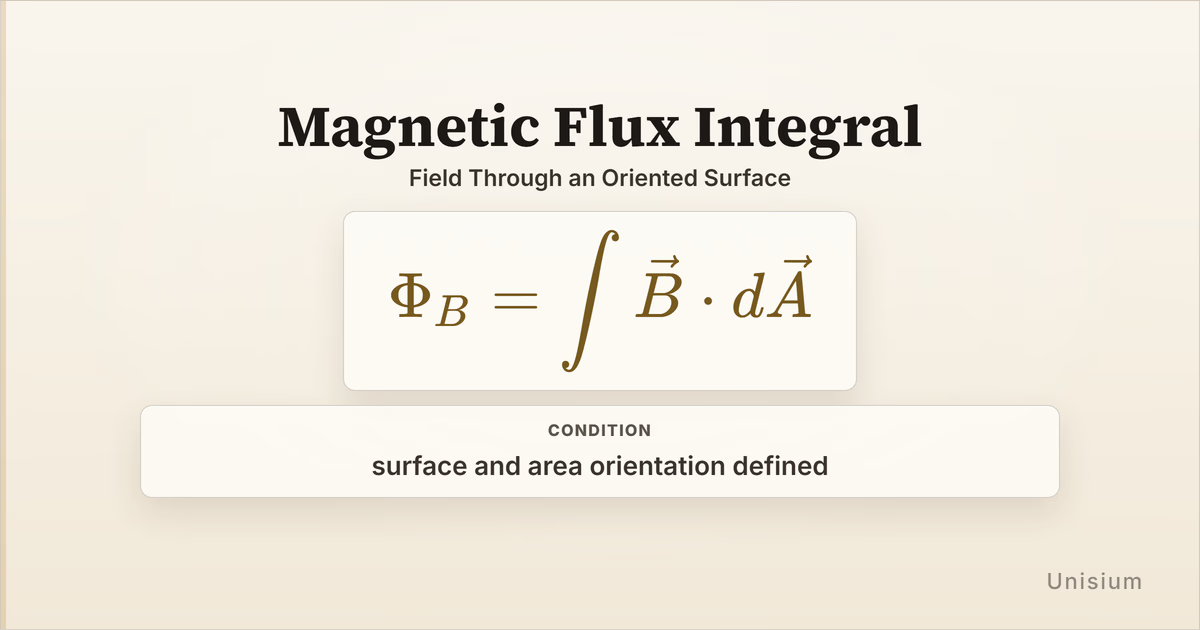
Magnetic Flux Integral says magnetic flux through a surface is the surface integral of magnetic field dotted with oriented area. The model is , and it applies when the surface and area orientation are defined. Use it when the magnetic field changes across the surface, the surface is curved, or you need the dot product to select the local field component normal to the surface.
This guide extends Magnetic Flux In A Uniform Field from one flat, uniform-field dot product to many local dot products over a surface. The surrounding decisions are surface choice, local normal direction, bounds, sign convention, and whether the problem is asking for flux itself or for a later induction or source law.
On this page: The Principle | Conditions | Misconceptions | Elaborative Encoding | Retrieval Practice | Worked Example | Solve a Problem | Related Principles | FAQ | Related Guides | How This Fits
The Principle
Statement
Magnetic Flux Integral measures the signed amount of magnetic field passing through an oriented surface. It adds up many small contributions, each one formed by dotting the local magnetic field with a local oriented area element. Tangential magnetic-field components do not contribute; only the component of along the local area vector matters.
Mathematical Form
Where:
- is magnetic flux in webers, , equivalent to
- is the magnetic field in tesla,
- is a small oriented area vector, with magnitude and direction normal to the surface
The diagram is a guide-level orientation scaffold. Each small surface patch has its own direction, so the integral adds local magnetic-field-through-area contributions:
For an open surface, the chosen normal direction sets the sign convention. For closed surfaces, the orientation is not arbitrary in the same way: the outward normal is the standard convention used in flux laws. The same local dot-product idea is used on every patch.
Connection to the uniform-field form
If the surface is flat and is constant over it, the local area vectors add into one area vector . Then the integral reduces to the earlier uniform-field relation:
The integral form is more general because it still works when varies from point to point or the surface normal changes across the surface.
Conditions of Applicability
Condition: surface and area orientation defined
Practical modeling notes
- Surface defined means you know what surface the flux is being computed through, including its bounds.
- Area orientation defined means you know the normal direction for each surface element before assigning the sign of the dot product.
- On an open surface, the normal direction is a convention that must be stated or chosen.
- On a closed surface, the outward normal is normally used unless the problem states otherwise.
- The integral can handle nonuniform fields, but only after the magnetic field is expressed on the surface being integrated over.
When it does not apply directly
- No surface is specified: flux is a surface quantity, so a magnetic field alone is not enough.
- Orientation is missing: a magnitude may be possible, but signed flux is not well-defined until the area direction is chosen.
- An induction or source relation is the target: use Faraday’s Law later for induced emf from changing magnetic flux, or Gauss Law For Magnetism later for net closed-surface magnetic flux.
Want the complete framework behind this guide? Read Masterful Learning.
Common Misconceptions
Misconception 1: The integral is over a volume
The truth: Magnetic flux is a surface integral. You add contributions over area elements, not over volume elements.
Why this matters: Using a volume element hides the normal direction and gives the wrong physical quantity.
Misconception 2: Every component of the magnetic field contributes
The truth: The dot product keeps only the component of along .
Why this matters: Tangential magnetic-field components can be present and still contribute zero local flux.
Misconception 3: Magnetic flux integral is Faraday’s Law
The truth: The flux integral computes magnetic flux at an instant. Faraday’s Law uses how magnetic flux changes to model induced emf.
Elaborative Encoding
Use these questions to build understanding before memorizing the formula. See Elaborative Encoding for the broader method.
Within the Principle
- Why does need both a magnitude and a direction?
- What does the dot product remove from the magnetic field at each local patch?
For the Principle
- What wording in a problem tells you the surface orientation is defined?
- How would you decide whether an open surface should use one normal direction or the opposite one?
Between Principles
- How does this integral generalize Magnetic Flux In A Uniform Field without changing the meaning of area orientation?
Generate an Example
- Describe a surface and magnetic field where the field is nonuniform but the magnetic flux integral is still straightforward because only one field component dots with .
Retrieval Practice
Answer from memory, then reveal the result and check it. See Retrieval Practice for the full study method.
State the principle in words: _____Magnetic flux through a surface equals the surface integral of magnetic field dotted with oriented area.
Write the canonical equation: _____
State the canonical condition: _____surface and area orientation defined
Worked Example
Use this worked example to practice Self-Explanation.
Problem
A rectangular surface lies in the -plane with and . The chosen area direction is . On the surface, the magnetic field is , where . Find the magnetic flux through the surface.
Step 1: Verbal Decoding
Target:
Given:
Constraints: rectangular surface in the -plane; area direction is ; normal magnetic-field component varies with
Step 2: Visual Decoding
Draw the rectangle in the -plane, mark the normal, and sketch magnetic-field arrows growing longer as increases. (The key visual fact is that the normal component varies across the surface.)
Step 3: Physics Modeling
Step 4: Mathematical Procedures
Step 5: Reflection
- Dimensional analysis: times three length factors gives .
- Interpretation: More flux comes from the larger- side because the normal magnetic field is stronger there.
- Limiting case: Reversing the area direction to would reverse the sign of the answer.
Before moving on: self-explain the model
Try explaining why Step 3 integrates a local normal component, why the bounds are area bounds, and why the sign depends on the chosen normal direction.
Physics model with explanation
Principle: We use Magnetic Flux Integral because the problem asks for magnetic flux through a defined surface, and the magnetic field varies across that surface.
Conditions: The rectangular surface and its area orientation are both specified, so the canonical condition is satisfied.
Relevance: The target is flux, so the direct model is the surface integral of .
Description: For a surface in the -plane with orientation, . Dotting with the magnetic field selects the local normal component .
Goal: We integrate the local normal-field contribution over the rectangular area.
Solve a Problem
Apply what you have learned with Problem Solving.
Problem
A rectangular surface lies in the -plane with and . The chosen area direction is . On the surface, the magnetic field is , where and . Find the magnetic flux through the surface.
Hint: The magnetic field varies with , so integrate the normal component across the rectangle.
Show Solution
Step 1: Verbal Decoding
Target:
Given:
Constraints: rectangular surface in the -plane; area direction is ; normal magnetic-field component varies with
Step 2: Visual Decoding
Draw the rectangle in the -plane, mark the normal, and note that magnetic-field arrows grow longer as increases. (The key visual fact is that the normal component changes across the surface.)
Step 3: Physics Modeling
Step 4: Mathematical Procedures
Step 5: Reflection
- Dimensional analysis: The integral multiplies magnetic field by two length differentials, giving .
- Magnitude: The average normal magnetic field is a little above over an area of , so is plausible.
- Interpretation: Positive flux means the field points with the chosen area direction.
Related Principles
See Electromagnetism: The Principle Map for where this field-calculus relation sits in the subdomain.
| Principle | Relationship to Magnetic Flux Integral |
|---|---|
| Magnetic Flux In A Uniform Field | The flat, uniform-field case that the integral form generalizes. |
| Faraday Law Integral | Uses the time rate of change of magnetic flux to model induced emf. |
| Gauss Law For Magnetism | States that net magnetic flux through a closed surface is zero. |
See Principle Structures for a broader view of how these relations connect.
FAQ
What is the magnetic flux integral?
The magnetic flux integral is the surface integral . It adds the local component of magnetic field through each oriented area element of a surface.
When does the magnetic flux integral apply?
It applies when the surface and area orientation are defined. You need both the surface bounds and the normal direction convention before the signed flux is meaningful.
What is the difference between magnetic flux integral and magnetic flux in a uniform field?
The uniform-field formula uses one dot product, , for a flat surface with constant magnetic field. The integral form adds many local dot products, so it can handle nonuniform fields or changing surface normals.
Why does the area vector direction matter?
The area vector direction sets the sign of each local dot product. Reversing the chosen normal reverses the sign of the flux through an open surface.
Is the magnetic flux integral the same as Faraday’s Law?
No. The magnetic flux integral computes flux. Faraday’s Law adds a separate physical claim: an induced emf is related to the time rate of change of magnetic flux through a circuit.
Related Guides
- Electromagnetism: The Principle Map - Place flux integrals in the field-calculus layer.
- Magnetic Flux In A Uniform Field - Review the flat, uniform-field dot product first.
- Magnetic Field In A Long Solenoid - Revisit a common source of magnetic fields before using field components inside integrals.
- Problem Solving - Practice turning a surface, bounds, and orientation into a model.
How This Fits in Unisium
Unisium treats Magnetic Flux Integral as a principle because most student errors happen before the integration: choosing the surface, setting the normal, identifying the normal field component, and preserving the sign convention. The useful learning path is to encode the area-element meaning, retrieve the integral with its condition, self-explain the dot product in worked examples, and solve new problems where bounds and orientation are not already packaged for you.
Ready to master Magnetic Flux Integral? Check access and join the Unisium waitlist or explore the full framework in Masterful Learning.

Masterful Learning
The book behind these guides: a study system for physics, math, & programming built on retrieval, connection, explanation, and problem solving.
Ready to apply this strategy?
Unisium turns these evidence-based techniques into guided study sessions for math and physics. Places are limited during early access. Check current availability to start a trial; joining the mailing list is optional.
See plans and availability Read More GuidesAlready have access? Sign in