Gauss Law: Net Flux Reveals Enclosed Charge
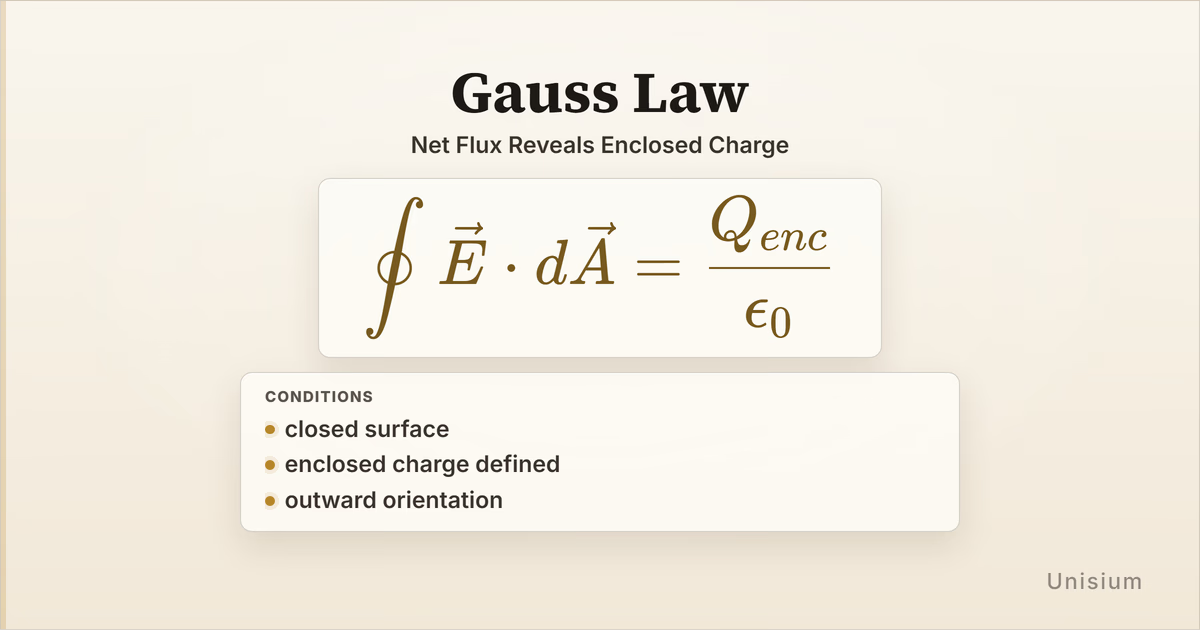
Gauss Law says the net electric flux through a closed surface equals the enclosed charge divided by the vacuum permittivity. The model is , and it applies when the surface is closed, enclosed charge is defined, and the area orientation is outward. Use it to connect a closed-surface flux count to source charge, not to choose the surface for you.
This guide builds on Electric Flux Integral: the local dot products are the same, but the surface is now closed and the result is tied to enclosed charge. Choosing a useful Gaussian surface is a surrounding modeling decision; Gauss Law is the closed-surface flux-to-charge relation once that setup is in place.
On this page: The Principle | Conditions | Misconceptions | Elaborative Encoding | Retrieval Practice | Worked Example | Solve a Problem | Related Principles | FAQ | Related Guides | How This Fits
The Principle
Statement
Gauss Law connects the net electric flux through any closed surface to the total charge enclosed by that surface. The law is not a shortcut for every electric-field problem; it becomes powerful when symmetry lets the flux integral simplify after the closed surface has been chosen.
Mathematical Form
Where:
- is the electric field on the closed surface, in
- is an outward-oriented area element
- is the net charge enclosed by the surface, in coulombs
- is the vacuum permittivity
The circle on the integral sign means the surface is closed. The left side is net outward flux: outward field contributions count positive, inward contributions count negative, and tangent components contribute zero. The right side says only the charge inside the closed surface sets that net flux.
Alternative Forms
In common notation, the same relation may appear as:
- Flux language: for a closed surface
- Symmetric-field shortcut: only after symmetry makes constant over the relevant surface area
Conditions of Applicability
Condition: closed surface; enclosed charge defined; outward orientation
Practical modeling notes
- Closed surface means the surface has no boundary edge; it fully encloses a region.
- Enclosed charge defined means you can identify the net charge inside that closed surface.
- Outward orientation means each points away from the enclosed volume.
- Choosing a Gaussian surface is surrounding setup, not the law itself.
- Symmetry is not part of the canonical condition, but it often decides whether Gauss Law is useful for finding .
When it does not apply directly
- The surface is open: use Electric Flux Integral to compute flux through the specified open surface.
- You need local field without symmetry: Gauss Law still holds, but it may not isolate ; use source-specific field models or superposition.
- The charge boundary is unclear: define what is inside the closed surface before writing .
Want the complete framework behind this guide? Read Masterful Learning.
Common Misconceptions
Misconception 1: Gauss Law says the electric field is zero whenever enclosed charge is zero
The truth: Zero enclosed charge means zero net flux through the closed surface. The local electric field on parts of the surface can still be nonzero.
Why this matters: External charges can send field lines through the surface; equal inward and outward flux can cancel in the net total.
Misconception 2: Any closed surface makes the field easy to find
The truth: The law applies to any closed surface, but only high-symmetry choices usually let you pull out of the integral.
Why this matters: Gaussian-surface choice is a modeling decision that determines whether the equation becomes solvable in one line or remains an integral statement.
Misconception 3: Charges outside the surface contribute to enclosed charge
The truth: Outside charges can affect the field on the surface, but they do not appear in .
Elaborative Encoding
Use these questions to build understanding before memorizing the formula. See Elaborative Encoding for the broader method.
Within the Principle
- Why does the integral use a closed-surface symbol instead of an ordinary surface integral symbol?
- What does “net outward flux” mean when some field lines enter the surface and others leave?
For the Principle
- What must you identify before you can write for a problem?
- Why is symmetry useful even though it is not part of the condition line?
Between Principles
- How does Gauss Law use Electric Flux Integral and add a source-charge claim?
Generate an Example
- Describe one closed surface with zero enclosed charge but nonzero electric field on parts of the surface.
Retrieval Practice
Answer from memory, then reveal the result and check it. See Retrieval Practice for the full study method.
State the principle in words: _____The net electric flux through a closed surface equals the enclosed charge divided by the vacuum permittivity.
Write the canonical equation: _____
State the canonical condition: _____closed surface; enclosed charge defined; outward orientation
Worked Example
Use this worked example to practice Self-Explanation.
Problem
A point charge sits at the center of a spherical Gaussian surface with radius . By symmetry, the electric field has the same magnitude everywhere on the surface and points outward. Find the electric field magnitude at the surface.
Step 1: Verbal Decoding
Target:
Given:
Constraints: spherical closed surface; charge is enclosed; outward orientation; field magnitude is constant on the surface
Step 2: Visual Decoding
The figure fixes the closed spherical surface, the centered enclosed charge, the radius, and the outward surface orientation. Use the stated symmetry to decide how relates to the outward area direction on the surface before simplifying the flux integral.
Step 3: Physics Modeling
Step 4: Mathematical Procedures
Step 5: Reflection
- Dimensional analysis: The units reduce to for electric field.
- Interpretation: A positive enclosed charge gives positive outward flux, matching the outward field direction.
- Limiting case: Increasing spreads the same enclosed charge over a larger sphere, so decreases as .
Before moving on: self-explain the model
Try explaining why Step 3 can use instead of keeping the full closed-surface integral, and why that simplification depends on the spherical symmetry stated in the problem.
Physics model with explanation
Principle: We use Gauss Law because the problem gives a closed surface, an enclosed charge, and outward orientation.
Conditions: The spherical surface is closed, the point charge is inside it, and the area vectors point outward.
Relevance: The target is the electric field on a symmetric closed surface, so the net flux relation can isolate .
Description: Since the charge is at the center, the field is normal to the sphere and has the same magnitude at every surface point. The flux integral becomes field magnitude times spherical area.
Goal: Solve the closed-surface flux equation for the field magnitude at radius .
Solve a Problem
Apply what you have learned with Problem Solving.
Problem
A long insulating cylinder has uniform volume charge density . Use a coaxial cylindrical Gaussian surface of radius and length , fully inside the charged material. By symmetry, the field is radial and constant on the curved side, and the end caps have zero flux. Find the electric field magnitude at radius .
Hint: The enclosed charge is charge density times the volume inside the Gaussian cylinder.
Show Solution
Step 1: Verbal Decoding
Target:
Given:
Constraints: cylindrical closed surface; charge is enclosed; outward orientation; curved-side field is constant and radial; end-cap flux is zero
Step 2: Visual Decoding
The figure fixes the physical charged material, the smaller coaxial Gaussian cylinder, the curved side, the end caps, and the enclosed region. Use those surface pieces with the stated radial symmetry to decide what charge is enclosed and how each part of the closed surface enters the flux integral.
Step 3: Physics Modeling
Step 4: Mathematical Procedures
Step 5: Reflection
- Dimensional analysis: has units of electric field.
- Interpretation: The length cancels because both enclosed charge and curved area scale with .
- Limiting case: At smaller radius, less charge is enclosed, so the interior field decreases linearly with .
Related Principles
See Electromagnetism: The Principle Map for where Gauss Law sits in the field-calculus layer.
| Principle | Relationship to Gauss Law |
|---|---|
| Electric Flux Integral | Supplies the closed-surface flux expression on the left side of Gauss Law. |
| Electric Field From Point Charge | Matches the spherical result when the enclosed charge is a point charge at the center. |
| Gauss Law For Magnetism | Uses the same closed-surface flux structure for magnetic field, with zero net magnetic flux. |
See Principle Structures for a broader view of how source laws and field relations connect.
FAQ
What is Gauss Law?
Gauss Law states that the net electric flux through a closed surface equals the enclosed charge divided by the vacuum permittivity. In symbols, .
When does Gauss Law apply?
It applies when the surface is closed, the enclosed charge is defined, and the area orientation is outward. Those are the canonical conditions from the principle key.
Does Gauss Law require symmetry?
No. Gauss Law is true for any closed surface under its condition. Symmetry is what often makes it useful for solving for an unknown electric field.
Do charges outside the surface matter?
Outside charges can affect the electric field at points on the surface, but they do not count in . Their flux contributions through the closed surface cancel in the net total.
Is Gauss Law the same as the electric flux integral?
No. The electric flux integral computes flux through a surface. Gauss Law adds the source relation that net flux through a closed surface equals enclosed charge divided by the vacuum permittivity.
Related Guides
- Electromagnetism: The Principle Map - Place Gauss Law among the field-source relations.
- Electric Flux Integral - Review the surface integral before closing the surface.
- Electric Flux In A Uniform Field - Revisit the dot-product meaning of flux.
- Problem Solving - Practice turning conditions and givens into a usable model.
How This Fits in Unisium
Unisium treats Gauss Law as a principle because the equation is short but the modeling boundary is subtle: closed surface, outward orientation, and enclosed charge must be kept separate from surface-choice strategy. The useful learning path is to encode what net flux means, retrieve the law with its condition, self-explain symmetric examples, and solve new problems where the surface setup is explicit.
Ready to master Gauss Law? Check access and join the Unisium waitlist or explore the full framework in Masterful Learning.

Masterful Learning
The book behind these guides: a study system for physics, math, & programming built on retrieval, connection, explanation, and problem solving.
Ready to apply this strategy?
Unisium turns these evidence-based techniques into guided study sessions for math and physics. Places are limited during early access. Check current availability to start a trial; joining the mailing list is optional.
See plans and availability Read More GuidesAlready have access? Sign in