Should You Listen to Music While Studying Math or Physics?
Should you listen to music while studying math or physics? Yes, if it helps you start, stay motivated, or block worse distractions without stealing working memory. The safest study music is high-motivation but low-interference: predictable, mostly instrumental, and easy to ignore once the equations, proofs, or multi-step problems get hard.
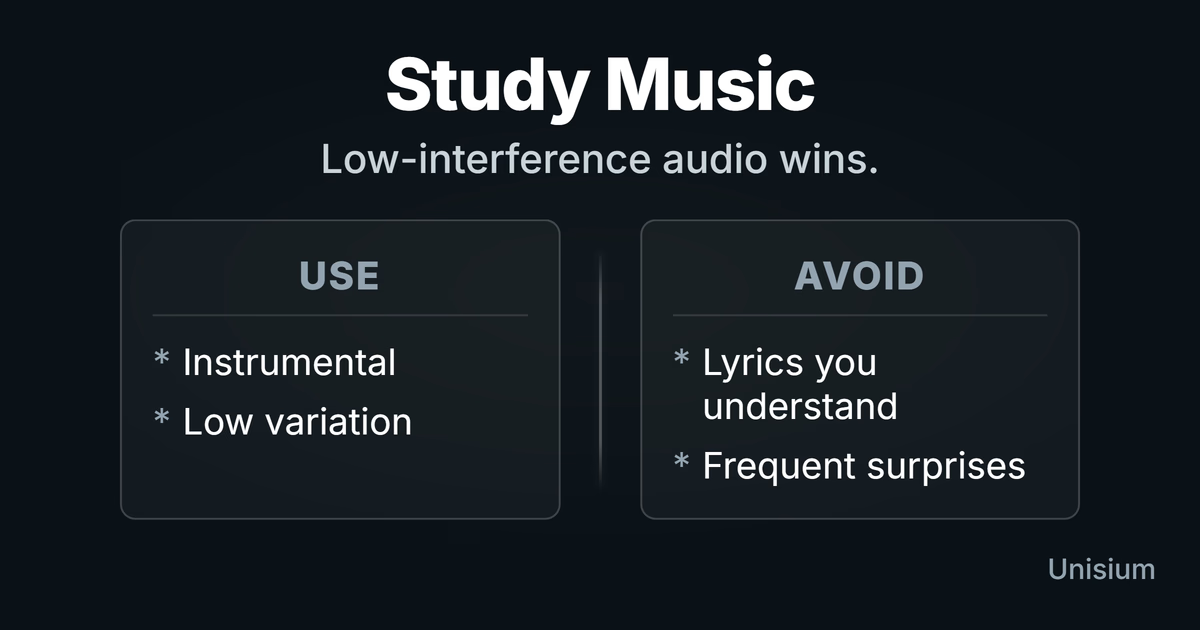
Music is not automatically bad for studying math or physics. For many students, the right track helps them start, stay energized, and block out worse distractions in a noisy room. The danger is not music itself. The danger is music that competes with the same working memory you need for equations, proofs, and multi-step problems.
A good rule is: use music when it increases flow without increasing mistakes. High-energy music can help you begin. Low-variation instrumental sound can help you keep going. But if lyrics, drops, or musical surprises make you reread lines, lose your place, or make more algebra slips, switch to silence or steady noise for the hardest reasoning.
The mechanism: why music helps or hurts problem solving
Learning math and physics requires heavy use of your working memory. You need to hold variables, visualize geometric relationships, and manipulate logic simultaneously. This cognitive workspace is limited.
The “irrelevant sound effect” occurs when background noise interferes with this processing. The interference is strongest when the noise contains speech. Your brain’s phonological loop—the inner voice you use to read and solve problems—automatically tries to process lyrics, even if you ignore them.
This is dual-task interference. When you listen to lyrical music while solving a differential equation, you are forcing your brain to multitask. This split attention reduces your processing speed and increases the error rate. The cost is not just distraction; it is a reduction in the available “RAM” for the physics problem at hand.
The verdict: Sound profiles
Not all sound environments are equal. For deep learning tasks, the useful question is not “music or no music?” It is “does this sound increase flow without pulling attention away from the work?” Some sound profiles are reliably lower-interference than others:
Sound profiles that work
- Silence: The lowest-interference option for high-load tasks like learning a new theorem or solving a novel problem. Use it when even good music starts costing attention.
- Continuous Noise: White noise, pink noise, or rain sounds. These mask distracting transient noises (like a conversation nearby) without engaging the language centers.
- Instrumental, Low-Variation Music: Long-form ambient, drone, familiar lo-fi, or predictable instrumental music. It can add energy and block distractions without “events” (drops, solos, vocal chops) that grab attention.
Sound profiles that hurt
- Lyrical Music: The worst option for deep work. The lyrics compete directly with the verbal and semantic processing required for study.
- High-Variation Music: Genres with frequent dynamic changes, drops, or complex melodies. Every surprise is a micro-interruption to your train of thought.
Personal note: My default is long, low-variation instrumental or ambient music because it fades into the background. If I notice I’m “listening” to the track, it’s too attention-grabby for hard problems. A track that often works for me is Koan – “Fern Thicket”.
Heuristic: The “Flow + No Penalty” rule
If a track reliably helps you enter flow, that matters. Flow increases time-on-task and reduces friction, which can beat “perfect” study conditions you don’t stick with.
Use a simple two-signal check. Keep the music if it (a) helps you stay absorbed, and (b) does not noticeably raise errors or slow you down on the same kind of work.
- Flow signal: You work 20–40 minutes without checking your phone, skipping steps, or feeling pulled away.
- Penalty signal: You catch yourself re-reading lines, losing your place in derivations, or making more sign/algebra slips than usual.
Rule: If Flow is high and Penalty is low, the music is “safe enough.” If Penalty is high, keep the music for warm-up/rote work and simplify the sound for the hard parts. Treat this as a decision rule, not an identity statement—more examples of useful defaults in Effective Study Mindsets.
When It Applies
Music is most useful when it supports the study session instead of becoming a second task:
- Startup and warm-up: Use it to get moving before the first hard block.
- Low-focus review: Flashcards, light review, or file cleanup can tolerate more background stimulation than derivations or proof work.
- Noisy environments: Steady instrumental tracks, white noise, or rain sounds can mask worse distractions.
- Familiar work: Once the task is procedural and stable, low-interference audio can help you stay in rhythm longer than silence would.
If the task depends on inner speech, multiple variables, or delicate algebra, treat silence as the default and make music earn its place.
Protocol: The Fade-to-Silence method
To balance the mood benefits of music with the cognitive benefits of silence, use this three-step protocol for your next physics or calculus session. If you like structure, pair it with a timer ramp (Pomodoro as starter motor).
1. The mood boost (0–10 minutes)
Start your session with your favorite high-energy music. It doesn’t matter if it has lyrics. The goal here is to organize your desk, open your notes, and get over the initial resistance. Do not start difficult problems yet.
2. The transition (10–15 minutes)
Switch to instrumental music or a familiar lo-fi playlist. Begin your warm-up problems. These should be easier tasks that don’t require your full cognitive capacity, like reviewing flashcards or copying diagrams.
3. The deep work (15+ minutes)
As soon as you encounter a difficult problem or need to learn a new concept, reduce the interference. Turn the music down, switch to something steadier, or pause it. Your brain is now warmed up, and the goal is to protect as much working memory as possible for the task.
Common Mistakes
- Using lyrical music for equations and proofs: Lyrics compete directly with the verbal channel you need for reasoning.
- Never cutting the audio: If you keep music on through the hardest part, you lose the benefit of the warm-up protocol.
- Testing music only on easy tasks: A playlist that feels fine during cleanup can still hurt on novel problem solving.
- Confusing comfort with performance: A setup can feel pleasant while still increasing error rates.
How this fits in Unisium
The Unisium Study System leans on high-effort activities like active recall and step-by-step problem solving, where working memory is often the bottleneck. If music helps you show up and stay consistent, keep it—consistency beats perfect conditions.
For the hardest cards, prefer silence, steady noise, or low-variation instrumental tracks, and reduce the audio load when you hit a real sticking point. If you want a deeper framework for choosing methods and environments, see Masterful Learning and pair this with retrieval practice.
FAQ
Can music help while solving math or physics problems?
Yes, if it improves flow without increasing mistakes. Music can help you keep momentum, feel more energized, and block out worse distractions from roommates, classrooms, libraries, or cafes. The test is the problem itself: if you keep losing your place, rereading lines, missing conditions, or making more algebra slips, the track is taking too much attention.
What is the best music for studying physics or math?
The best music for studying physics or math is high-motivation and low-interference. Pick something predictable with no lyrics you understand and no sudden drops or vocal hooks. For the hardest reasoning, silence or steady noise may still win, but the goal is not to be anti-music. The goal is to keep the useful energy while removing the attention cost.
What about the Mozart Effect?
The “Mozart Effect”—the idea that listening to classical music makes you smarter—is largely a myth. Studies show that any temporary performance boost is due to the mood elevation described above, not the music itself. You would get a similar benefit from any audio you enjoy, provided it doesn’t distract you.
Do binaural beats work?
The evidence for binaural beats enhancing concentration is weak and inconsistent. While some users report feeling more focused, this is likely a placebo effect or simply the benefit of masking background noise. If they work for you as a form of white noise, use them, but don’t expect them to alter your brain waves significantly.
Can I listen to music for rote tasks?
Yes. If you are formatting a bibliography, cleaning up your aesthetic notes, or organizing files, music is fine. These tasks have low cognitive load, so the interference is negligible. Save the silence for the hard math.
Next Steps
- Can’t start? See Study Habits or Pomodoro Technique.
- Start but drift? See From Resistance to Flow.
- Working but not improving? See Effective Study Mindsets.
Ready to apply this strategy?
Unisium turns these evidence-based techniques into guided study sessions for math and physics. Places are limited during early access. Check current availability to start a trial; joining the mailing list is optional.
See plans and availability Read More GuidesAlready have access? Sign in