Charge Density Differential Relation: Turn Density Into dq
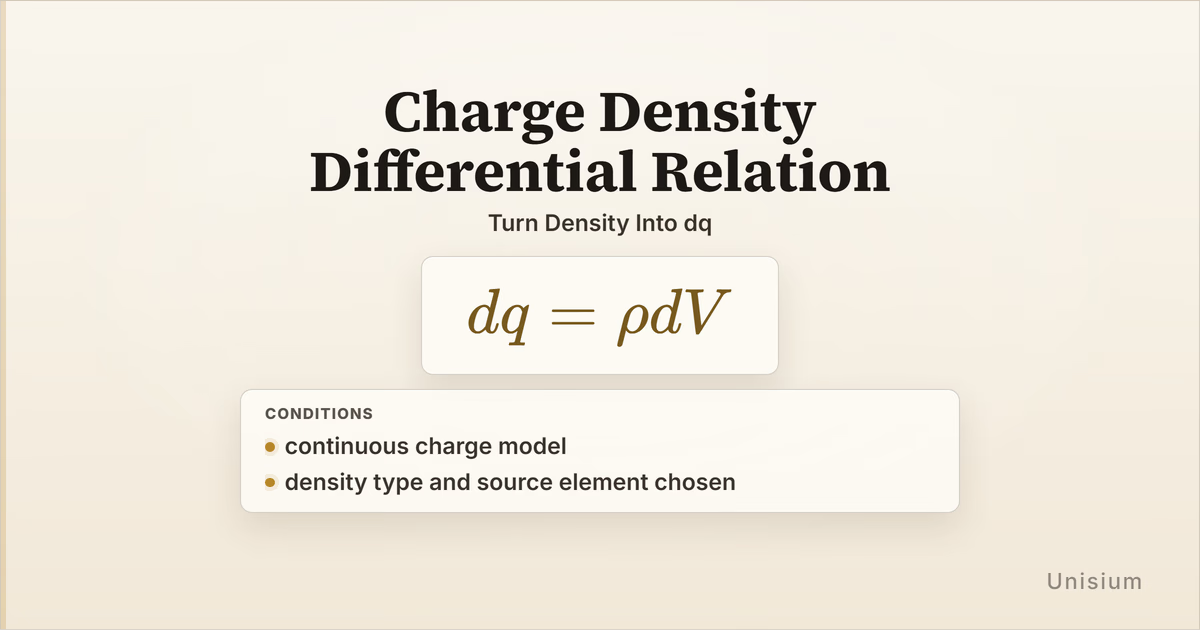
Charge Density Differential Relation says a continuous charge model turns a small source element into differential charge: , , or . It applies when the charge is modeled continuously and the density type plus source element are chosen. Use it before electric-field or potential integrals; the common mistake is mixing a line, surface, or volume density with the wrong element.
This guide sits in the field-calculus layer of the Electromagnetism Principle Map, between earlier flux and field-law guides and later continuous-source integrals. The surrounding decisions are choosing the source model, coordinates, and integration limits; those choices are setup work around this relation, not extra principles to memorize.
On this page: The Principle | Conditions | Misconceptions | Elaborative Encoding | Retrieval Practice | Worked Example | Solve a Problem | Related Principles | FAQ | Related Guides | How This Fits
The Principle
Statement
Charge Density Differential Relation connects a continuous charge density to the small charge element used inside an integral. If the source is a line, use linear charge density with a length element. If it is a sheet, use surface charge density with an area element. If charge fills a region, use volume charge density with a volume element.
Mathematical Form
Where:
- is a small charge element, in coulombs
- is linear charge density, in coulombs per meter
- is a small length element on a charged line
- is surface charge density, in coulombs per square meter
- is a small area element on a charged surface
- is volume charge density, in coulombs per cubic meter
- is a small volume element inside a charged region
The relation does not decide the geometry for you. It says that once the density type and source element are chosen, the differential charge follows. Later relations such as electric field from a continuous charge distribution or electric potential from a continuous charge distribution use this inside their own integrals.
Alternative Forms
For uniform density over a whole object, the same idea often appears as total charge:
- Line source:
- Surface source:
- Volume source:
Those are not new principles. They are the finite-size versions that appear when the density is constant over the whole length, area, or volume.
Conditions of Applicability
Condition: continuous charge model; density type and source element chosen
Practical modeling notes
- Continuous charge model means the discrete charges are being approximated as a smoothly distributed source.
- Density type chosen means you have decided whether the source is best represented as a line, surface, or volume.
- Source element chosen means , , or matches the geometry you plan to integrate over.
When It Doesn’t Apply
- Point-charge model: If the source is a small number of point charges, use point-charge relations and sums instead of a density element.
- Wrong source dimension: A thin wire needs , not , unless you are explicitly modeling its three-dimensional material volume.
- Undefined geometry: If the source element and coordinates are not chosen, the density relation is not ready to enter an integral.
Want the complete framework behind this guide? Read Masterful Learning.
Common Misconceptions
Misconception 1: The symbol rho is the only charge density
The truth: is volume charge density. Line and surface sources usually use and .
Why this matters: The density unit tells you which geometric element belongs beside it.
Misconception 2: dq is the final answer
The truth: is usually an ingredient inside a later field, potential, or total-charge integral.
Why this matters: Finding is the source-modeling step, not the whole continuous-charge problem.
Misconception 3: Density choice and integration limits are the same decision
The truth: The density relation tells you the local charge element; limits come from the object’s geometry.
Elaborative Encoding
Use these questions to build understanding before memorizing the forms. See Elaborative Encoding for the broader method.
Within the Principle
- Why does the unit of the density determine whether the element is , , or ?
- What does represent physically if the source is continuous rather than a single point charge?
For the Principle
- What words in a problem suggest a line source rather than a surface or volume source?
- Before writing , what has to be decided about the source geometry?
Between Principles
- How does this relation prepare the source term used in continuous electric-field and electric-potential integrals?
Generate an Example
- Describe one charged object that would naturally use , one that would naturally use , and one that would naturally use .
Retrieval Practice
Answer from memory, then reveal the result and check it. See Retrieval Practice for the full study method.
State the principle in words: _____A continuous charge density converts the matching small source element into a differential charge element for integration.
Write the charge-density differential forms: _____
State the canonical condition: _____continuous charge model; density type and source element chosen
Worked Example
Use this worked example to practice Self-Explanation.
Problem
A thin charged rod lies along the -axis from to . Its linear charge density is . Write an expression for the total charge on the rod.
Step 1: Verbal Decoding
Target:
Given: , ,
Constraints: continuous line charge; rod lies on one axis; length element chosen along
Step 2: Visual Decoding
Draw the rod on the -axis from to , mark a small segment , and label its charge as . (The key visual fact is that the source element is a length element.)
Step 3: Physics Modeling
Step 4: Mathematical Procedures
Step 5: Reflection
- Dimensional analysis: has units of charge.
- Limiting case: If increases while stays fixed, the total charge grows linearly.
- Interpretation: The average density is half the endpoint density because the density rises linearly from zero.
Before moving on: self-explain the model
Try explaining why Step 3 uses rather than or , and why the integral limits come from the rod geometry rather than from the density relation itself.
Physics model with explanation
Principle: We use Charge Density Differential Relation because the rod is modeled as a continuous line charge.
Conditions: The source is continuous, the density type is linear charge density, and the source element is chosen along the rod.
Relevance: The target is total charge, so the first job is to express each small charge element as .
Description: Each small length element contributes a small amount of charge, and the total charge is the sum of those elements over the rod.
Goal: Convert the given density into , then integrate along the source.
Solve a Problem
Apply what you have learned with Problem Solving.
Problem
A circular insulating disk has radius and uniform surface charge density . Write an expression for the total charge on the disk.
Hint: Use a surface element for a uniform charged surface.
Show Solution
Step 1: Verbal Decoding
Target:
Given: ,
Constraints: continuous surface charge; uniform density; circular disk geometry
Step 2: Visual Decoding
Draw the disk from above, mark a small area patch , and label its charge as . (The key visual fact is that the source element is an area element.)
Step 3: Physics Modeling
Step 4: Mathematical Procedures
Step 5: Reflection
- Dimensional analysis: Surface charge density times area gives charge.
- Interpretation: Uniform density lets factor out of the integral.
- Connection to concept: The source is a surface, so is the matching element.
Related Principles
See Electromagnetism: The Principle Map for where this density relation prepares later continuous-source principles.
| Principle | Relationship to Charge Density Differential Relation |
|---|---|
| Electric Flux Integral | Uses differential surface elements, but for field-through-surface flux rather than source charge. |
| Gauss Law | Relates flux through a closed surface to enclosed charge after the source model is known. |
| Electric Field From Continuous Charge Distribution | Later uses as the source element inside the field integral. |
See Principle Structures for a broader view of how source-modeling definitions prepare later laws.
FAQ
What is the charge density differential relation?
It is the rule that turns a continuous charge density into a small charge element: , , or . The correct form depends on whether the source is modeled as a line, surface, or volume.
When does this relation apply?
It applies under the canonical condition: continuous charge model; density type and source element chosen. If a problem gives point charges instead of a continuous source, use a sum over point charges instead.
How do I know whether to use lambda, sigma, or rho?
Use for charge per length, for charge per area, and for charge per volume. The unit of the density is often the fastest check.
Is dq the same as total charge?
No. is one small piece of charge. Total charge comes from summing or integrating those pieces over the source.
Why does this matter for electric field and potential?
Continuous-source field and potential formulas integrate contributions from many small charge elements. This relation supplies the that those later integrals need.
Related Guides
- Electromagnetism: The Principle Map - Place this relation in the continuous-source layer.
- Electric Flux Integral - Compare source elements with surface-flux elements.
- Gauss Law - Connect enclosed charge to flux through a closed surface.
- Problem Solving - Practice translating a physical setup into equations and constraints.
How This Fits in Unisium
Unisium treats Charge Density Differential Relation as a principle because the formula is small but the modeling choice is easy to blur. The useful learning path is to encode which density belongs to which source element, retrieve the correct form with its condition, self-explain the geometry choice, and solve new problems where source modeling comes before integration.
Ready to master Charge Density Differential Relation? Check access and join the Unisium waitlist or explore the full framework in Masterful Learning.

Masterful Learning
The book behind these guides: a study system for physics, math, & programming built on retrieval, connection, explanation, and problem solving.
Ready to apply this strategy?
Unisium turns these evidence-based techniques into guided study sessions for math and physics. Places are limited during early access. Check current availability to start a trial; joining the mailing list is optional.
See plans and availability Read More GuidesAlready have access? Sign in