Is Memory Palace Effective for Learning Math/Physics? Rarely
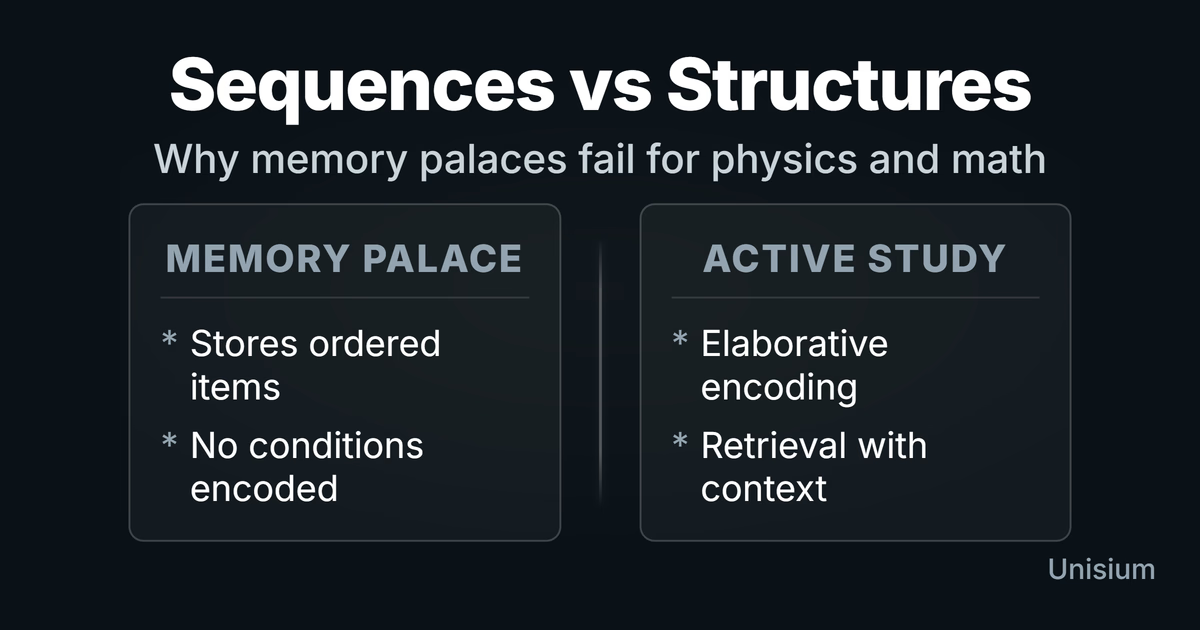
Memory palaces (method of loci) excel at storing ordered sequences—names, lists, speeches—but fail for math and physics because exams demand principle selection and transfer, not recall of fixed routes. Placing Newton’s laws along an imaginary hallway doesn’t encode when each law applies or how to discriminate between them on a novel problem. For STEM learning, use elaborative encoding, retrieval practice, and problem-solving instead.
Memory palaces are famous because world champions use them to memorize decks of cards or thousands of digits. The technique is powerful for that kind of task. Math and physics require flexible retrieval based on problem features, not route traversal.
The core failure mode is cue competition. Exams cue retrieval by problem features (conditions, givens, asked quantity), while loci cues retrieval by location. That trains a retrieval pathway you won’t have access to when you most need it. This mismatch explains why memory palaces are often listed among ineffective study techniques for STEM.
On this page: What Is the Memory Palace · Why It Fails for STEM · Can It Be Salvaged? · What to Do Instead · FAQ · How This Fits
What Is the Memory Palace (Method of Loci)?
The method of loci—also called the memory palace—dates back to ancient Greek and Roman orators. Here’s how it works:
- Choose a familiar place (your house, a route you walk daily).
- Identify distinct locations along the route (front door, kitchen table, bookshelf).
- Associate each item you want to remember with a vivid, exaggerated image at each location.
- To recall, mentally walk the route and “see” each image.
For memorizing a speech or a grocery list, this technique is effective. The spatial context provides retrieval cues, and the bizarre imagery makes items memorable.
The question is whether this helps with physics equations, mathematical proofs, or problem-solving. The short answer: rarely.
Why Memory Palaces Fail for Math and Physics
1) They Store Sequences, Not Relationships
A memory palace encodes items in a fixed order along a route. But physics and math knowledge isn’t sequential—it’s relational. You need to know that the impulse-momentum theorem is a restatement of Newton’s second law for time-varying forces, not just that it comes “after” momentum conservation in your mental hallway.
When you face a problem, you don’t walk a route. You recognize features, retrieve candidate principles, and check conditions. Spatial mnemonics don’t train this discrimination.
2) They Don’t Encode Conditions of Use
Knowing when a principle applies is half the battle in physics. Conservation of momentum requires no net external force. Work-energy requires you to identify all forces doing work. The Five-Step Strategy builds this condition-checking into every problem.
Memory palaces store what (the principle exists) but not when (the conditions for use). You might recall that “work-energy theorem” is at the refrigerator, but that tells you nothing about whether to use it on a given problem.
3) The Maintenance Cost Is High
Every new principle needs a new location. Every modification (learning a new condition, connecting to a new topic) requires updating your mental imagery. Over a semester of physics, you might encounter dozens of principles, each with conditions and relationships.
Palace upkeep grows faster than the benefit. Meanwhile, principle structures—tables that list name, equation, and conditions—adapt naturally as you learn.
4) Transfer Fails Under Pressure
On an exam, you are not strolling through a route and waiting for the next location cue. You are scanning givens and constraints and deciding which principle fits.
That cue is feature-based (“constant acceleration”, “isolated system”, “elastic collision”), not location-based. Memory palaces train location -> item retrieval, so the pathway you practice competes with the pathway you need (features -> principle), and retrieval slows down or fails when the cue does not match.
Memory champions use loci because card order is arbitrary. Physics principles are conditional and structured.
Want the complete framework behind this guide? Read Masterful Learning.
Can It Be Salvaged?
Memory palaces are not useless, but they are narrow. Like Keyword Mnemonics, they help when the material is arbitrary and order matters.
Ordered lists you must recall. Loci can support recall for short sequences you are forced to reproduce (prefixes, a short constants list, named sequences). Treat it as recall scaffolding and keep it small.
A reminder that a topic exists. You can place “hooks” in a palace to remember what to revisit later. Then build usable knowledge with Elaborative Encoding and Retrieval Practice.
Vocabulary with weak internal logic. When pairings are arbitrary (term -> meaning), imagery can lower forgetting. Most math/physics knowledge is conditional and relational, so the payoff drops fast.
What to Do Instead
Replace memory palaces with strategies that match what exams demand: recognizing structures, checking conditions, and generating solutions. That means you practice features -> principle -> condition checks, not location -> item.
1) Elaborative Encoding — Build Meaning and Conditions
Don’t just store that a principle exists. Ask: What does it mean? When does it apply? How does it differ from similar principles?
Example: For the work-energy theorem, encode: “Net work equals change in kinetic energy. Applies when I can identify all forces doing work. Differs from impulse-momentum, which tracks momentum change over time instead of energy change over displacement.”
This creates relational knowledge, not spatial placeholders. See the full Elaborative Encoding guide.
2) Retrieval Practice — Test Recall by Cue, Not by Route
Practice recalling principles from problem features, not from a mental walk.
Example: See a problem about a collision. Ask yourself: “What principles apply to collisions?” Retrieve momentum conservation, check conditions (is external force negligible?), then verify. This is feature-cued retrieval—the kind exams demand.
Build this into your sessions with Retrieval Practice.
3) Principle Structures — Organize by Relationship
Create tables that group principles by domain, with columns for name, equation, and conditions. Update them as you learn. This replaces the palace with something more adaptable and directly useful for problem-solving.
See Principle Structures for templates and examples.
4) Self-Explanation — Extract Transferable Rules
When studying worked examples, explain each step: what principle, what condition, what operation. This builds “if-condition-then-step” rules you can deploy on novel problems.
See Self-Explanation.
These four strategies—elaborative encoding, retrieval practice, principle structures, and self-explanation—form the core loop inside the Unisium Study System. They target what memory palaces miss: conditions, relationships, and transfer.
FAQ
What is the memory palace technique?
The memory palace (method of loci) is a mnemonic strategy where you associate items with locations along a familiar route, then recall by mentally walking that route. It works well for ordered lists but poorly for structured, conditional knowledge like physics principles.
Is the memory palace good for studying?
For pure list memorization (vocabulary, names, sequences), yes. For math and physics, rarely—because these subjects require understanding when principles apply and how they relate, not just that they exist.
Why do memory champions use memory palaces if they don’t work?
Memory champions solve different problems: memorize a deck of cards, recall 1,000 digits of pi. These are arbitrary-sequence tasks. Physics exams ask you to select and apply principles to novel structures—a fundamentally different challenge.
Can I combine memory palaces with other strategies?
You can use a palace to remember that topics exist, then do the real learning with elaborative encoding and retrieval practice. But this makes the palace optional scaffolding, not a core strategy.
What’s the best alternative to memory palaces for physics?
Use elaborative encoding to build meaning and conditions, retrieval practice to test recall, and problem-solving practice to build transfer. These strategies target what exams demand.
How This Fits in Unisium
Unisium replaces passive and mismatched strategies—like memory palaces—with the active loop that builds transferable knowledge: elaborative encoding → retrieval practice → self-explanation → problem-solving. Every study session in the app targets conditions, relationships, and transfer, not arbitrary sequences.
Ready to study smarter? Check access and join the Unisium waitlist or explore the full framework in Masterful Learning.
Next Steps
- Do instead: Elaborative Encoding
- Big picture: Ineffective Study Techniques
Masterful Learning
The book behind these guides: a study system for physics, math, & programming built on retrieval, connection, explanation, and problem solving.
Ready to apply this strategy?
Unisium turns these evidence-based techniques into guided study sessions for math and physics. Places are limited during early access. Check current availability to start a trial; joining the mailing list is optional.
See plans and availability Read More GuidesAlready have access? Sign in