Current Density Definition: Add Flow Through Oriented Area
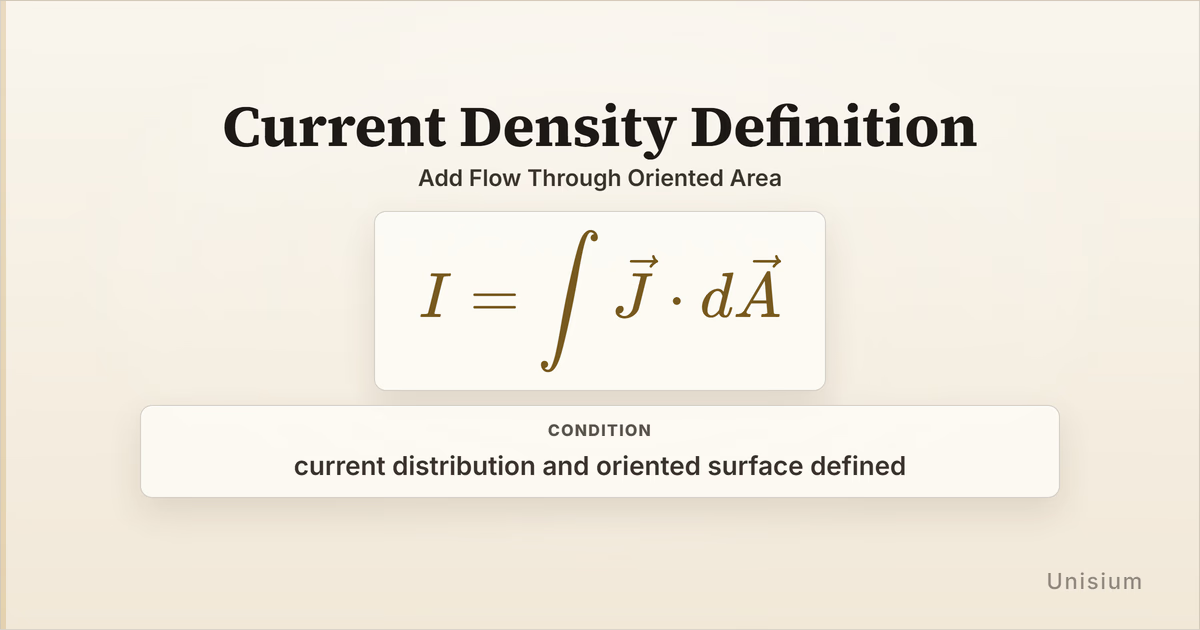
Current Density Definition says total current through a surface is the surface integral of current density dotted with oriented area. The model is , and it applies when a current distribution and oriented surface are defined. Use it when current is spread across a chosen area; the common mistake is treating as total current instead of current per area.
This guide extends Electric Current Definition from charge crossing one surface per time to a local current-density field crossing many area elements. The surrounding decisions are choosing the surface, choosing its orientation, and deciding the sign convention for positive current; those are setup choices around the definition, not separate principle keys.
On this page: The Principle | Conditions | Misconceptions | Elaborative Encoding | Retrieval Practice | Worked Example | Solve a Problem | Related Principles | FAQ | Related Guides | How This Fits
The Principle
Statement
Current Density Definition measures total current by adding the local flow-through-area contribution over an oriented surface. At each small area element, the dot product keeps the part of current density normal to the surface and assigns a sign from the chosen orientation. The surface integral adds those local contributions into the net current through the whole surface.
Mathematical Form
Where:
- is the signed current through the chosen surface, in amperes
- is current density, in amperes per square meter
- is a small oriented area vector, with magnitude and direction normal to the surface
The diagram is a guide-level orientation scaffold. A current-density field can point partly through a surface and partly along it; only the normal component contributes to signed current through that surface. For a flat surface with uniform , the integral reduces to the dot product
When the current density varies across the surface or the surface normal changes, the integral form keeps the local bookkeeping honest.
Related local form
The small contribution from one local patch is
This is not a new principle. It is the differential version of the same definition, useful when you need to build the integral patch by patch.
Conditions of Applicability
Condition: current distribution and oriented surface defined
Practical modeling notes
- Current distribution defined means is known or modeled on the surface being crossed.
- Oriented surface defined means the surface and its normal direction are chosen before assigning a sign to the current.
- Reversing the area orientation reverses the sign of but not the physical flow itself.
- If the problem asks only for current magnitude through a perpendicular cross-section, you may use the magnitude after the orientation is clear.
When it does not apply directly
- No surface is chosen: current density is local flow per area, so total current is incomplete until a crossing surface is specified.
- No orientation is chosen: the magnitude may be meaningful, but signed current is not fixed.
- Lumped-circuit current is already given: if a problem gives a single wire current directly, use circuit relations unless the spatial distribution across area matters.
Want the complete framework behind this guide? Read Masterful Learning.
Common Misconceptions
Misconception 1: Current density is the same thing as current
The truth: Current density is current per area with direction. Total current comes from integrating its normal component over a surface.
Why this matters: Doubling the surface area can double the total current for the same normal current density.
Misconception 2: Every component of current density contributes
The truth: Only the component of along contributes to current through the surface.
Why this matters: Current density tangent to a surface describes flow along the surface, not flow through it.
Misconception 3: Surface orientation is cosmetic
The truth: Orientation sets the sign convention for current. The same physical flow can be positive or negative depending on the chosen normal direction.
Elaborative Encoding
Use these questions to build understanding before memorizing the formula. See Elaborative Encoding for the broader method.
Within the Principle
- Why does have units of amperes per square meter rather than amperes?
- What does the dot product remove when current density is not perpendicular to the surface?
For the Principle
- What wording in a problem tells you which surface the current is crossing?
- Before assigning a sign to , what orientation choice has to be made?
Between Principles
- How does this definition extend Electric Current Definition while using the same idea of charge crossing a chosen surface?
Generate an Example
- Describe a situation where current density is uniform but the total current changes because the chosen area changes.
Retrieval Practice
Answer from memory, then reveal the result and check it. See Retrieval Practice for the full study method.
State the principle in words: _____Total current through an oriented surface equals the surface integral of current density dotted with oriented area.
Write the canonical equation: _____
State the canonical condition: _____current distribution and oriented surface defined
Worked Example
Use this worked example to practice Self-Explanation.
Problem
A flat circular surface of radius has area vector in the direction. The current density is uniform across the surface: . Find the current through the surface.
Step 1: Verbal Decoding
Target:
Given:
Constraints: flat circular surface; uniform current density; area orientation is
Step 2: Visual Decoding
Draw a disk with its area vector pointing in and current-density arrows pointing in the same direction. (The key visual fact is that is normal to the surface and aligned with .)
Step 3: Physics Modeling
Step 4: Mathematical Procedures
Step 5: Reflection
- Dimensional analysis: times gives amperes.
- Magnitude: A small disk area gives a fraction of an ampere even with a three-digit current density.
- Interpretation: The answer is positive because points with the chosen area orientation.
Before moving on: self-explain the model
Try explaining why Step 3 uses a surface integral, why the dot product became a positive scalar, and why this problem needs area as well as current density.
Physics model with explanation
Principle: We use Current Density Definition because the problem gives local current flow per area and asks for total current through a surface.
Conditions: The current distribution is uniform and the circular surface has a stated orientation, so the canonical condition is satisfied.
Relevance: The target is , and the model adds over the surface.
Description: Since is perpendicular to the disk and points with the area vector, each local dot product is .
Goal: Multiply the normal current density by the disk area to get total current.
Solve a Problem
Apply what you have learned with Problem Solving.
Problem
A rectangular surface has dimensions by and area vector in the direction. The uniform current density is . Find the signed current through the surface.
Hint: Keep the sign from the dot product before multiplying by area.
Show Solution
Step 1: Verbal Decoding
Target:
Given:
Constraints: flat rectangular surface; uniform current density; area orientation is ; signed current requested
Step 2: Visual Decoding
Draw the rectangle with its area vector pointing in and draw the current-density arrows in . (The key visual fact is that flow is opposite the chosen positive surface direction.)
Step 3: Physics Modeling
Step 4: Mathematical Procedures
Step 5: Reflection
- Dimensional analysis: Current density times area gives amperes.
- Verification: The negative sign matches current density pointing opposite the chosen area vector.
- Interpretation: The physical current magnitude is , but it is negative under this orientation convention.
Related Principles
See Electromagnetism: The Principle Map for where current density sits in the devices, networks, and local-material layer.
| Principle | Relationship to Current Density Definition |
|---|---|
| Electric Current Definition | Defines current as charge crossing per time before spatial current density is introduced. |
| Electric Flux Integral | Uses the same oriented-surface dot-product structure, but for electric field flux rather than current. |
| Microscopic Ohm’s Law | Later relates local current density to electric field in an ohmic material. |
See Principle Structures for a broader view of how definitions prepare later modeling relations.
FAQ
What is current density?
Current density is local current per unit area with direction. It describes how strongly charge is flowing through space at a point, usually measured in amperes per square meter.
What is the current density definition formula?
The formula is . It says total signed current through a surface comes from adding the normal component of current density over that surface.
When does the current density definition apply?
It applies under the canonical condition: current distribution and oriented surface defined. You need both on the surface and a chosen surface normal before signed current is determined.
Why is there a dot product in the formula?
The dot product keeps only the component of current density perpendicular to the surface. Flow tangent to the surface does not cross through it.
How is current density different from electric current?
Electric current is the total rate of charge crossing a surface. Current density is the local flow per unit area, so integrating current density over area gives the total current.
Related Guides
- Electromagnetism Principle Map - Place current density inside the broader EM sequence.
- Electric Current Definition - Review current as charge crossing a surface per time.
- Electric Flux Integral - Compare two oriented-surface dot-product integrals.
- Problem Solving - Practice translating a physical setup into equations and constraints.
How This Fits in Unisium
Unisium treats Current Density Definition as a principle because the equation is short but the representation is easy to blur: local flow, surface choice, orientation, and total current have to line up. The useful learning path is to encode the dot-product meaning, retrieve with its condition, self-explain orientation in worked examples, and solve new problems where current is distributed across area.
Ready to master Current Density Definition? Check access and join the Unisium waitlist or explore the full framework in Masterful Learning.

Masterful Learning
The book behind these guides: a study system for physics, math, & programming built on retrieval, connection, explanation, and problem solving.
Ready to apply this strategy?
Unisium turns these evidence-based techniques into guided study sessions for math and physics. Places are limited during early access. Check current availability to start a trial; joining the mailing list is optional.
See plans and availability Read More GuidesAlready have access? Sign in