Is It Too Late to Learn Math or Physics as an Adult?
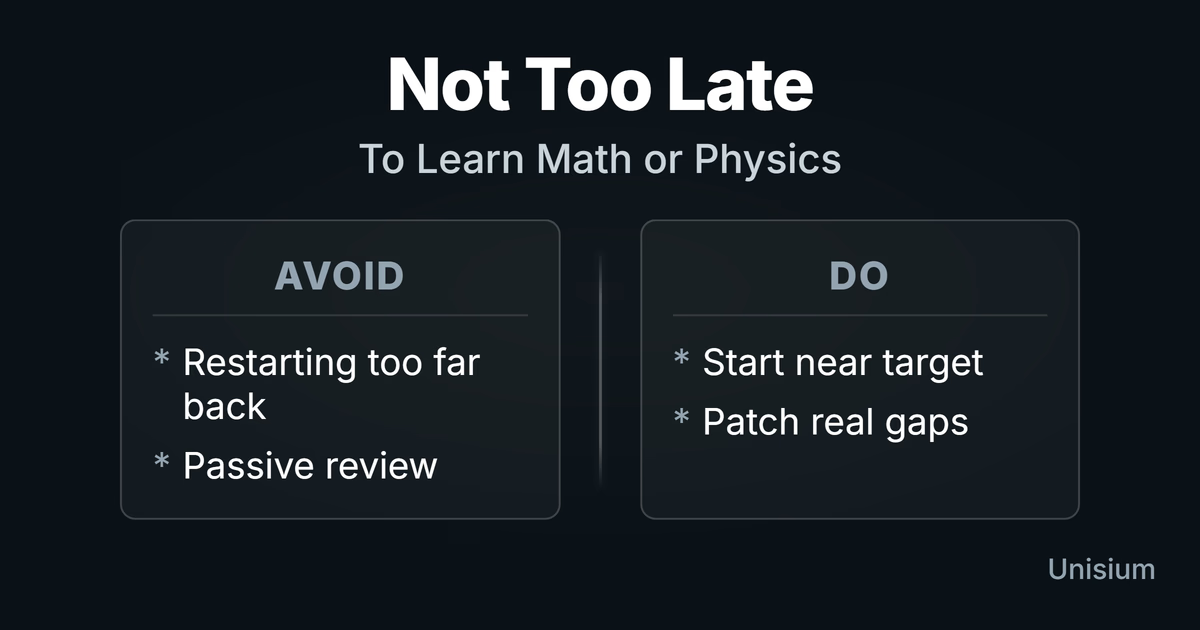
No, it is not too late to learn math or physics as an adult. You can restart at 30, 40, 60, or 90, and adults can still build serious competence. What matters is restarting in a way that builds real skill instead of spending months on passive review or relearning everything from the beginning.
If your goal is to solve calculus problems, understand mechanics, pass technical courses, or rebuild serious competence after years away, the fastest path is rarely a full reset. Start close to the work you want to do, let real problems show you what is missing, and then slow down enough to understand the exact principles, assumptions, and steps that blocked you.
On this page: Honest Answer | Restart Strategy | Physics vs Math | 7-Day Test | FAQ
The Honest Answer: You Are Not Too Old to Learn
You are not too old to restart math or physics. Adults can learn new mathematics, understand physical principles, solve harder problems, and become much stronger than they are now. Age does not close that door.
What changes with age is the situation around learning. Adults often have less free time, more responsibilities, and more frustration when study feels vague. But adults also bring advantages that younger students often do not have: patience, seriousness, better self-management, more background knowledge, and a clearer reason for studying.
Many adults underestimate those advantages. Learning can feel faster later in life because new ideas have more hooks to attach to. You have seen more systems, solved more practical problems, and learned more about how you learn. Raw processing speed may decline somewhat with age, but that is not the whole story. Knowledge, maturity, discipline, and purpose matter enormously.
I am turning 40 this year, and I do not feel less equipped to learn hard things than I did at 20. I feel more equipped. I know more, I understand learning better, and I am more willing to focus on what works instead of what feels productive.
The hard part is not proving that adults can learn. The hard part is putting yourself back into real contact with the material: problems, solutions, principles, mistakes, and repeated attempts.
First decide what kind of return this is
There is nothing wrong with studying math or physics for curiosity. If your goal is to enjoy science again, use videos, books, Brilliant, Khan Academy, popular science, or whatever keeps you engaged. Curiosity is a valid goal.
But if your goal is mastery, the method has to change. Mastery means being able to solve problems, explain why steps work, understand the principles underneath formulas, and perform well in courses or exams. For that goal, the center of the work is not consuming explanations. It is trying real problems, getting stuck, self-explaining solutions, extracting meaning from each unclear step, and returning later to solve without help.
The Real Problem Is Usually the Restart Strategy
Most restart plans fail because they put too much time between the learner and the real work. The student asks, “Where do I begin again?” and gets handed a long ladder of courses, playlists, textbooks, and prerequisite topics. That can sound responsible, but it often becomes months of preparing to prepare.
You might remember half the calculus moves, forget why derivative rules make sense, recognize a force diagram, and then freeze when a mechanics problem asks you to choose the right principle without a label. A full restart treats all old knowledge as equally broken. That is too blunt. The better question is: which exact gap is blocking this problem right now?
People do not need an infinite resource list first. They need a loop that creates evidence.
Videos, books, and review courses are useful when they answer a specific gap exposed by real work. They are weak as the main loop if your goal is mastery. You will not get good at math or physics by mainly receiving passive input. You get good by trying, failing, explaining, repairing, and trying again.
The useful move is to start close enough to the target that the work is recognizable, but hard enough that the gaps show themselves quickly. Then you use those gaps as diagnosis. That is the same logic behind How to Self-Study Math and Physics Effectively, Self-Explanation, and Problem Solving: the work itself tells you what is missing, and your job is to respond honestly.
Skeptical take: “Just believe in yourself” is too weak. “Restart from the beginning” is too blunt. The better answer is to work near the target and repair the specific gaps that real problems expose.
Want the complete framework behind this guide? Read Masterful Learning.
How to Restart Without Relearning Everything From the Beginning
Step 1: Name the real goal
Start with the work you want to become able to do. Pass calculus. Understand mechanics. Prepare for engineering. Rebuild enough fluency to study seriously again. Different goals require different restart depths.
Example: If you want classical mechanics, your target is not “all of math.” It is being able to model motion, forces, energy, and momentum. That tells you much more clearly which mathematical ideas you need.
Step 2: Start near the target
Pick material slightly below or at the subject you want, then see what happens. Adults lose time when they move too far back by default. The real gaps may be much narrower: algebra manipulation, trig, vectors, function interpretation, notation, or principle choice.
Example: If your aim is calculus, try a small set of precalculus and early calculus problems. If you understand the goal of the question but cannot execute the setup, you may need targeted repair in algebra, functions, or trig. That is different from restarting all school mathematics.
Step 3: Use real problems to expose the gap
A problem you can solve immediately without help may be useful for confidence, but it is not where most learning happens. When you are placed at the right edge, some problems will stop you. That is not a sign that you should give up or drop five levels. It is the signal you need.
Ask where the problem broke:
- Did you understand what the question was asking?
- Did you know which principle, definition, rule, or equation applied?
- Did you understand why that principle applied here?
- Did the algebra, trig, vector setup, graph, or notation block you?
- Could you follow the solution, but not explain why one line followed from the previous line?
Each answer points to a different repair.
Step 4: Self-explain the solution until the unclear steps become meaningful
Do not merely read the solution. Self-explain it. That means taking every step you do not fully understand and asking what it means, why it is allowed, what principle it uses, and what had to be true for that move to work.
Treat every difficult solution as three linked puzzles. The problem is the first puzzle. The solution is the second puzzle. The principle is the third puzzle: what named rule, equation, definition, or method is being used here, and what conditions make it valid?
For each unclear step, ask:
- What is being done here?
- Which principle, rule, definition, or equation is being used?
- What are the conditions for using it?
- What does each symbol or term represent?
- Why is this sign, component, substitution, or transformation correct?
- What would have made me notice this move myself?
This is where weak foundations are repaired. Not by rereading a whole course because you feel behind, but by stopping at the exact place where meaning breaks and extracting the missing knowledge.
AI can help here, but only if you use it narrowly. Do not mainly ask it to “explain this problem.” Paste the problem, the solution, and your own explanation of one step. Then ask whether your interpretation is correct: which principle is being used, why a sign appears, why sine rather than cosine, what condition makes the equation valid, or what assumption you missed. Specific questions turn AI into feedback. Vague questions turn it into another passive explanation source.
Example: In calculus, do not store the derivative as a bag of rules. Treat each rule as a principle with a job, a meaning, and conditions. In mechanics, do not memorize conservation of energy as a line to copy; ask when it applies and what would break it.
Step 5: Return later and solve again without help
After you have self-explained a solution, come back later and try the same problem without looking. If you still cannot solve it, that is useful. It shows which parts were not fully understood or remembered well enough.
Then self-explain those parts again. This loop is simple:
- Try a real problem.
- Get stuck or make an error.
- Study and self-explain the solution deeply.
- Repair the exact principle or operation that blocked you.
- Return later and solve without help.
- Move to harder, less familiar, or more varied problems when the current type becomes too easy.
That loop matters more than finding the perfect course.
For Physics, Do Not Wait Until You Have Finished the Math
If physics is the goal, do not turn math into a gate you must fully complete before touching physics. That can delay the real work for months or years.
Physics problems are often the best way to reveal the mathematics you need right now. A mechanics problem may show that you do not understand vector components, trig signs, derivatives, graph interpretation, or algebraic rearrangement. When that happens, slow down at the exact mathematical step that broke the solution.
That does not always mean leaving the physics problem and doing a separate set of math exercises. Often the better move is to learn the math inside the physics problem. Identify the mathematical principle or operation being used, explain why it applies, redo the step yourself, and keep working until the line-to-line movement makes sense.
If the same mathematical gap keeps appearing across many problems, then a focused repair block can help. But the repair should stay connected to the problems that exposed the gap. Do not make “finishing the math” a permanent excuse for not doing physics.
How to Find Your Current Level
To find your current level, use real problems from the level you want to reach and watch where the breakdown happens. A placement test can help, but course-style problems reveal more because they show whether the bottleneck is memory, setup, algebra, graph sense, vectors, principle choice, or solution interpretation.
A full restart makes sense only when the basic language of the work is consistently unreadable. For example:
- straightforward algebra fails constantly, not occasionally
- graphs, functions, fractions, exponents, or basic trig are opaque across many problems
- worked solutions are impossible to follow because the symbolic steps themselves do not make sense
If that is your situation, go lower and rebuild the basics. There is no shame in that. But if the target material is partly understandable, do not assume you need to restart from the beginning. Start near the target and patch what blocks you.
| Mistake | Better move |
|---|---|
| Restarting far below the real target | Start near the subject you want and let real problems reveal which older gaps are real. |
| Waiting to finish all math before starting physics | Study physics and math together. Learn the math when a physics problem shows why you need it. |
| Collecting resources instead of building skill | Pick a problem source, try problems, self-explain solutions, and return later without help. |
| Treating age as the issue | Treat placement, method, time, and motivation as the real design problems. |
A 7-Day Restart Test for Calculus or Mechanics
Use the next week to generate signal, not to build the perfect plan.
- Choose a target: early calculus, precalculus, or introductory mechanics.
- Pick a small set of real problems from a textbook, course page, old exam, or serious problem source.
- Try the problems before you feel fully ready.
- For each problem that stops you, identify the exact gap: principle choice, setup, algebra, trig, vectors, notation, graph interpretation, or line-to-line solution meaning.
- Self-explain the solution until the unclear steps make sense.
- Return later and solve selected problems again without looking.
- Adjust difficulty: move up if everything is easy, move down if the basic language is unreadable, and stay near the edge if you are getting stuck in ways you can learn from.
The goal is not to prove your ability in seven days. The goal is to find the correct level of friction. Too easy gives little signal. Completely unreadable gives too much noise. The useful zone is where you can understand enough to learn, but not enough to coast.
When This Becomes a Degree or Career Question
Learning the subject and making a career out of it are different decisions.
For learning, start. You can build real math and physics skill as an adult if you put in serious, structured work. For degrees and careers, be more careful. Becoming strong in physics is not the same as being employed specifically as a physicist, and that path can be longer, narrower, and more constrained by credentials and timing.
That career uncertainty should not answer the learning question for you. You can decide to learn now even if you later discover that a specific degree or career path is not the right target. If you need a reality check on the career side, the official AIP employment data for physics is a better source than generic motivation posts.
FAQ
Is it too late to learn math or physics as an adult?
No. It is not too late to learn math or physics as an adult. The real question is how to restart in a way that builds skill. If your goal is mastery, do not rely mainly on passive review. Work near the target, use real problems, self-explain solutions, and patch the exact gaps that appear.
Can you still become good at math and physics later in life?
Yes. You become good by building principle knowledge, retrieval strength, solution understanding, and problem-solving fluency over time. Adults can bring advantages younger students often lack: patience, discipline, seriousness, background knowledge, and a clearer reason for learning.
Should I relearn all of math before starting physics?
Not if physics is the real goal. Start beginner physics early enough that the math has a purpose. When a physics problem exposes weak algebra, trig, vectors, functions, or calculus, stop and repair that exact mathematical idea in context. Use separate math practice when the same gap keeps appearing.
Where should I restart math after years away?
Restart at the lowest level where the target material is still partly understandable. If you want calculus, that often means algebra, functions, trig, and early calculus problems. If the material is completely opaque, move lower. If it is easy, move up. The goal is to find the edge where problems reveal useful gaps.
What if I want a physics degree or a career change, not just self-study?
That is a separate decision. Learning physics as an adult is possible. Turning physics into a degree or career path depends on credentials, time, money, location, and the kind of work you want afterward. Do not confuse those questions. Start learning, but evaluate the career path separately.
What do adults often do better than younger students?
Adults often bring more seriousness, better time management, more background knowledge, and less appetite for fake progress. They are often more willing to ask what works in practice and more able to connect new ideas to things they already understand. The cost is that adults also have less spare time, so the study loop needs to be sharper.
Related Guides
- How to Self-Study Math and Physics Effectively - Build the weekly loop after you have chosen the right restart level.
- Self-Explanation - Learn how to extract structure from worked solutions instead of just following them.
- Problem Solving - Turn principles into usable problem setup and execution.
- Retrieval Practice - Strengthen memory so the principles you study are available when you need them.
- Effective Study Mindsets for Math and Physics Mastery - Replace comfort work with better study rules.
- Guide Index - Browse the wider guide library by strategy, subject, and bottleneck.
How This Fits in Unisium
Within the Unisium Study System, adult restart is treated as a diagnosis and sequencing problem: identify the target work, surface the exact missing principle or subskill, retrieve it, explain it, and apply it again under pressure. That is the same logic running through Masterful Learning and through the practice flow in the app when you move from explanation to recall to problem solving.
Ready to try it? Check access and join the Unisium waitlist or explore the full framework in Masterful Learning.
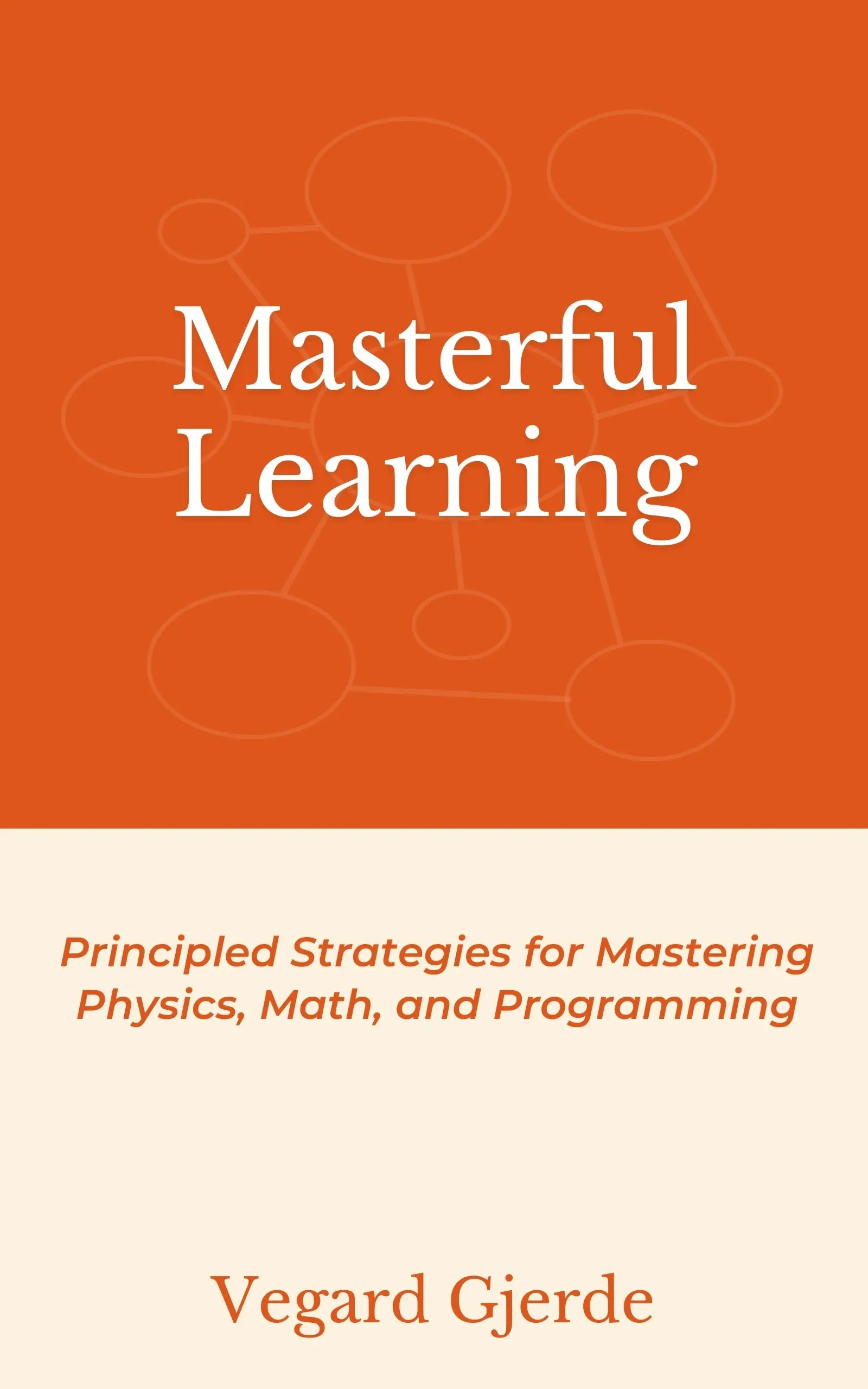
Masterful Learning
The book behind these guides: a study system for physics, math, & programming built on retrieval, connection, explanation, and problem solving.
Ready to apply this strategy?
Unisium turns these evidence-based techniques into guided study sessions for math and physics. Places are limited during early access. Check current availability to start a trial; joining the mailing list is optional.
See plans and availability Read More GuidesAlready have access? Sign in