Why Study Math and Physics in the Age of AI?
Studying math and physics still matters in the age of AI because it trains precise, constraint-aware thinking: modeling, checking assumptions, and auditing whether an answer is consistent with units, limits, and first principles. AI makes shallow output cheap, which raises the value of humans who can spot errors and steer a solution toward what is true and useful. If you want to use AI without outsourcing responsibility, math and physics are among the best training grounds.
The question: If tools like ChatGPT can already solve problems, explain concepts, and write code, is there still any point in studying hard subjects like physics and math?
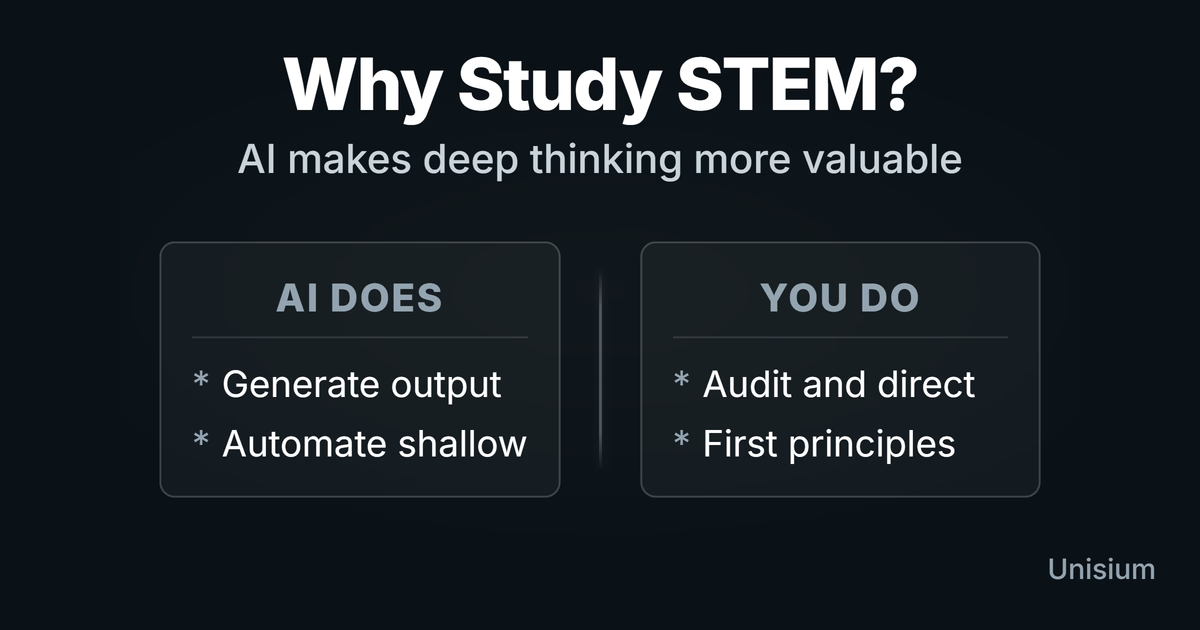
Short answer: yes—more than ever. AI makes shallow knowledge cheap and makes deep, precise thinking dramatically more valuable. Physics and math are still two of the best ways to build that kind of thinking.
Modern AI is built on massive amounts of math and computation. But the deeper story is this: the same kind of quantitative, model-based thinking that powers AI is what you build when you study math and physics—and that’s exactly the kind of thinking the world is short on.
Most people frame AI in the wrong way: “If the machine can do X, why should I learn X?”
A better framing is: “If the machine can cheaply do the average thing, what kind of human skill becomes scarce and valuable?”
This guide is about that scarcity. It’s a biased guide—deliberately. It’s a commercial for getting highly skilled at STEM, especially physics and math, in a world full of powerful language models.
This guide sits one level above Unisium’s core strategies—elaborative encoding, retrieval practice, self-explanation, and problem solving—and asks a prior question: why invest in these skills at all? If you want the economic case for what one serious hour of practice may be worth, read The Expected Value of One Hour of Deliberate Practice in Math and Physics.
On this page:
Key takeaways · What AI Is Good and Bad At · How LLMs Work · Math, Physics, and the AI Under the Hood · Learning to Think Precisely · Deep Expertise + AI · The Brain-Rot Trap · Why Top People Started in Math and Physics · First-Principles Thinking · Training Grounds · Careers · FAQ
Key takeaways
- AI automates average work. That doesn’t kill the value of knowledge; it kills the value of shallow knowledge.
- Math and physics train precise, model-based thinking—the kind of thinking you need to direct, debug, and challenge AI.
- Deep expertise + AI = innovation multiplier. If you understand systems quantitatively, AI amplifies you instead of replacing you.
- Letting AI think for you leads to brain rot. Other people will gradually lose the ability to reason from scratch. Learning hard things keeps your “thinking muscles” alive.
- Many top people in diverse fields started in math/physics. Not because they stayed in those fields, but because the training made them systematic thinkers.
- First-principles thinking is the shared core. Physics and math principles give you a way to reason from fundamentals instead of copying surface patterns—exactly what you need in an AI-saturated world.
What AI Is Good and Bad At
Modern language models (LLMs) are pattern machines: they predict the next token (piece of text) that fits, based on gigantic training data. They’re extremely good at:
- Generating fluent explanations, summaries, and drafts
- Spotting obvious patterns in text and code
- Producing plausible solutions to standard-looking tasks
They’re much weaker at:
- Knowing when they’re wrong
- Keeping strict track of constraints and edge cases
- Maintaining long chains of precise reasoning without slipping
- Deciding which question matters in a messy real problem
Practically:
- They can produce a solution.
- They cannot reliably guarantee that the solution respects physical laws, mathematical constraints, or domain-specific edge cases.
So the real question becomes:
Do you want to be the person who types prompts and hopes the output is fine,
or the person who can audit, direct, and improve what the model does?
If you pick the second, you’re in “learn math and physics” territory.
How LLMs Work (Simple Version)
It helps to demystify this a bit. A large language model is basically a huge mathematical function:
input words (tokens) → a lot of math → output words (tokens)
Given some text, it doesn’t “think about the meaning.” It computes which next token is most probable given the previous ones and its training data, then repeats that step over and over:
- Turn words into numbers (vectors).
- Push those numbers through a giant stack of learned matrix operations and nonlinearities.
- Get a probability distribution over the next token.
- Sample one, append it, and continue.
Everything is math and probabilities on sequences of symbols. There is no inner voice doing physics, ethics, or sanity checks—only “what token is likely here?”
That’s why expertise matters so much. If you know math and physics, you can:
- See when an explanation quietly violates a conservation law or a basic theorem.
- Notice when numbers, units, or trends don’t make sense.
- Tell the difference between a fluent answer and a correct one.
The model is good at generating plausible text.
You are the one who decides whether that text is true, safe, and useful.
Math, Physics, and the AI Under the Hood (Low-Tech Link)
Under that black box, modern ML and LLMs lean heavily on three pillars: linear algebra for representing and transforming information (vectors, matrices, embeddings, attention), calculus and optimization for learning from data (gradients, loss functions, parameter updates), and probability and statistics for handling uncertainty (distributions, sampling, evaluation). You don’t need to derive every detail, but if you’re comfortable with vectors, rates of change, and probabilities, these systems stop being magic tricks and start looking like tools. That level of quantitative literacy is exactly what deep math and physics study gives you.
Learning to Think Precisely: Your Real Superpower
You’ve already seen that LLMs are probability engines over tokens: they optimize for likelihood, not truth.
That gap is where precise human thinking lives.
Thinking precisely starts with knowing key principles and formulas well enough that you can recall them exactly—but it doesn’t stop there. It means knowing the formal vocabulary well enough to be explicit about assumptions (what you’re treating as constant, negligible, or linear), tracking when a formula or theorem really applies (and when it silently breaks), following the implications of a claim and what would contradict it, respecting constraints like units, signs, and conservation laws, and checking whether the answer makes physical sense.
This is exactly what AI is bad at by default. It can simulate it in small chunks, but it will happily output something that’s locally plausible and globally impossible.
Why this pairs so well with AI
If you can think precisely, AI gives you:
- Speed: it drafts, expands, and computes.
- Breadth: it suggests analogies, variants, and viewpoints.
- Convenience: it handles repetitive algebra, boilerplate code, and formatting.
You bring filters (you notice when numbers, units, or implications don’t add up), models (you know what matters in the situation), and judgment (you decide which simplifications are acceptable and which are dangerous).
The result is a division of labor:
AI: “Here are five plausible solution paths.”
You: “These three violate energy conservation. This one ignores a constraint. This one is consistent with the model—let’s refine that.”
That combination—AI for generation, you for precision—is outrageously powerful. But it only works if your own thinking is sharper than the model’s.
Math and physics are among the best training grounds for building that sharpness.
Deep Expertise + AI: How Innovators Get Leverage
AI doesn’t magically turn everyone into an innovator. It amplifies whatever is already there:
- If you mostly copy, AI lets you copy faster.
- If you understand systems deeply, AI lets you explore, test, and implement ideas at a scale that used to require a whole team.
Deep knowledge in math and physics gives you a language for describing complex systems precisely, intuition about what’s possible vs impossible, and the ability to design and interpret models instead of just running them.
Add AI on top and you get:
- Faster iteration on designs, experiments, and simulations
- Rapid exploration of variants and edge cases
- Automated grunt work on derivations, coding, and documentation
In other words: AI is a multiplier for innovators, not a replacement for them. If you want to sit in the “I invent, the machine helps” seat rather than the “the machine invents, I click things” seat, deep STEM training is one of the cleanest routes.
If you like superhero metaphors: think of AI as the Iron Man suit. On its own, it’s just a powerful shell. What makes it dangerous is Tony Stark’s understanding of physics, engineering, and systems. In the same way, AI without deep human expertise is mostly a demo. Deep math and physics are how you become Stark rather than a bystander.
The Brain-Rot Trap: Outsourcing All Thinking
There’s a genuine risk in this new world: you can get things done without thinking.
- Need an explanation? Ask AI.
- Need a solution? Ask AI.
- Need code, a derivation, a summary? Ask AI.
If you do that for everything, your own ability to think from scratch decays: you lose your feel for numbers and magnitudes, your ability to hold a multi-step argument in your head, and your patience for slow, careful reasoning.
That’s the brain-rot trap. And while you’re in it, other people are building deep understanding—and they’ll be the ones who can direct AI, not follow it.
Studying hard subjects—properly—pushes in the opposite direction:
- You repeatedly confront things you don’t understand, then fight through them.
- You build capacity for sustained, precise thinking.
- You get used to owning arguments and derivations yourself.
Feeling stupid while you’re wrestling with hard problems is normal; the difference is whether you keep going and use good strategies.
There’s intrinsic value here that has nothing to do with grades or job titles. Building real understanding of how the world works feels good. You see more structure, more connections, more “I finally get it” moments. You feel yourself getting sharper over time.
Even if you never become “a physicist,” that experience of growing your own understanding is worth having.
Others will lean into convenience and let their thinking atrophy. You don’t have to.
Why So Many Top People Started in Math and Physics
Look at the biographies of people who built important things in:
- Technology and AI
- Finance and economics
- Engineering and complex systems
- Even “softer” fields like sports science, physiotherapy, or policy
You keep seeing a similar pattern: early training in math, physics, or a closely related field, then a shift into something more applied.
That’s not mystical. These fields force you to wrestle with abstract structures instead of stories, to reason from definitions and constraints rather than vibes, and to get comfortable being wrong, debugging your own thinking, and trying again.
Once you have that, you can bolt it onto almost anything: physics gives you better injury and load models in sports science, math sharpens models in economics, epidemiology, or policy, and physics/math make strategy and complex organizations less hand-wavy and more concrete.
Math and physics travel well. They let you import structure and quantitative thinking into fields that mostly run on anecdotes—and that’s a big edge in an AI-saturated world.
First-Principles Thinking in an AI World
“First-principles thinking” has become a cliché in business and tech circles. Stripped of the hype, it means:
Start from fundamental truths and constraints, then build up.
Don’t just copy existing solutions or analogies.
Physics and math are first-principles training on hard mode:
- In physics, your building blocks are conservation laws, symmetries, and interaction models.
- In math, your building blocks are definitions, axioms, and theorems.
You learn to ask what are we assuming?, to separate core principles from convenient hacks, and to rebuild solutions in new domains by reusing structures rather than surface features.
A simple non-physics example: instead of asking “What pricing tricks have others used?”, a first-principles approach asks “What is the cost structure, what are the constraints, and how does demand change with price?”—you’re essentially building a small math model of the situation rather than copying anecdotes.
This is exactly how you should treat AI, too:
- Don’t just ask: “What did the model output?”
- Ask: “What are the underlying principles? What constraints and trade-offs are at play?”
If you want more on principles specifically, see:
- Principle Structures — how principles are built and when they apply
- Elaborative Encoding — how to embed principles in rich, memorable contexts
- Retrieval Practice — how to make principles available on demand
First-principles thinking is not a buzzword if you can reason from principles. Math and physics give you that ability. AI then becomes a tool for exploring the consequences of those principles faster—not a replacement for them.
Why Math and Physics Are Perfect Training Grounds
Think of math and physics as the gym where you train the muscles AI doesn’t have.
1. You learn to think in models, not anecdotes
Physics forces you to ask:
- What are the relevant objects?
- What’s interacting with what?
- What’s conserved? What’s approximated?
You’re constantly turning messy stories into simplified models you can analyze. That’s the same mental move you need when you’re:
- Evaluating an AI-generated solution to a real-world problem
- Designing a policy, an experiment, or a simulation
- Deciding whether a “cool idea” is physically or economically feasible
It’s the same constraint-aware, model-first thinking you practice in mechanics and calculus—just pointed at real systems.
2. You get used to hard constraints
In physics and math, some things are just wrong:
- Accelerating forever with no force
- Probabilities adding to more than 1
- Units not matching, infinities appearing where they shouldn’t
LLMs will happily propose all of these if you’re not watching. A physics/maths-trained brain has internal alarms for this. You get a “that can’t be right” instinct that fires even when the explanation sounds nice.
3. You build tolerance for complexity
Modern systems (climate, markets, power grids, large codebases, AI pipelines) are complicated, coupled, and non-linear. Physically and mathematically trained people are:
- Less scared of that complexity
- Better at isolating key variables
- More comfortable with trade-offs, approximations, and uncertainty
That’s not an accident. It’s the direct result of fighting through mechanics, electromagnetism, calculus, linear algebra, probability, etc., and repeatedly translating between equations, diagrams, and words.
4. You get long-half-life skills
Tools churn. Today’s framework or LLM API won’t be the same in five years.
But:
- Derivatives and integrals stay.
- Vectors and eigenvalues stay.
- Conservation of energy and momentum stay.
- Probabilistic reasoning stays.
You can layer new tools on top of those foundations forever. They don’t expire.
Careers: Where This Matters
The direction of the economy is brutally simple:
- Routine, well-defined tasks → increasingly automated or AI-assisted.
- Ill-defined, high-stakes, model-heavy tasks → still human-led, but amplified by AI.
Math and physics position you for roles that sit on the second side:
- Data science, ML, AI safety and evaluation
- Engineering (mechanical, electrical, civil, aerospace, materials…)
- Climate and energy modeling, quantitative finance, operations research
- Robotics, control systems, simulation, biotech
These are all domains where:
- You need to respect hard constraints (physics, probability, regulation).
- Mistakes are expensive.
- AI is a powerful tool, but someone has to design, constrain, and monitor what it’s doing.
Day to day, you’re paid to do exactly what math and physics trained you for: build models, test assumptions, and keep an eye on the constraints while everyone else waves their hands.
FAQ: Common Questions About Studying Math and Physics in the Age of AI
”Isn’t it enough to know how to use AI?”
Knowing how to prompt is useful. But if you can’t tell when AI is wrong, you’re outsourcing not just the work but the responsibility. In any domain where correctness matters, that’s not tenable.
”Won’t AI eventually do precise reasoning too?”
It will get better than today. But as long as systems have real-world consequences, there will be demand for humans who can:
- Specify constraints
- Interpret results
- Decide which trade-offs are acceptable
That’s not going away. If anything, more powerful systems mean more pressure for humans who understand the math and physics behind them.
And even in the extreme scenario where humans became unnecessary for most knowledge work, it would still be worth understanding the world deeply. The inherent beauty and coherence of math and physics don’t disappear just because a model can approximate them. You don’t need economic usefulness to justify understanding reality.
”Do I need to be a genius for this to be worth it?”
No. You need:
- Willingness to think slowly and precisely
- Good study strategies (retrieval practice, self-explanation, problem solving, elaborative encoding)
- Enough persistence to get through the initial “this feels hard” phase
AI can lower some barriers here—it can give you alternative explanations, extra examples, and quick feedback. You bring the effort and the decision to aim for depth, not just passing grades.
How This Fits in Unisium
Unisium is built for the “AI as assistant, not replacement” stance: you attempt, explain, and retrieve first, and AI is used to critique your reasoning and generate targeted follow-ups. That’s the Unisium Study System applied to modern study—keep the human accountable for constraints and correctness, and use the model to speed feedback, examples, and practice. Ready to try it? Check access and join the Unisium waitlist or explore the full framework in Masterful Learning.
Related Learning Guides
- Elaborative Encoding: Learn Faster with Better Connections — Make principles meaningful so they stick.
- Retrieval Practice: Make Knowledge Stick — Keep principles accessible so you can use them.
- Self-Explanation: Learning from Worked Solutions — Turn examples (including AI-generated ones) into reusable rules.
- Problem Solving: The Learning Strategy That Turns Knowledge into Skill — Where you train automation, judgment, and transfer.
- Principle Structures: Building Blocks of Understanding — How to base your thinking on first principles instead of pattern matching.
For a full system that ties these together, see Masterful Learning.
← Prev: Problem Solving | Next → Retrieval Practice
Ready to apply this strategy?
Unisium turns these evidence-based techniques into guided study sessions for math and physics. Places are limited during early access. Check current availability to start a trial; joining the mailing list is optional.
See plans and availability Read More GuidesAlready have access? Sign in