Unisium vs Quizlet: Pick the Tool That Fits Your Exam Goals

By Vegard Gjerde Based on Masterful Learning 10 min read
quizlet quizlet-plus unisium flashcards physics math learning-strategies spaced-repetition

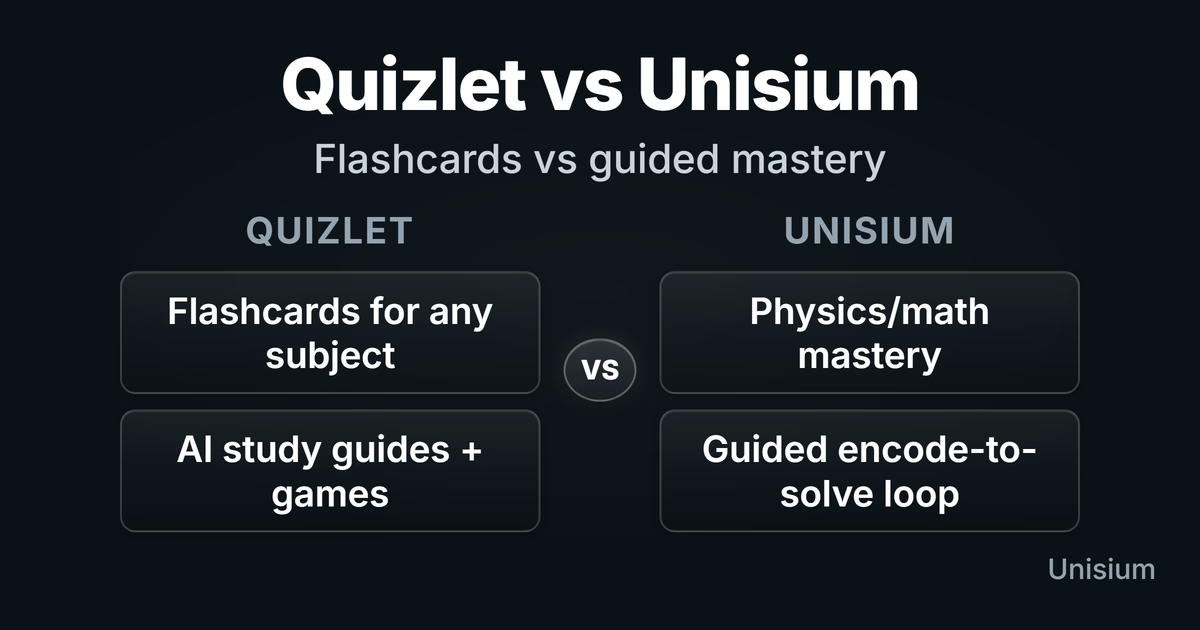
Unisium vs Quizlet is really the choice between fast recall practice and a guided physics/math training system. Quizlet is excellent for flashcards, while the Unisium Study System tracks principle growth across retrieval, elaboration, self-explanation, and problem solving so you know what to practice next.

If you’ve ever looked at a physics or math problem, recognized the topic, and still had no idea how to start—that isn’t a recall failure. That is an execution gap. You stare at the problem, the clock is running, and nothing starts. If you freeze on problems, the fix isn’t more content—it is training the move: identifying the right principle fast and executing the first 2–3 setup steps correctly, so starts become faster and less error-prone. Quizlet is excellent at recall. It was not designed to train that move.

Unisium is closer to a guided Quizlet + textbook-problem workflow than to a pure flashcard app—because continuing is easier when the decision overhead is lower.

Decision split: Quizlet for flashcard recall; Unisium for guided physics/math mastery.
Use Quizlet when recall is the finish line. Use Unisium when performance on problems is the finish line.

On this page: Quick Verdict | When to Use Each | First Session | Side-by-Side | What Students Get Wrong | Key Differences | Quizlet Learn for Physics | Two-Week Plan | Myths | Common Mistakes | FAQ | How This Fits in Unisium


Quick Verdict

Choose Quizlet if you mainly need:

  • Fast recall of terms, definitions, identities, symbols, and short facts.
  • A huge library of ready-made sets and easy import from notes.
  • Lightweight study momentum via Learn mode and games.

Choose Unisium if your exam demands:

  • Multi-step problem solving (physics, calculus, engineering, quantitative methods).
  • Reliable principle selection—knowing what to use—more than remembering what words mean.
  • A principle-based progression system that builds retrieval, explanation, elaboration, and application—then spaces what needs reinforcement.
  • No planning needed: the session gives you a guided next step.
  • No card design required: short sessions (10–15 min) that practice the skills behind faster, cleaner starts.

The goal isn’t “I studied.” The goal is: start more cleanly, finish more problems, stop losing points to wrong-principle attempts.

Choose both (the smart combo):

  • Quizlet for supporting facts (symbols, definitions, unit conversions, core identities).
  • Unisium for principle mastery and transfer to real problems.

Unisium is NOT for you if:

  • You want passive video learning or lecture summaries.
  • Your entire course is vocabulary, definitions, or short-answer factual recall.
  • You’re not willing to do short active reps per session.

Want to see whether that workflow fits? Check current access and pricing.


When to Use Each Tool

Scenario A — Quizlet works well: You have 3 days before a psych or biology exam. Most questions test definitions, classification, and concept identification. Run Learn mode on a curated set, review misses, use Practice Tests for timing. No execution bottleneck. Quizlet can carry you.

Scenario B — Quizlet falls short: You have a mechanics or calculus exam. You’ve reviewed all the formulas. You sit down to practice and recognize the topic—but still don’t know how to start. That gap isn’t a memory failure. It’s a setup failure. More Learn mode doesn’t fix it.

Scenario C — Use both: Quizlet for supporting recall (Newton’s laws wording, trig identities, unit conversions, circuit element symbols). Unisium for execution reps: selecting the right principle, setting up the problem correctly, running checks. Combined, setup time drops and you stop losing the first 3 points on every problem.


What a 10-Minute Unisium Session Looks Like

Here is what a first principle block can look like—using Newton’s Second Law as the example. The exact mix varies by principle and current level:

  1. Retrieve or discriminate — You may start by naming the principle from memory or by deciding whether it fits the current situation.
  2. Explain“What conditions must be true to apply F = ma?” You state the conditions, traps, or boundaries before the breakdown appears.
  3. Solve“A 5 kg block, 20 N net force. Write the setup and sign convention.” You work the setup before guided feedback appears.
  4. Elaborate and check — You connect the principle to a limit case or contrast it with a tempting wrong approach.
  5. Progress update — The system records evidence for that principle across task type and difficulty. Stronger performance on harder tasks counts more than easier success.
  6. Next task guidance — Early inside a subdomain, release is more structured. Once enough principles are active, practice becomes more interleaved based on reinforcement need and advancement potential.

What you leave with after 10 minutes: one principle strengthened across multiple evidence types, one weak point exposed, and a clearer next step.

The same progression model works for u-substitution, circuit analysis, or torque problems. Pick your hardest topic—Unisium guides the next steps.

Why you can trust the system: it is built around retrieval practice, self-explanation, elaboration, and deliberate practice research—packaged so you don’t have to design the progression yourself.


Side-by-Side Comparison

Quizlet helps you remember. Unisium helps you perform.

The difference is the unit of progress you are training.

  • Quizlet: “I can recall this item.”
  • Unisium: “I can use this principle correctly under exam pressure.”
QuizletUnisium
Best forRecall-heavy courses (vocab, definitions, facts)Physics/math exams with multi-step problems
Unit of progress”I can recall this card""I can select and apply this principle”
Core mechanismStudy sets, Learn/Test, scheduled reviewPrinciple-based progression across retrieval, elaboration, self-explanation, and problem solving
Scheduling targetMemory Score + scheduled reviews (flashcard recall)Principle evidence over time, not just card recall
Problem-solving supportIndirect (you can describe steps on cards)Built-in guided solving and solution breakdowns
Setup costLow (import or paste notes)Low (no card design; session is guided)
Typical failure mode”Feels fluent” but freezes on problemsGuided reps give evidence about setup, recall, and transfer
PricingPublished rates change; verify current Quizlet pricing before deciding*See current beta pricing and access status

If you do 10 minutes a day for 14 days with Unisium, here is what to watch for:

  • Session starts become easier: you leave with a clearer next step.
  • Wrong-principle attempts may become easier to diagnose because you have retrieved each principle from multiple angles.
  • Problem setup can become more deliberate because principle selection is being practiced directly.
  • “Blank page” moments may become less mysterious because you have practiced starting, not just recognizing.

Why this works: Cognitive science and deliberate practice research point in the same direction: retrieval practice builds durable knowledge only when it targets the right act; interleaved evidence from retrieval, explanation, elaboration, and application is what many problem-solving courses demand. Most study tools optimize for recall. Unisium tracks principle growth across all four, and harder successful performances count more.

Designed by a physics educator and learning-science researcher. Built specifically for physics and math problem-solving—not every subject.

You don’t need as much willpower to choose the right reps—Unisium reduces the decision burden.

*Quizlet pricing and tier limits are time-sensitive. As of February 2026, the public upgrade page listed Plus and Unlimited options; verify current rates and limits at quizlet.com/upgrade before deciding.


What Students Get Wrong (And Why It Matters)

Most students don’t lose points because they never saw the content. They lose points because they can’t turn knowledge into an action sequence under time pressure: which principle applies, what the conditions are, what the first move is, and what checks prove the setup is correct. Retrieval practice speeds up recall; it does not automatically train execution.

The real cost shows up on exam problems: wrong principle, slow setup, blank start, no checks. Quizlet cannot catch that failure mode because it does not train that failure mode.

Skeptical take: If your plan is “Quizlet until it feels familiar, then problems later,” later often never happens—or it happens too close to the exam.

Want the complete framework behind this guide? Read Masterful Learning.


Key Differences That Matter

1) Spaced repetition: same claim, different target

Quizlet’s spaced repetition (Memory Score + scheduled reviews) is real—useful for flashcard recall. Unisium tracks progression at the principle level: retrieval, elaboration, self-explanation, and problem solving all contribute evidence. Scheduling covers the right unit of work—not just “did you remember the term?“

2) Learn mode vs guided training (and who is the coach)

Quizlet Learn is a strong recall engine. It personalizes question types within a session. That is enough when recall is the finish line.

Unisium tracks principle growth across multiple task types, not one repeated prompt style. Early progression inside a subdomain is structured; later practice becomes more interleaved and performance-guided. One difference worth naming: Quizlet requires you to be your own coach—you decide what cards exist, which problems to attempt, and when. Unisium is the coach. The session structure is guided, so you spend less effort deciding what to do next.

3) Content breadth vs physics/math depth

Quizlet covers every subject; that breadth is useful for recall-heavy courses. For STEM problem solving, it is a tax: you end up engineering your own system on top of the app. Unisium goes deep where students struggle most—principle selection and execution—so no system design is required.

4) AI: content generation vs performance feedback

Quizlet turns notes into study materials and generates practice tests. It also offers Ask Quizlet (US, age-gated), a chat-style AI assistant for in-session help—useful for on-demand recall support and quick concept clarification. Unisium uses AI inside the loop as targeted hints while you attempt the work, so AI accelerates practice instead of replacing it.

5) Pricing: what you are buying

Quizlet pricing and tier limits change over time. As of February 2026, Quizlet’s public upgrade page listed Plus and Unlimited tiers with different monthly limits. Verify current rates, trial terms, and limits at quizlet.com/upgrade before deciding.

Unisium costs more because it is not selling a general flashcard platform. It is a guided training system designed to improve the skills that often block physics and math exam performance: principle selection, cold recall, setup generation, and transfer.


Quizlet Learn for Physics: The Best Way to Use It

Quizlet is stronger than people think for recall-heavy studying: Learn, Practice Tests, and Expert Solutions can carry a course that rewards recognition and definitions. The limit surfaces when your exam demands execution—selecting and applying a principle under time pressure, not just recognizing it.

If you use Quizlet for physics or math, your cards must train judgment, not trivia. Make decision cards, not vocabulary cards.

  • Trigger card: “What conditions tell you to use this principle?”
  • First move card: “What is the first setup step for this problem type?”
  • Boundary card: “When does this principle NOT apply?”
  • Trap card: “What wrong assumption do students make here?”
  • Check card: “What must be true at the end—units, sign, limit case?”

This works—but it is labor. Quizlet requires you to be your own coach: you decide what cards to make, which problems to attempt, and when to do them. Unisium is the coach: the principle progression system serves these reps, weights harder evidence more heavily, and guides the next step—no “what should I study today?” spiral.

Quizlet makes content easy. Unisium makes execution easier to practice deliberately.


A Two-Week Plan for Cleaner Problem Starts

Run this 14-day experiment to see whether your bottleneck is recall, setup, or principle selection.

Option A: Quizlet best-case version (10–15 min/day)

  1. 6–8 min — Learn mode on a tight set (max 30–60 cards).
  2. 2–3 min — Rewrite misses into decision cards (trigger, first move, trap).
  3. 3–5 min — Do one short problem that uses the principle you just reviewed.

What you will notice: recall improves quickly. What still breaks: principle selection and setup on unfamiliar problem variants.

Option B: Unisium as the core system (10–15 min/day)

Day 1: Pick your hardest topic—the one where you freeze most on exams. Start there.

  1. Run one principle block — a mix of retrieval, explanation, elaboration, or problem solving, depending on what that principle needs.
  2. Fix one weakness — whichever task type exposed it.
  3. Let release and interleaving logic guide the next step — no “what should I study today?” spiral.

What to look for by week 2: fewer unexplained blank starts, cleaner setup decisions, fewer wrong-principle attempts, and less decision fatigue. By week 2, you have revisited the same principles from multiple angles—retrieval, elaboration, self-explanation, and problem solving—and stronger performances on harder tasks have given the system better evidence. The progression system—collection cards, levels, mastery states—reduces planning overhead and keeps sessions short enough that you are more likely to keep doing the reps.


Myths and What to Do Instead

MythRealityDo This Instead
”If I can flip cards fast, I know it.”Recognition is cheap; exams demand generation and application.Use written recall, then immediately do a short problem step.
”Spaced repetition means my problem-solving will improve.”Spacing helps memory; it does not automatically train execution.Space application reps, not just recall reps.
”AI study guides replace studying.”AI formats content; it cannot do your retrieval reps.Use AI output as raw material, then practice retrieval and application.
”Unisium is basically flashcards.”Flashcards are one tool; Unisium is a principle progression engine.Use the system until principle choice and setup become automatic.
”Quizlet plus textbook problems is the same thing.”The bottleneck is consistency, sequencing, and principle-level progression. Most students don’t sustain that on their own.Use a system with guided next steps and low-friction reps.

Common Mistakes (and the Fix)

MistakeFix
Using Quizlet as if physics were vocabulary.Convert to decision cards, then do at least one application rep daily.
Copying huge public sets and trusting them.Treat them as drafts. Prune hard. Rewrite in your own words.
Overusing AI generation (too many shallow cards).Cap volume. Every card must predict an exam move.
Measuring progress by streaks or time instead of performance.Track: “Can I start correctly?” and “Can I finish with checks?”
Skipping explanation after a miss.After each miss: write the condition, first move, and one common trap.

FAQ

Is Quizlet good for physics and math?

Yes—for supporting recall (symbols, definitions, identities). It is weaker for the thing exams punish: selecting the right principle and executing multi-step setups reliably. For a fuller picture of what physics and math study requires, see Is Unisium Right for You?.

Is Quizlet good for calculus?

Yes—for recall-heavy parts: derivative rules, integration formulas, trig identities, series convergence tests. It is less effective for the core of calculus exams: recognizing which technique applies to an unfamiliar problem, setting it up correctly, and checking the result. Those skills require execution reps, not formula recall. Use Quizlet to lock in the formulas; use problem practice (or Unisium) to train the setup judgment.

Does Quizlet do spaced repetition?

Yes. Quizlet uses Memory Score and scheduled reviews to help you review flashcards before you forget them. That is useful when recall is the target. If your goal is problem-solving under time pressure, you also need principle-level work that trains explanation, elaboration, and problem solving—not just recall. See how Anki compares to Unisium for a deeper look at scheduling systems.

What is the difference between Quizlet Plus and Quizlet Plus Unlimited?

Quizlet’s paid tiers and limits change over time. As of February 2026, Quizlet’s public upgrade page listed Plus and Unlimited tiers with different monthly limits. Verify current rates, trial terms, and limits at quizlet.com/upgrade before deciding.

Is Quizlet Plus worth it?

Worth it if you do daily Learn sessions and rely on AI practice tests or Expert Solutions. If you use Quizlet casually, the free tier is often enough.

What is the difference between Quizlet Learn, Test, and Practice Tests?

Learn builds a personalized repetition path across multiple question types (multiple choice, written, matching). Test is a one-shot practice test you configure yourself—question count, types, time limit—but progress is not saved between sessions. Practice Tests (AI-powered) generate a full exam simulation with a configurable time limit; currently available for sciences and humanities.

Which Quizlet mode should I use the week before the exam?

Prioritize Learn mode on a tight, curated set—focus on your weak cards, not the full set. Use Practice Tests for a timed exam simulation. Avoid spending that week on new card creation; you want reps, not content building. If your exam is problem-solving, pair each Quizlet session with at least one short problem using the principle you just reviewed.

Does Quizlet still have Q-Chat?

No. Quizlet retired Q-Chat and turned it off after June 30, 2025.

What does Unisium cost?

Unisium is currently in beta. The pricing page lists Unisium Premium at $30/month, with a 14-day free trial when access opens. Check current access and pricing.

Can I use both without wasting time?

Yes. Use Quizlet for supporting facts. Use Unisium for the reps that move exam performance: principle-level retrieval, explanation, elaboration, and problem solving, scheduled over time.

Is Quizlet Learn enough for physics problem solving?

For recall of formulas, definitions, and identifiers: it is strong. For the thing exams punish—selecting and executing multi-step setups from scratch under time pressure—Learn is not enough. It trains “I remember this,” not “I can start this correctly.” Use Learn for supporting recall; layer in a problem-solving loop (Unisium, or deliberate problem practice after each session) for execution.

How do I use Quizlet Learn effectively?

Three rules: (1) Keep sets small—20–40 cards per session; large sets dilute repetition on your weak items. (2) Study until Learn reaches 100%, not until you run out of time. (3) After each session, do at least one application rep on the concept you missed most—a short problem, not more cards. That last step is the one most students skip, and it is the one that turns recall into exam performance.

How do I use Quizlet for calculus without wasting time?

Keep sets small and principle-focused. Replace “define integral” with “when do you use u-substitution?” and “what is the first step for this class of problem?” Run Learn mode, then immediately solve one problem that matches the card. Cap each session at 30–40 cards. If you spend more time making cards than doing problems, you have the balance wrong.

Quizlet vs Anki vs Unisium: which is best for STEM exams?

Anki gives maximum scheduling control and works well across all subjects—but setup cost is high and it remains mostly a recall tool. Quizlet is faster to start and broader in content. Neither is designed around the STEM bottleneck: execution under time pressure. Unisium is purpose-built for physics/math problem-solving: it tracks principle growth across multiple evidence types, weights harder successful tasks more heavily, and removes the system-design burden. See how Anki compares to Unisium for a detailed comparison.

What are the best Quizlet alternatives for physics and math?

If you want strict spaced repetition and full control, Anki is the classic option—but setup is demanding and it is still mostly recall-first. Khan Academy covers physics and math with video explanations and practice exercises, but it is not a principle progression system. Unisium is the alternative built specifically for physics/math problem-solving performance: it combines retrieval, explanation, elaboration, and guided solving inside one progression model, without requiring you to design your own cards.

Is Quizlet good for engineering exams?

For engineering, the same pattern applies as in physics and math. Quizlet helps with formula recall, definition review, and unit-conversion practice. It is less useful for multi-step derivations, free-body diagrams, circuit analysis, or system modeling. If your exam is mostly conceptual or formula-lookup, Quizlet can carry you. If it is problem-solving under time pressure, you need a system that also trains execution.


How This Fits in Unisium

Unisium was built to solve one specific problem: why students who study hard still underperform on problem-solving exams. Learning is not exposure—it is successful retrieval, explanation, and correct application over time. That is why Unisium gives you a principle-based progression system instead of just content: progress is tracked at the principle level using retrieval practice, elaboration, self-explanation, and problem solving. Early progression inside a subdomain is structured; later practice becomes more interleaved and performance-guided. Stronger performance on harder tasks counts more, so progress reflects better evidence than simple completion.

For the product overview, read What Is Unisium?. To compare solver-style tools, read Unisium vs Photomath. Check current access and pricing or explore the full framework in Masterful Learning.

Masterful Learning book cover

Masterful Learning

The study system for physics, math, & programming that works: retrieval, connection, explanation, problem solving, and more.

Read the book (opens in new tab) ISBN 979-8-2652-9642-9

Ready to apply this strategy?

Join Unisium and start implementing these evidence-based learning techniques.

Start Learning with Unisium Read More Guides

Want the complete framework? This guide is from Masterful Learning.

Learn about the book →