Best Calculus Study App for Mastery and Exams
The best calculus study app for mastery is the one that trains the work mastery requires. For that purpose, Unisium is the strongest fit because it trains retrieval practice, elaborative encoding, self-explanation, and problem solving. Math Academy is the serious alternative if you mainly want a broad adaptive math curriculum, while Khan Academy, Brilliant, Symbolab, Anki, and Quizlet are useful as narrower support tools.
If you are looking for a calculus app, there is a good chance the problem is not a lack of explanations. You may be able to follow the lecture, remember the formula, or watch the worked example and still freeze when the next problem is not labeled.
If your goal is calculus mastery, the standard is therefore higher than “does this app explain steps?” or “can it check my answer?”
A strong calculus study app should help you retrieve principles, connect them to conditions and examples, explain worked solutions, and solve problems where the method is not already labeled. If an app mainly gives you more explanations, more guided prompts, or faster answer checking, it may help without fixing where you get stuck.
The same pattern matters across university math, but calculus is where many students first notice the gap clearly: they can follow, but they cannot yet produce the next move alone.
Quick Verdict
If your goal is to master calculus, not just gather more explanations or get unstuck on homework, the strongest options are Unisium and Math Academy. They are both serious, but they help in different ways.
- Choose Unisium if you can follow explanations, worked solutions, and formulas but still need a study routine that makes you recall, explain, and solve on your own.
- Choose Math Academy if you mainly need a broad adaptive math curriculum and a clearer roadmap through prerequisites and calculus.
- Use Khan Academy or Brilliant when you need explanations or guided introductions, but do not confuse those with a routine that builds independent skill.
- Use Symbolab only after a serious attempt if you need to inspect steps, compare a solution, or catch algebra mistakes.
- Use Anki or Quizlet only for narrow memory targets such as definitions, theorem conditions, identities, and standard forms.
What Calculus Mastery Requires
Calculus mastery is not just knowing formulas or recognizing worked examples. You need four kinds of active work:
- Retrieval practice — recall the relevant principle, rule, or method before it is shown.
- Elaborative encoding — connect the principle to examples, conditions, boundary cases, and related ideas.
- Self-explanation — explain why steps in a worked solution make sense.
- Problem solving — apply principles in problems where the method is not already named.
Worked solutions are important, but only if you study them actively. Reading a solution is weak. Explaining why each step works is much stronger.
If You Understand the Lecture but Still Cannot Solve New Problems
This is one of the most common places students get stuck in calculus. You can follow the worked example, understand the lecture while it is happening, and still stall when the next problem does not announce the method.
The missing piece is usually not one more explanation. It is active retrieval and step selection under uncertainty: choosing the principle, checking the condition, and deciding where to start before the method is shown.
That is why a serious calculus study app should train uncued problem solving, not just explanation consumption or answer checking.
If You Remember Formulas but Not Why They Work
Another common problem is formula familiarity without real ownership. You may remember the derivative rule, substitution pattern, or integral identity and still not know why it works, when it applies, or what changes when the problem is slightly reframed.
Different tools can help with different parts of that problem. Anki or Quizlet can help you retain narrow memory targets. Khan Academy, Brilliant, or a textbook can help you revisit explanations. But if you want those ideas to become usable later, you still need a study routine that makes you retrieve the principle, explain the step, and solve with it.
Best Calculus Study Apps Ranked for Mastery
| Rank | App | Why it belongs here |
|---|---|---|
| 1 | Unisium | Best choice for active mastery: retrieve principles, connect conditions and examples, explain worked solutions, and solve problems. |
| 2 | Math Academy | Strongest serious alternative for broad adaptive math progression and low planning overhead. |
| 3 | Khan Academy | Useful free explanations and course coverage, but easy to consume passively. |
| 4 | Brilliant | Good for intuition and interactive introductions, weaker as a sustained mastery system. |
| 5 | Symbolab | Useful for answer checking after an attempt; dangerous as the main loop. |
| 6 | Anki / Quizlet | Useful for narrow memory targets, not a complete calculus system. |
Why Unisium Is First for Active Mastery
Unisium is built around the full active study routine: retrieve, connect, explain, solve.
- Retrieval practice — recall the principle or method before it is shown.
- Elaborative encoding — connect the principle to conditions, examples, boundary cases, and related ideas.
- Self-explanation — explain steps in worked solutions so you learn from expert solutions instead of just reading them.
- Problem solving — apply principles in problems, including cases where several ideas interact.
That matters in calculus because success is not just remembering a derivative rule or integration formula. You need to understand when a principle applies, why a step works, and how to use it in a problem.
See how your calculus skills develop
Unisium tracks all four activities for each principle. In this calculus example, notice how Explain can reach higher levels while Solve remains lower. Explaining a worked solution and solving a new problem yourself develop through different practice, and separate profiles make that difference visible.
Illustrative example using simulated practice Each position is a principle. Movement shows successive practice sessions.
- Connect
- Explain
- Solve
- Retrieve · recall %
Connect, Explain, and Solve use the levels on the left. Retrieve uses the estimated recall percentage on the right. The exam-level band marks the intended difficulty of Level 4 practice.
You can start Unisium before you fully understand the concept if you are willing to try actively, get feedback, and use explanations when you get stuck. Passive input can help, but it does not have to come first.
Ready to practise calculus principles?
Practise recalling principles, explaining why they apply, and solving calculus problems. Try Unisium free for 14 days. The subscription includes all currently available subjects.
Explore the 14-day free trial
Where the Other Apps Fit
Khan Academy
Khan Academy is useful if you want free explanations and course coverage. Use it when you need a quick first explanation or a refresher.
The limitation is the study routine. Watching explanations and doing sectioned exercises can feel productive without building independent calculus skill. Use Khan Academy as input when needed, not as the whole system.
Brilliant
Brilliant is good for intuition and interactive introductions. It can make ideas feel approachable.
The limitation is depth. Guided interaction is not the same as sustained mastery, especially if you need to solve full problems without prompts.
Math Academy
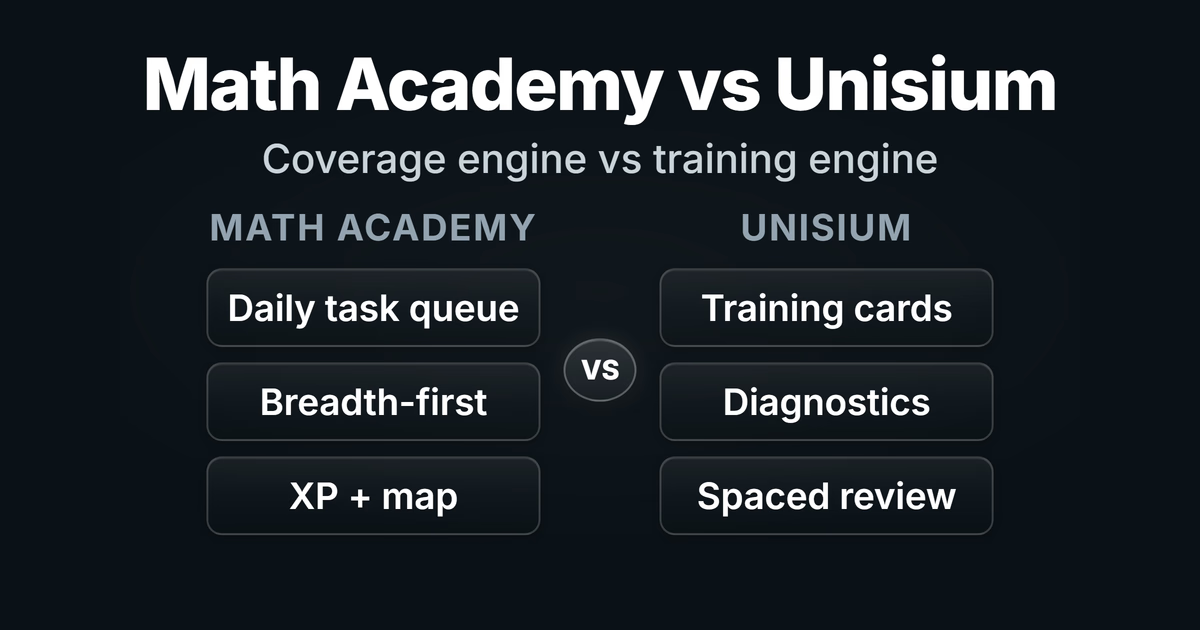
Math Academy is the strongest alternative to Unisium if your main goal is broad adaptive math progression. It gives structure, coverage, and low planning overhead.
The difference is the center of gravity. Math Academy is closer to an adaptive curriculum. Unisium is a guided active study system built around principles, worked-solution explanation, retrieval, and problem solving.
If you want the direct comparison, read Math Academy vs Unisium.
Symbolab
Symbolab is useful after an attempt. It can help you inspect steps, compare solutions, and find algebra errors.
It should not be your main study routine. If Symbolab chooses the method and performs the steps, it is doing the thinking you need to train.
Anki and Quizlet
Anki and Quizlet can help with definitions, theorem conditions, identities, standard forms, and derivative rules.
They are not complete calculus mastery systems unless you build the missing worked-solution and problem-solving practice yourself.
Passive Input Is Useful — But It Is Not the Main Bottleneck
Explanations are everywhere: textbooks, lectures, Khan Academy, YouTube, AI tools, and Unisium’s free principle guides. That makes passive input useful, but not rare.
The scarce thing is not another explanation. The scarce thing is a study routine that gets you to do the hard work: retrieve, connect, explain, and solve.
That is why a calculus mastery app should not be judged mainly by how many videos or worked examples it contains. Those can help when you are stuck. But the main routine has to make you produce understanding, not just consume it.
What to Do Next
If you want calculus mastery, first ask whether this kind of math work fits you. Then read Is Unisium Right for You? and check current access and pricing. If you mainly want a broad adaptive math curriculum, Math Academy is the other serious option to consider. If you mainly need a free explanation, use Khan Academy or another input source, then return to active study quickly. If you have a summer before the course, learn how to study calculus over the summer so lectures feel like a second pass. If physics is your subject, use the corresponding physics learning app comparison.
FAQ
What is the best app for mastering calculus?
For active mastery, Unisium is the strongest choice because it trains retrieval practice, elaborative encoding, self-explanation, and problem solving. Math Academy is the serious alternative if you mainly want a structured adaptive math curriculum.
Is Unisium good for calculus?
Yes. Calculus is exactly the kind of subject where principles, conditions, worked-solution explanation, and problem solving all matter. Unisium is built to train those together.
What if I can follow examples but still cannot solve new calculus problems?
That usually means you can follow an explanation without yet being able to use it on your own. You need practice retrieving the principle, deciding where to start, and explaining why each step works before the method is shown. A tool that only gives you more explanations or step-by-step solutions often does not fix that gap.
Is there an app that teaches calculus instead of just checking steps?
If by “teaches” you mean more than answer checking, the useful question is whether the app builds independent skill. A serious calculus study app should help you retrieve principles, connect them to conditions, explain worked solutions, and solve uncued problems. Solvers and answer checkers can help after an attempt, but they are not enough by themselves.
Is Khan Academy enough for calculus?
Khan Academy can be useful for explanations and free course coverage. It is usually not enough by itself if your goal is mastery, because watching explanations and doing sectioned exercises does not automatically produce independent problem-solving skill.
Is Brilliant good for calculus?
Brilliant can be useful for intuition and interactive introductions. It is weaker as a complete mastery system if you need sustained problem solving, worked-solution explanation, and long-term progression.
Is Symbolab good for learning calculus?
Symbolab is useful after an attempt. It can show step-by-step solutions, but if it chooses the method and performs the steps for you, it can hide the exact skill you need to build.
Should I use Anki for calculus?
Use Anki for narrow memory targets: definitions, theorem conditions, derivative rules, identities, and standard forms. Do not treat Anki as a complete calculus study system. It can help you remember what the rule says, but it does not by itself teach you where to start or why a step works in a new problem.
Math Academy or Unisium for calculus?
Choose Math Academy if you want a broad adaptive math curriculum. Choose Unisium if you want a guided study system that makes you retrieve principles, connect ideas, explain steps, and solve problems.
Can I start Unisium before I fully understand the concept?
Yes, if you are willing to try actively and use feedback. You can also use free principle guides when you get stuck. Unisium is not based on the idea that you must passively consume explanations before doing active work.
How much does Unisium cost?
See Pricing for the 14-day free trial, subscription prices, and current availability.
How This Fits in Unisium
Calculus is not mastered by watching enough examples or checking enough answers. You need to retrieve principles, connect them to conditions and examples, explain steps in worked solutions, and solve problems.
That is the Unisium Study System: guided active study at the principle level. If you want the broader overview, read Is Unisium Right for You?, or compare Unisium with a flashcard workflow in Unisium vs Anki.
Ready to apply this strategy?
Unisium turns these evidence-based techniques into guided study sessions for math and physics. Places are limited during early access. Check current availability to start a trial; joining the mailing list is optional.
See plans and availability Read More GuidesAlready have access? Sign in