Recall and connect
Retrieve principles from memory. Explain what the quantities mean, when a principle applies, and how it connects to other ideas.
Classical mechanics with Unisium
Understand motion, forces, and energy. Practise explaining the principles and using them in unfamiliar problems.
See plans and the 14-day free trialA slingshot is aimed straight at a hanging coconut. It fires at the instant the coconut drops. Ignore air resistance; the stone reaches the tree before the coconut lands. Does the stone pass above the coconut, hit it, or pass below it?
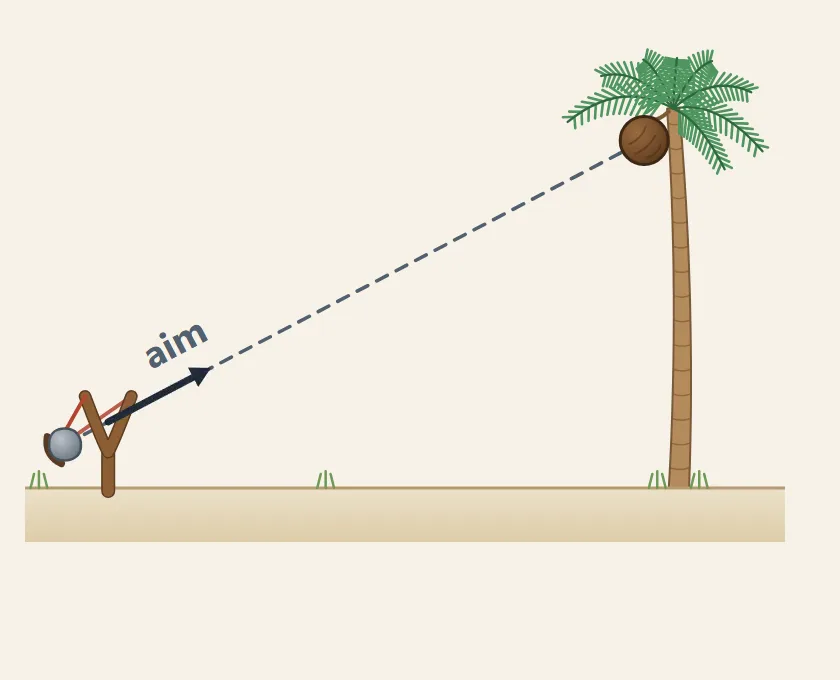
A slingshot aimed along a dashed line labeled aim at a coconut hanging from a palm tree. An arrow from the slingshot points along the aim line.
Watch the animation, or go straight to the result.
The animation could not play here. Open the animation, or read the result below.
The stone hits the coconut.
Both the stone and the coconut fall. Why do they meet, even though the stone’s path curves below the aim line? Explain it to yourself before comparing.
The stone does not keep flying along the aim line. Gravity accelerates it downward from the moment it leaves the slingshot, with the same acceleration as the coconut, so it falls below the aim line by exactly as much as the coconut falls below its branch.
The stone's path does curve below the aim line, but the coconut falls too, from the same instant and with the same acceleration. When the stone reaches the tree, it is exactly as far below the aim line as the coconut is below its branch, so the two meet.
Gravity gives both bodies the same downward acceleration from the same instant. Without gravity, the stone would travel along the aim line to the coconut’s original position.
After any time t, gravity puts each body ½gt² below where it would have been without gravity, where g is the gravitational acceleration. When the stone reaches the tree, it is the same distance below the aim line as the coconut is below its branch, so they meet.
This requires the stone to reach the tree before the coconut hits the ground, with air resistance ignored.
Read the position and acceleration explanation
In the animation: The shot, then a replay. In the replay, dashed outlines show where each body would be without gravity: the stone on the aim line and the coconut still at its branch. At every moment, both are the same distance below their outlines.
Choose your prediction, then watch what happens.
A prediction gives you something to explain. In Unisium, you write explanations of mechanics principles and receive AI feedback on your reasoning, then practise recalling and applying those principles in problems.
Created by Vegard Gjerde, drawing on ten years researching university students’ learning strategies and exam preparation.
Try Unisium free for 14 daysStart with classical mechanics. Your subscription also includes the other currently available subjects.
A payment method is required. Billing begins after the trial unless you cancel. See pricing for plans and current availability.
From familiar formulas to usable knowledge
Retrieve principles from memory. Explain what the quantities mean, when a principle applies, and how it connects to other ideas.
Study a worked problem, then explain why its principles and mathematical steps make sense. Use feedback to revisit gaps in your reasoning.
Choose a model, work through a problem, and check your result. Return to practice as Unisium brings material back for review.
Unisium organizes the activities and review. You do the thinking. A session can be a few cards or a longer stretch of work; it does not have to include every activity.
Build university-level mechanics skills
Learn Newtonian mechanics through questions, worked solutions, and problem solving. The current material includes Level 4 practice, designed to match university exam difficulty. We plan to extend the material to higher levels of difficulty.
Position, velocity, acceleration, and kinematics.
Newton's laws, force diagrams, and friction.
Work, kinetic and potential energy, and conservation.
Impulse, momentum, and conservation.
Torque, moment of inertia, and angular momentum.
Gravitational force and its role in motion.
You will use equations, graphs, vectors, and basic trigonometry. The algebra material included in Unisium can help you practise rearranging equations. Calculus-based forms use derivatives and integrals.
Use the free principle guides to learn the ideas, then build your skills with elaborative encoding questions, retrieval practice, worked solutions, and problems in Unisium. The resources and study activities work together so you can learn independently.
If you are taking a course, match your practice to its syllabus and use what you learn in your assignments and exams.
Your first practice