ALEKS vs Unisium: Adaptive Course Platform vs Active Mastery System
ALEKS is an adaptive course platform for diagnosing gaps and guiding practice in math and chemistry, while the Unisium Study System is built for a different job: helping students build usable math and physics skill through retrieval practice, elaborative encoding, self-explanation, and problem solving. Use ALEKS when your course requires it, when you need placement prep, or when prerequisite fluency is the bottleneck. Use Unisium when your goal is mastery, exam performance, and solving future problems yourself.
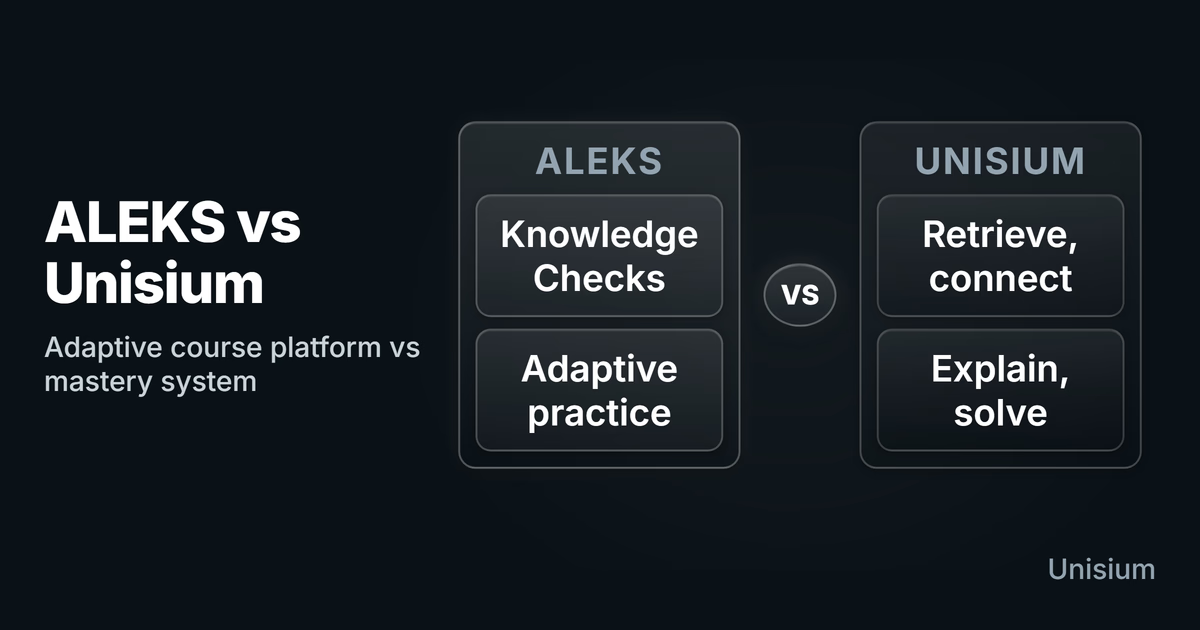
ALEKS and Unisium solve different problems.
ALEKS is strongest when you need adaptive gap diagnosis, course-aligned practice, placement prep, or prerequisite fluency in math and chemistry. Unisium is strongest when you want a guided active-study system for mastering math and physics principles: retrieve them, connect them, explain worked solutions, and solve problems with them.
There is also a subject difference. ALEKS is mainly a math-and-chemistry platform. Unisium is built for math and physics, where the bottleneck is often not only procedural fluency but also choosing principles, explaining worked solutions, and solving unfamiliar problems.
If you are deciding between them, ask a simpler question than which platform is better: is your bottleneck missing prerequisites and course compliance, or is it turning ideas into usable skill under independent conditions?
Quick Verdict
- Choose ALEKS if your course requires it, you are preparing for ALEKS placement, or you need adaptive practice on prerequisite math or chemistry topics.
- Choose Unisium if you want guided active study for deeper math and physics mastery.
- Choose Unisium especially if you can follow examples but still struggle to explain worked solutions, choose principles, or solve unfamiliar problems independently.
- Use both only when there is a real reason. That usually means ALEKS is mandatory or prerequisite fluency is blocking deeper study.
How ALEKS Works
ALEKS is an adaptive assessment and learning platform from McGraw Hill, primarily used in higher-ed math and chemistry. It is built to estimate what a student knows, what they do not know, and what they are ready to learn next.
That estimate drives the platform. ALEKS uses assessments and Knowledge Checks to estimate your current knowledge state, open topics you are ready to learn, and update your progress in the pie chart. In Learning Mode, you work topic by topic with practice and explanations. Later Knowledge Checks can move topics back into “Needs More Practice” if retention was not strong enough.
That can feel frustrating, but it matches ALEKS’s job. ALEKS is trying to keep its estimate of your topic knowledge conservative. Topic knowledge is useful; it is not the same as deep math or physics mastery.
Where ALEKS Is Strong
ALEKS is strong when the job is structured adaptive coursework, not open-ended mastery.
- Placement prep for ALEKS-based placement workflows.
- Prerequisite remediation in areas like algebra, functions, and precalculus.
- Procedural fluency through repeated topic-level practice.
- Math and chemistry coverage inside course-aligned learning paths.
- Instructor-managed work with deadlines, assignments, and reporting.
If you need a system to diagnose gaps, tell you what topic is next, and keep moving through required content, ALEKS makes sense.
Where ALEKS Falls Short
ALEKS can help students practice and retain topics. The limitation is that topic-level progress is not the same as being able to explain a worked solution, choose the right principle in a new problem, or solve independently when the surface changes.
For physics specifically, ALEKS can support the math underneath the course. It is not built to choose the physical system, identify the relevant interactions, or build the model from the situation.
Why Unisium Is Different
Unisium is a principle-based study system for math and physics.
The system is built around four kinds of active work:
- Retrieval practice — recall the principle before it is shown.
- Elaborative encoding — connect the principle to conditions, examples, boundary cases, and related ideas.
- Self-explanation — explain steps in worked solutions so you learn why the solution works.
- Problem solving — apply principles in problems where the method is not already handed to you.
Unisium was built by a physicist and learning-science researcher with experience teaching university physics to close a specific gap in math and physics courses: students can often follow examples, but still cannot reliably produce the next move themselves.
That is the gap Unisium targets. It does not only ask whether a student completed a topic. It asks whether the student can remember the principle, connect it to conditions and examples, explain it inside worked solutions, and use it in problems.
Head-to-Head
| Question | ALEKS | Unisium |
|---|---|---|
| Main job | Diagnose gaps and guide practice | Build usable math and physics skill |
| Main subjects | Math and chemistry | Math and physics |
| Progress unit | Topics and course objectives | Principles across study modes |
| Assessment style | Knowledge Checks and course tasks | Performance across retrieval, connection, explanation, and problem solving |
| Best use | Placement, remediation, required coursework | Mastery, exams, and durable skill |
| Main risk | Mistaking topic completion for mastery | Requires active effort |
If Your Course Requires ALEKS
If ALEKS is required, use it seriously. Let it diagnose gaps, assign practice, and drive the placement or course workflow.
Then add one habit ALEKS does not force: after each topic, explain why the procedure works and when it applies. That turns adaptive practice into something closer to real study.
If deeper mastery is the goal, use Unisium for the active study ALEKS does not mainly target: retrieval practice, elaborative encoding, self-explanation, and problem solving.
What to Do Next
If you need ALEKS for placement or a required course, follow your institution’s ALEKS policy for retakes, prep modules, calculator rules, and deadlines.
If your goal is deeper math or physics mastery, start with Is Unisium Right for You? and check current access and pricing.
If you are comparing Unisium with other study systems, read Unisium vs Anki and Math Academy vs Unisium.
FAQ
What is ALEKS?
ALEKS is an adaptive assessment and learning platform from McGraw Hill, primarily used in higher-ed math and chemistry. It identifies what you know, what you do not know, and what you are ready to learn next, then guides practice accordingly.
Does ALEKS use AI?
McGraw Hill currently markets ALEKS as AI-powered. More concretely, ALEKS is an adaptive system associated with Knowledge Space Theory and uses student performance to decide what to assess next and what topics to open.
Why did my ALEKS pie drop?
Because a later Knowledge Check found that some previously mastered topics did not hold under assessment conditions. ALEKS may move them back into “Needs More Practice.” That is frustrating, but it matches the platform’s retention-checking role.
Is ALEKS good for physics?
ALEKS can be useful for physics prerequisites like algebra, functions, and symbolic manipulation. It is not a physics mastery system. Physics performance also depends on choosing principles, identifying conditions, and building models from situations.
Is ALEKS good for placement prep?
Yes. ALEKS is widely used for placement and placement-prep workflows. But retake limits, required prep hours, waiting periods, and calculator rules vary by institution, so follow your school’s ALEKS PPL policy rather than generic internet advice. If you have a summer window before the test, see how to prepare for placement over the summer.
Is ALEKS enough for college math?
ALEKS can be enough if your main goal is prerequisite fluency, placement prep, or completing required course topics. If your goal is deeper mastery — remembering ideas, explaining worked solutions, and solving unfamiliar problems independently — you may need a more active study system alongside or after ALEKS.
Can ALEKS and Unisium be used together?
Yes, but only for a specific reason. Use ALEKS when the course requires it or when prerequisite fluency is blocking you. Use Unisium when you also need deeper mastery and independent problem-solving skill. It should not be automatic that everyone uses both.
Which one should I choose?
Choose ALEKS if your immediate job is placement, remediation, or required adaptive coursework. Choose Unisium if your job is building usable math and physics skill for exams and future problems. Choose both only when those two jobs are both real for you.
How much does Unisium cost?
Check Pricing for current beta access, trial status, and subscription details.
How This Fits the ALEKS vs Unisium Decision
This comparison is about the job you need the system to do. ALEKS is useful when the problem is course-aligned gap diagnosis, placement prep, or prerequisite fluency. Unisium is useful when the deeper goal is turning study time into usable math and physics skill.
If you can already follow examples but still cannot solve independently, that is usually the point where ALEKS and Unisium separate most clearly.
Masterful Learning
The book behind these guides: a study system for physics, math, & programming built on retrieval, connection, explanation, and problem solving.
Ready to apply this strategy?
Unisium turns these evidence-based techniques into guided study sessions for math and physics. Places are limited during early access. Check current availability to start a trial; joining the mailing list is optional.
See plans and availability Read More GuidesAlready have access? Sign in